Sparse and Single-mode
Asteroseismic Inversions

Joel Ong
University of Sydney
with Anuj Gautam, Simon Murphy, Tim Bedding, Sarbani Basu

TASC X, July 6 2026 | Slides at hyad.es/talks
I.
Asteroseismic Inversions?

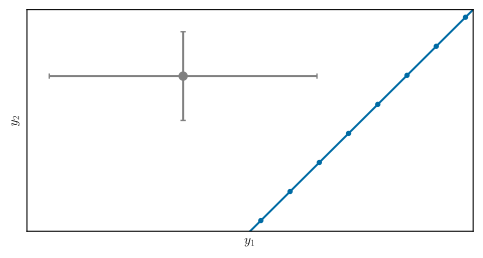
Data: y_\text{obs} \in Y

Models: x_i \in X;F: X \to Y
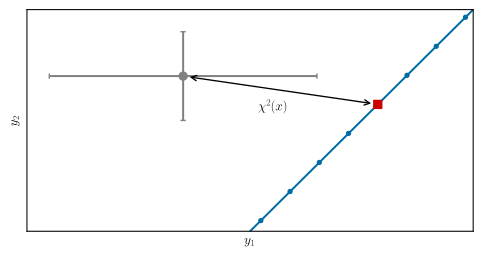
Best-fitting model: x = \mathop{\mathrm{argmax}}_{x_j \in X}\mathcal{L}\left(x_j\right)
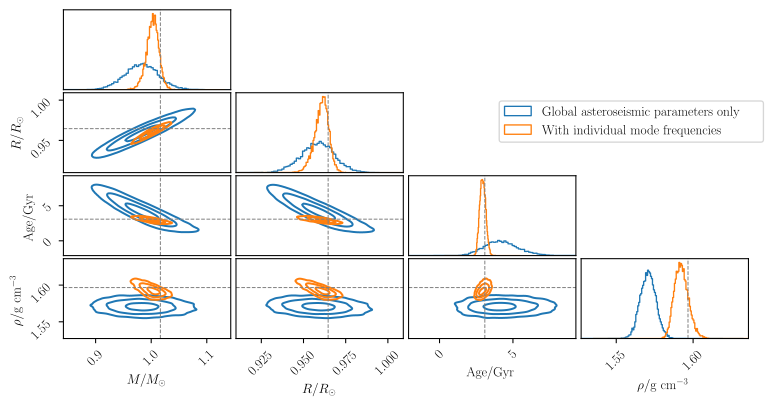
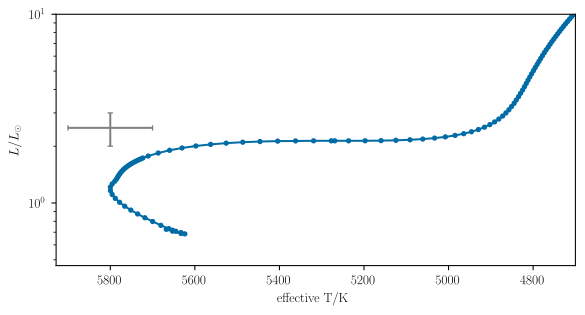
F: \underbrace{\left(M, t, Y_0, Z_0, \alpha_\text{mlt}, \ldots\right)}_{x \in X} \mapsto \underbrace{\left(L, T_\text{eff}, [\text{M/H}], \log g, \ldots\right)}_{y \in Y}

///GARSTEC

ADIPLS/ \small\color{darkorange} \to \Delta\nu, \nu_{\text{max}}, \left\{\nu_{n,\ell}\right\}

All models are wrong,
but some are useful.
— George E. P. Box
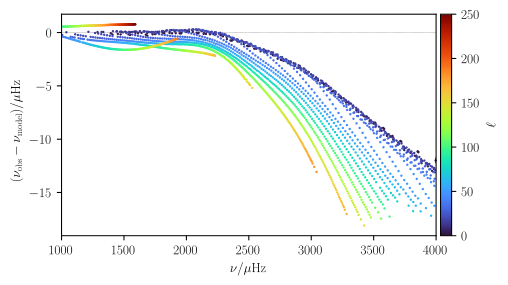
f-modes: \omega_f \sim \sqrt{\left(\ell + {1\over 2}\right){GM\over R^3}}


p-modes: \omega_p \sim {\pi \over T}\left(n + {\ell \over 2} + \epsilon_p\right)
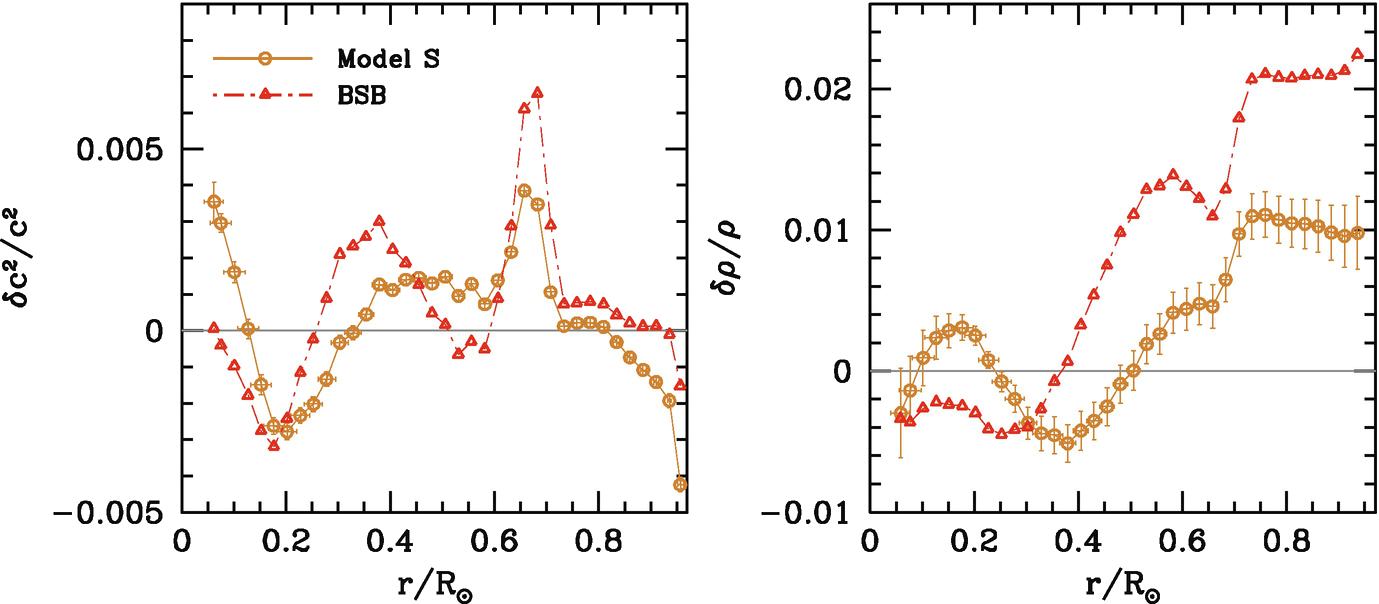
Inversions in a nutshell

Frequencies constrain.

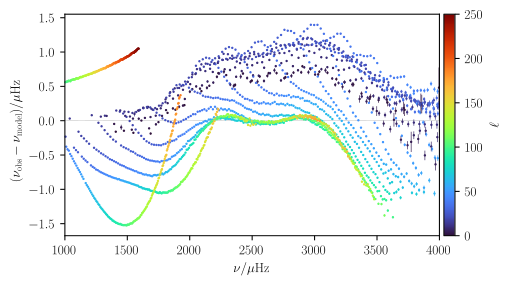
Frequency differences constrain differentially.

from Basu (2020)

two standard
solar models

cf. P14 (Perrin), P72 (Ahlborn), P85 (Leclerc)

Frequency Differences from Structure Differences

\Large {\color{darkorange}{\delta\omega_i \over \omega_i}} = \int K_{c_s,\rho,i}{\color{RoyalBlue}{\delta c_s \over c_s}}\ \mathrm d r + \int K_{\rho,c_s,i}{\color{RoyalBlue}{\delta \rho \over \rho}}\ \mathrm d r
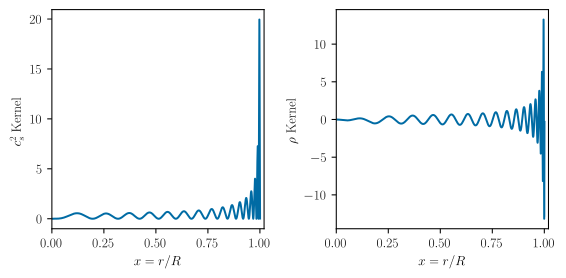
Structure Differences from Frequency Differences

\Large {\color{darkorange}{\delta\omega_i \over \omega_i}} = \int K_{c_s,\rho,i}{\color{RoyalBlue}{\delta c_s \over c_s}}\ \mathrm d r + \int K_{\rho,c_s,i}{\color{RoyalBlue}{\delta \rho \over \rho}}\ \mathrm d r

{\color{darkorange}{\delta\omega_i \over \omega_i}} \approx \sum_j {\Delta r K_{c_s,i}(r_j)}{\color{RoyalBlue}{\delta c_s(r_j) \over c_s}} + \sum_j {\Delta r K_{\rho,i}(r_j)}{\color{RoyalBlue}{\delta \rho(r_j) \over \rho}}

{\color{darkorange}\mathbf{b}} = {\mathbf{A}}{\color{RoyalBlue}\mathbf{x}}\implies \boxed{{\color{RoyalBlue}\mathbf{x}} \stackrel{??}{=} \mathbf{A}^{-1}{\color{darkorange}\mathbf{b}}}

II.
Asteroseismic Inversions?

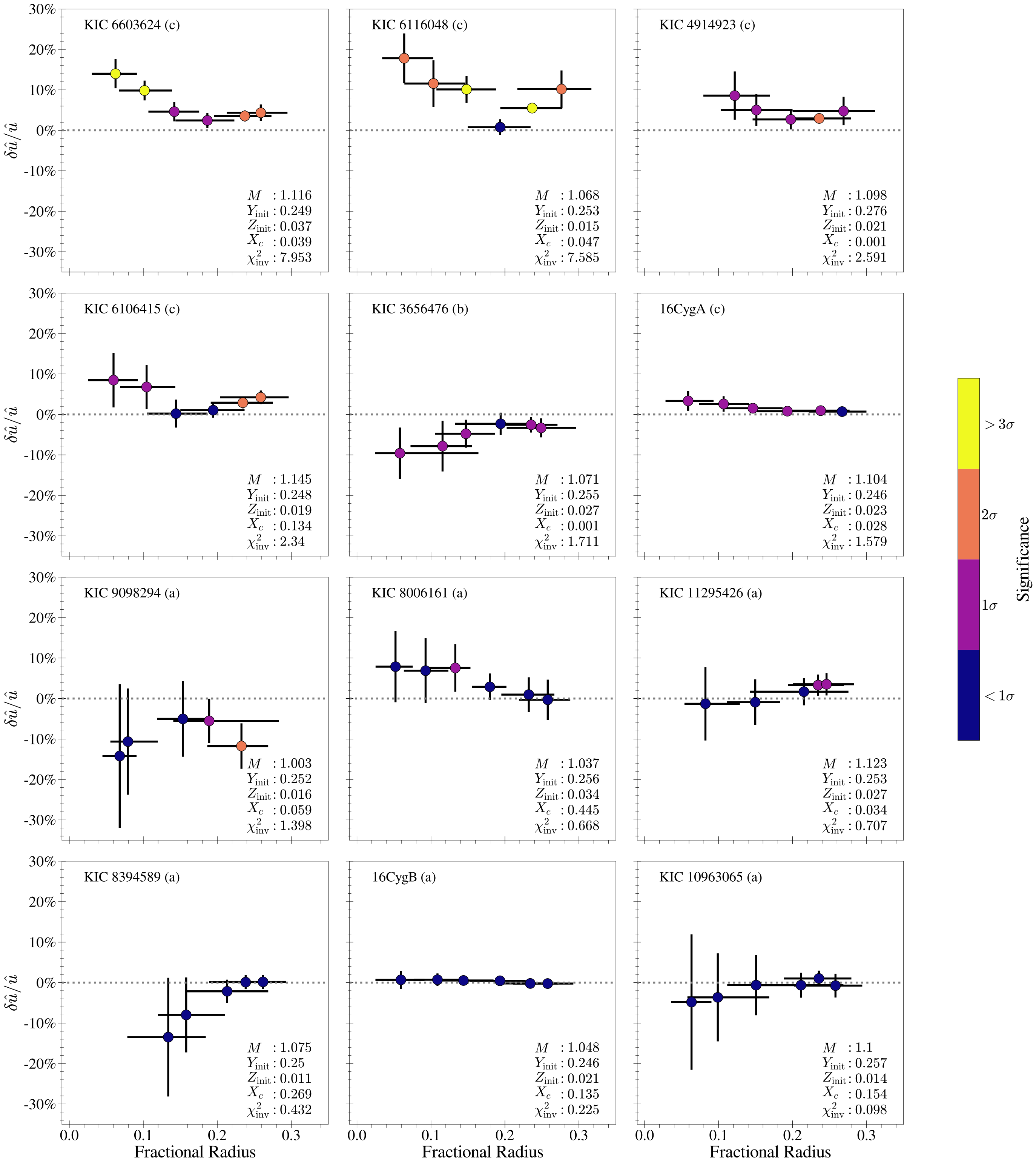
We can* do this for ~30 other (cool MS) stars

Recipe:

  1. Make very good model
  2. Have very high \chi^2
  3. ???
  4. PROFIT

(e.g. Bellinger+ 2017, 2019;
Vanlaer+ 2023; Buchele+ 2024)
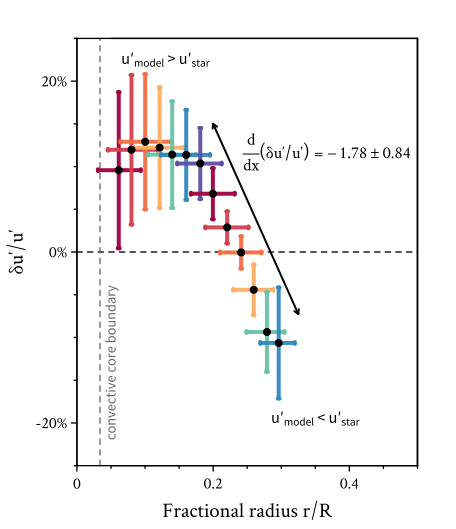
Bellinger+ 2019

Buchele+ 2024

Relative difference in isothermal sound speed

* it’s hard
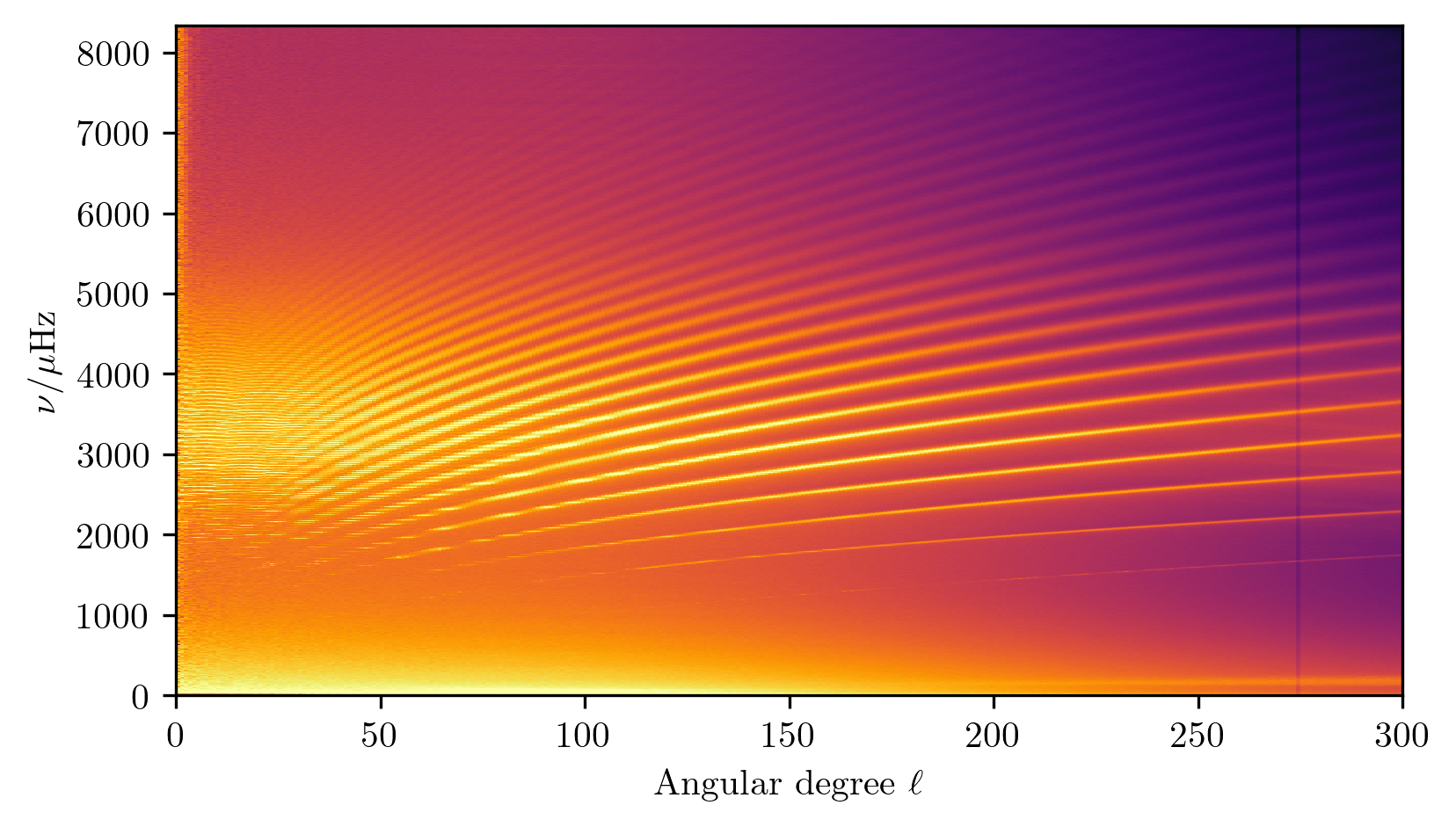
MDI Dopplergrams

MDI Dopplergrams

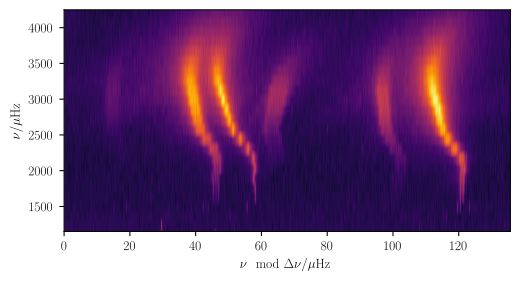
Murphy+ 2023

What structure inversions are possible
with only a few observed (p-)modes?

III. An Inverse Transform

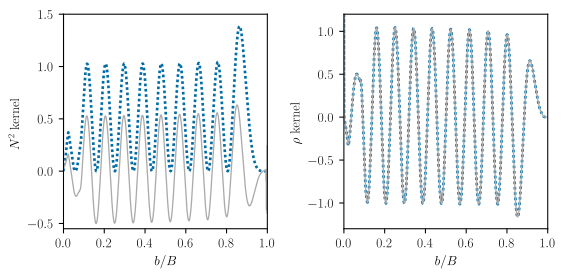
The sensitivity kernels kind of look like sinusoids
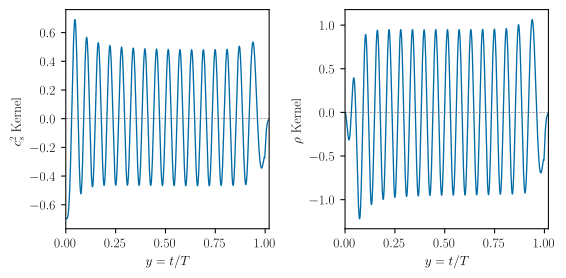
Integral Transforms

\Large\text{Forward: }{\color{darkorange}\hat{f}_j} = \int_0^1 e^{-2\pi i j x} {\color{RoyalBlue}f(x)}\ \mathrm d x

\Large\text{Inverse: }{\color{RoyalBlue}f(x)} = \sum_j {\color{darkorange}\hat{f}_j} {\color{red}e^{2 \pi i j x}}

\Large\text{Forward: }{\color{darkorange}\hat{f}_j} = \int_0^1 K_j(x) {\color{RoyalBlue}f(x)}\ \mathrm d x

\Large\text{Inverse: }{\color{RoyalBlue}f(x)} = \sum_j {\color{darkorange}\hat{f}_j} {\color{red}\phi_j(x)}

\Large\text{Forward: } K_j(x_0) \sim \left.{\partial {\color{darkorange}{\hat f}_j} \over \partial {\color{RoyalBlue}f(x_0)}}\right|_{\color{RoyalBlue}f(x \ne x_0)}

\Large\text{Inverse: }{\color{red}\phi_k(x)} = \left.{\partial {\color{RoyalBlue}f(x)} \over \partial {\color{darkorange}{\hat{f}_k}}}\right|_{\color{darkorange}\left\{\hat{f}_{j \ne k}\right\}}

(reminder: {\color{RoyalBlue} \mapsto \delta c_s^2/c_s^2, \delta\rho/\rho}; {\color{darkorange}\hat f \mapsto \delta \omega/\omega})

cf. Guo 2026; Guo & Aerts 2026; Dorsa Majidi’s poster P55

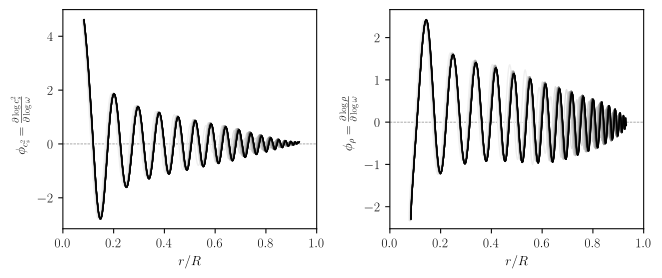
Inverse Basis Functions

\ell = 0, n_p = 22 mode of Model S
IV. What can we do with this?

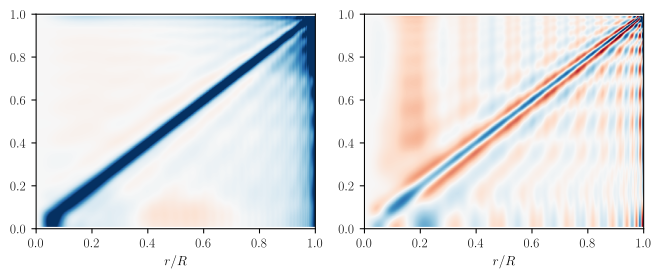
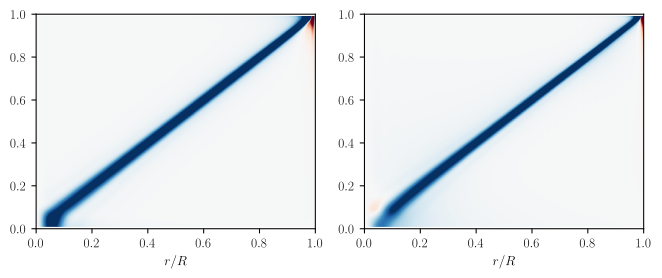
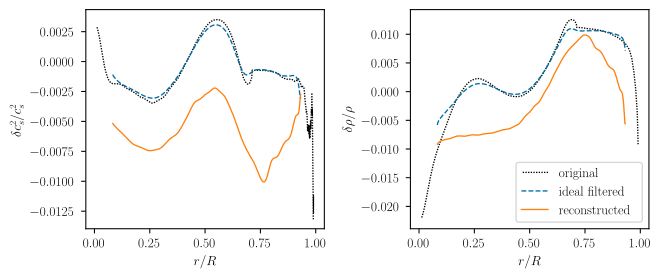
1. Notch-filtered structure reconstruction

c_s^2 window function

\rho window function

Target r/R

Model S vs. SSM of Magg+ 2024
The basis functions \phi_k are a
natural set of basis functions
for RLS inversions.

(that’s a real one for a luminous red giant \to)
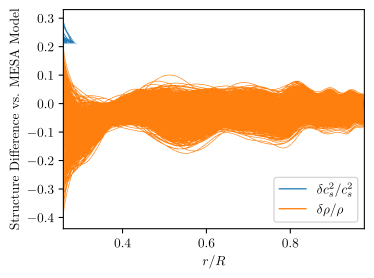
RLS inversions for Zvrk (Ong+ 2024)
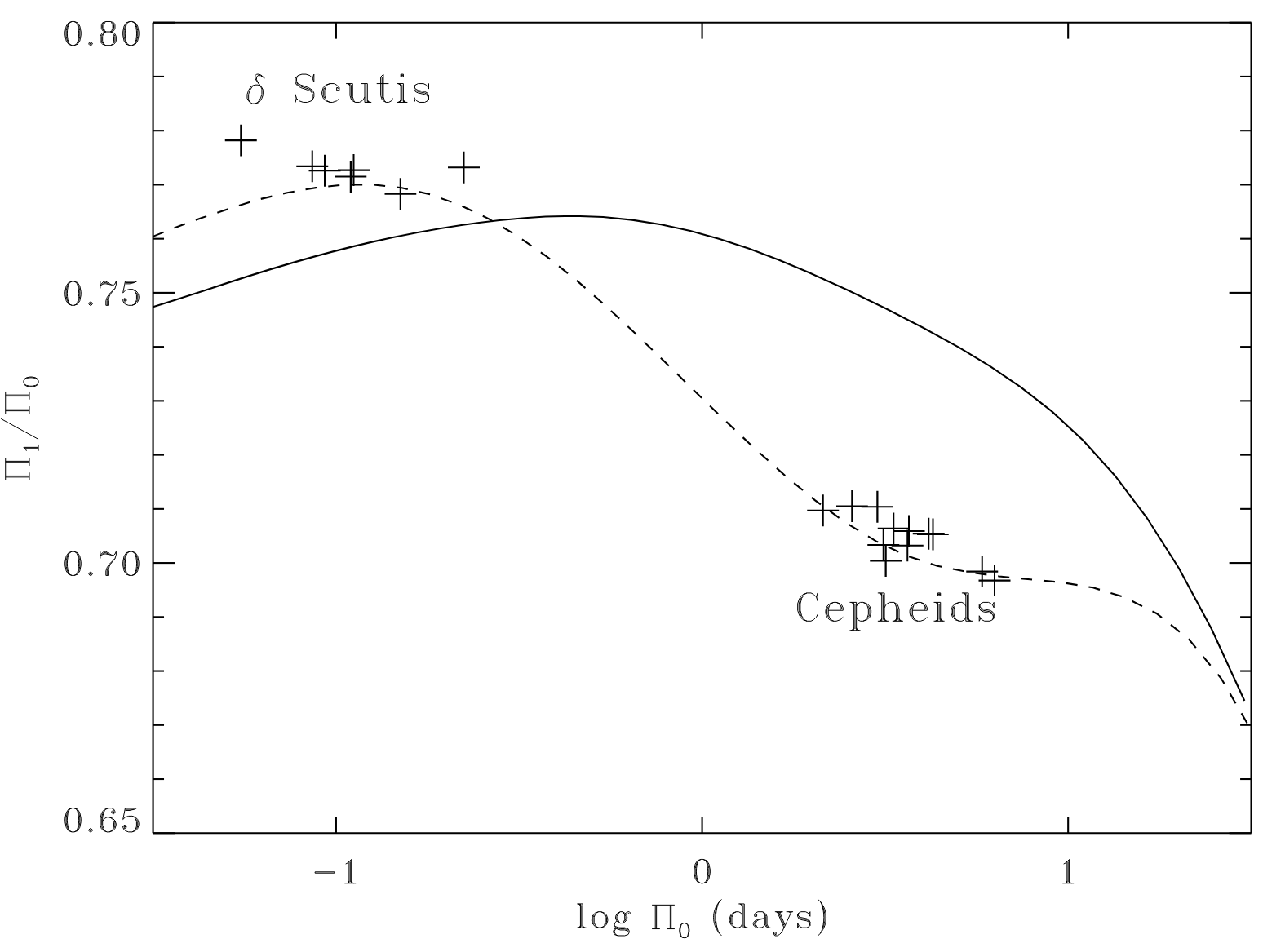
2. The fundamental radial mode

from Christensen-Dalsgaard 1993

The fundamental radial mode,
of δ Scu stars in particular,
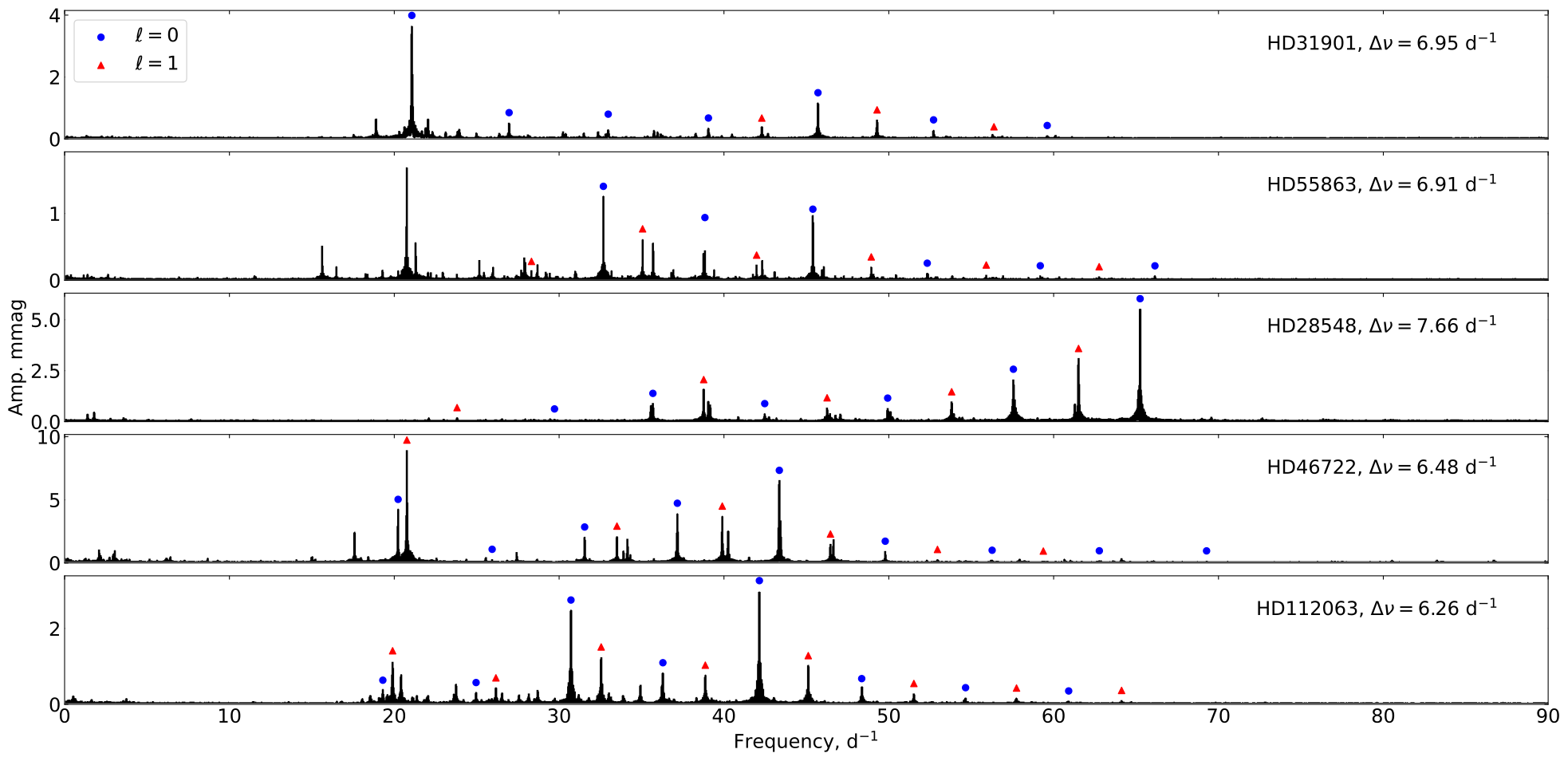
is known to differ from values predicted by stellar models.
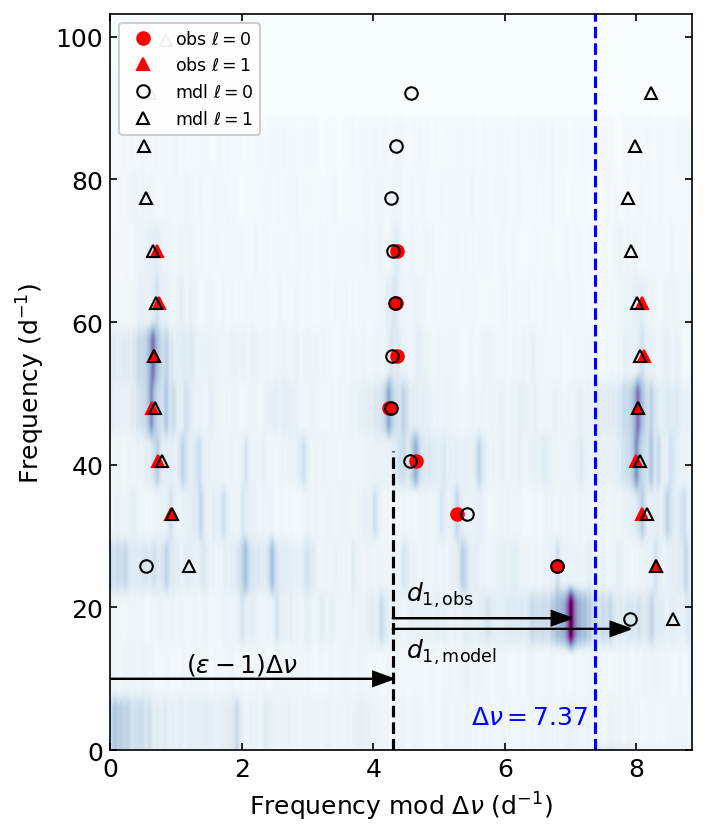
from Murphy+ 2023

\implies structure differences possibly
dominated by \phi_{\ell=0,n_p=1}!
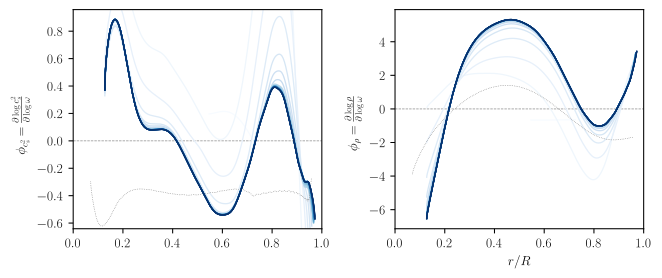
\implies structure differences might be dominated by \phi_{\ell=0,n_p=1}!

Sparse and Single-Mode Asteroseismic Inversions

If we treat first-order perturbation theory as an integral transform, the inverse transform’s basis functions \phi_k specify structure changes
which perturb the frequency of only the k^{\text{th}} mode and no others.

Surprisingly, this has interesting applications in
actual inverse problems where fewer modes are
available than in MS solar-like oscillators.

\mathrm{j}\mathrm{o}\mathrm{e}\mathrm{l}\cdot\mathrm{o}\mathrm{n}\mathrm{g}\ \text{@}\ \text{sydney}.\text{edu}.\text{au}