Why is Kepler-56?

Joel Ong
University of Sydney

Stars in Newcastle | November 21, 2025 | AEW 11
What is Kepler-56?

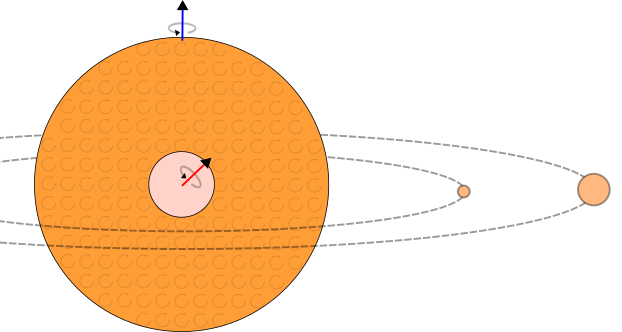
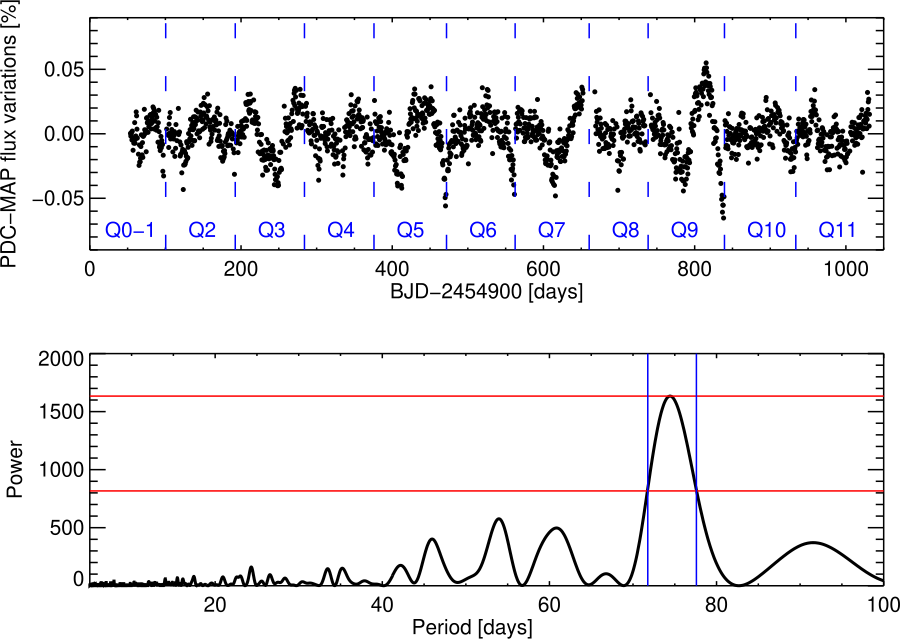
Rapidly rotating: P_\text{rot} \sim 74\ \mathrm{d}

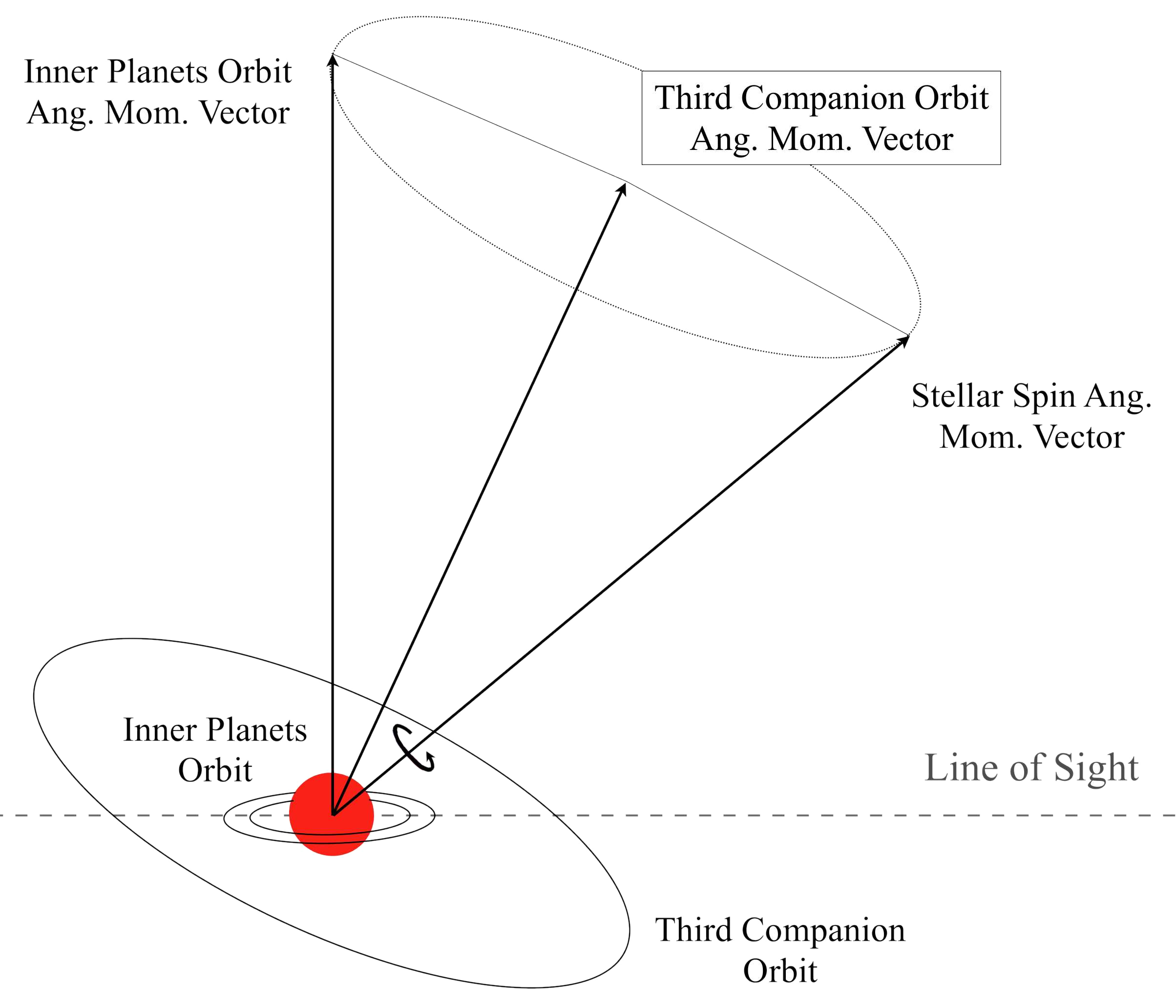
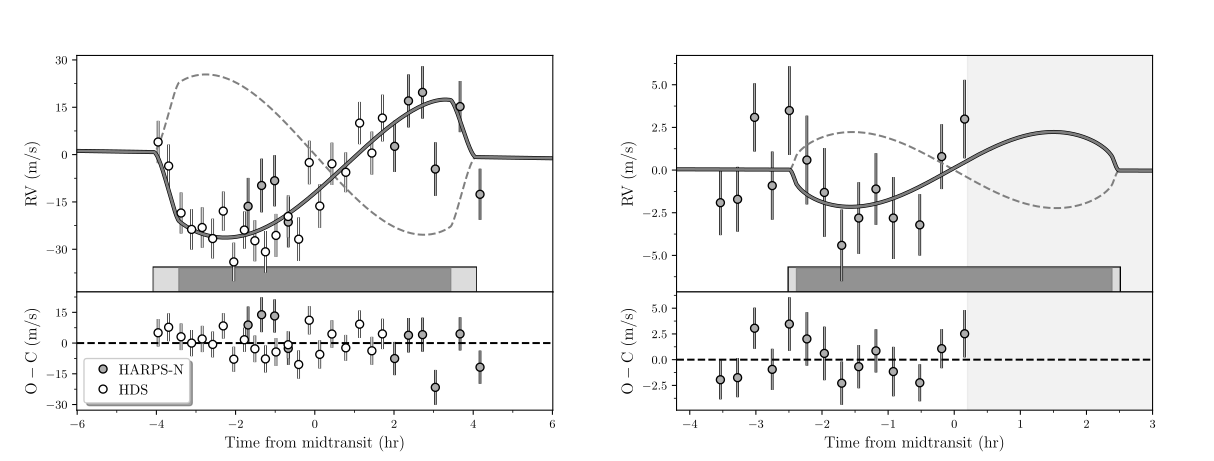
Multitransiting, Spin-Orbit Misaligned.
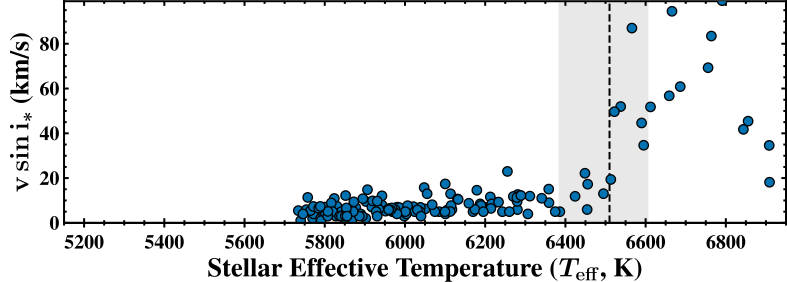
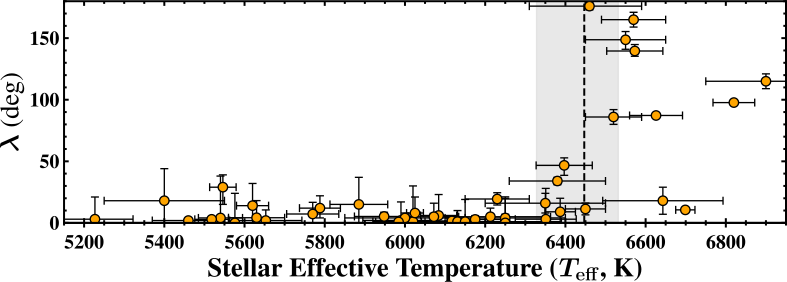
T_\text{eff} \sim 4840\ \mathrm{K}: Coolward of Kraft Break

\implies should not be (rapidly) rotating

\implies should not be spin-orbit misaligned

+ spin-orbit misalignment vs mutually aligned planets is exceedingly rare

From Wang, Wang & Ong, accepted to ApJL
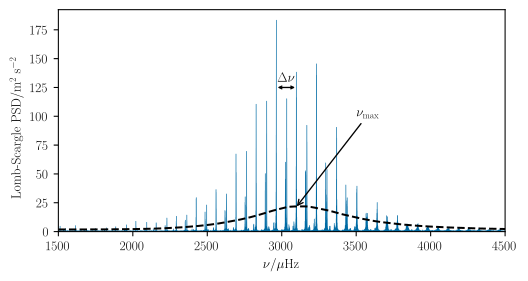
Seismology and Rotation

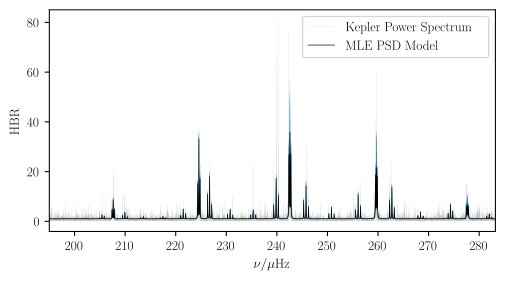
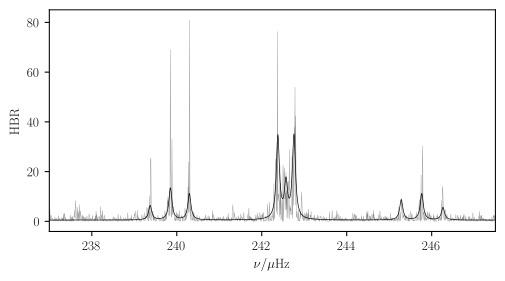
Power spectra of MDI dopplergrams

Cool stars support p-modes (pressure waves).

Mode frequency measurements constrain
internal structure and rotation.
\begin{array}{c} {\scriptsize\text{Power}}\\ \big\uparrow \end{array}

\longrightarrow {\scriptsize\text{Frequency}}

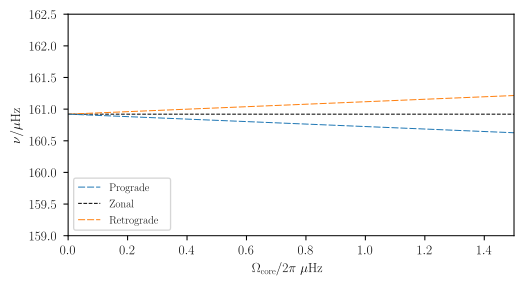
Multiplet splittings give averaged rotation rates: \huge\left\langle\Omega\right\rangle_i = b_i\int K_i(r) \Omega(r) \mathrm d r

Differential Rotation

Pressure waves (p-modes)
propagate isotropically
in the envelope.

Buoyancy waves (g-modes)
propagate anisotropically
in the core.

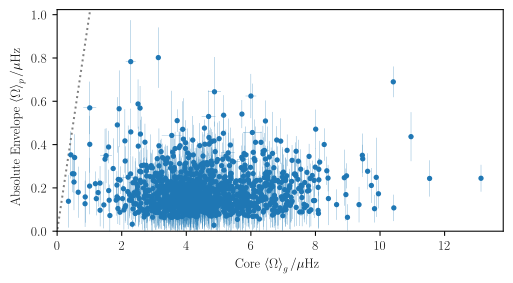
\left\langle\Omega\right\rangle_g

\left\langle\Omega\right\rangle_p

from Li et al. 2024
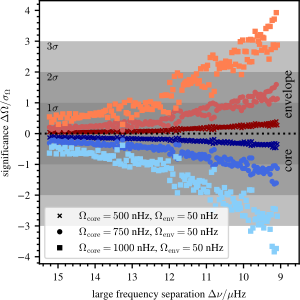
Neglecting avoided-crossing effects means previous estimates of envelope rotation were likely significantly overestimated.

Systematic measurement error (sigmas)

(proxy for age \rightarrow)

from Ahlborn, Ong, et al. 2025
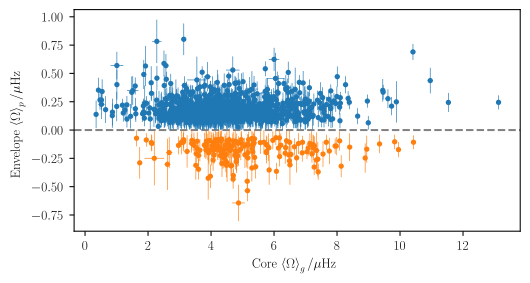
from Li et al. 2024
Geometrical differential rotation?

  1. \forall \ell, \exists (2\ell + 1) \times (2\ell + 1) matrices
    \mathbf{J}_x^\ell, \mathbf{J}_y^\ell, \mathbf{J}_z^\ell satisfying commutation relations
    \left[\mathbf{J}_i, \mathbf{J}_j\right] = -i\epsilon_{ijk}\mathbf{J}_k, with
    \mathbf{J}_z \hat{=} \mathrm{diag}(-\ell, -\ell + 1 \ldots \ell - 1, \ell).

for \ell = 1,

\small\mathbf{J}_x \hat{=} {1 \over \sqrt{2}}\begin{bmatrix}0 & 1 & 0 \\ 1 & 0 & 1 \\ 0 & 1 & 0\end{bmatrix}; \mathbf{J}_y \hat{=} {1 \over \sqrt{2}}\begin{bmatrix}0 & i & 0 \\ -i & 0 & i \\ 0 & -i & 0\end{bmatrix}; \mathbf{J}_z \hat{=} \begin{bmatrix}-1 & 0 & 0 \\ 0 &0 &0 \\ 0& 0 &1\end{bmatrix}.

  1. For fixed m (to leading order):

\left(-\mathbf{\Omega}_0^2 + 2 \omega m \mathbf{R} + \omega^2 \mathbf{\Delta}\right)\mathbf{c} = 0

For fixed n (to leading order):

(-\omega_0^2 \mathbb{1}_{2\ell+1} + 2 \omega \mathbf{J}_z R_{n,n} + \omega^2 \mathbb{1}_{2\ell+1})\mathbf{y} = 0

  1. Under separation of variables, \vec{\xi}_{n\ell m}(r, \theta, \varphi) = \vec{\xi}_{n\ell}(r) Y_\ell^m(\theta, \phi) \iff \underbrace{\tilde{R}_{n, n', m, m'} = R_{n,n'} J_{m,m'}}_{\text{this is a }\textbf{tensor product}!}

\implies \left(-\mathbf{\Omega_0}^2 \otimes \mathbb{1}_{2\ell+1} + 2 \omega \underbrace{\mathbf{R} \otimes \mathbf{J}_z}_{\tilde{\mathbf{R}}} + \omega^2 \mathbf{\Delta} \otimes \mathbb{1}_{2\ell+1}\right)\mathbf{x} = 0

  1. Let’s associate with each mass shell at r both \Omega(r)
    (as is customary), and also a rotational axis
    \hat{\mathbf{n}}(r) =\sum_i n_i \mathbf{e}_i.

\small \begin{aligned} \mathbf{R}_{n\ell, n\ell} &= b_{n\ell}\int {\mathbf{d}^\ell}^\dagger(\beta(r)) \Omega(r) \mathbf{J}_z {\mathbf{d}^\ell}(\beta(r))\ K(r)\ \mathrm{d} r\\ &= b_{n\ell}\int \Omega(r) (\hat{\mathbf{n}} \cdot \vec{\mathbf{J}})\ K(r)\ \mathrm{d} r\\ &= \boxed{b_{n\ell}\left(\int \vec{\mathbf{\Omega}}(r) K(r)\ \mathrm{d} r\right) \cdot \vec{\mathbf{J}}}. \end{aligned}

\implies For each mode, AM matrix is
specified by usual vector addition.

  1. We only assume that the pure p- and g-mode solutions
    are separately amenable to separation of variables;
    the mixed-mode eigenfunctions need not be.

\small \left(\begin{bmatrix} {\color{grey}\mathbf{L}_{\pi\pi}} & \mathbf{L}_{\pi\gamma} \\ \mathbf{L}_{\pi\gamma}^T & {\color{red}\mathbf{L}_{\gamma\gamma}} \end{bmatrix} \otimes \mathbb{1}_{2\ell+1} + 2 \omega \begin{bmatrix} {\color{forestgreen}\tilde{\mathbf{R}}_\pi} & 0 \\ 0 & {\color{forestgreen}\tilde{\mathbf{R}}_\gamma}\end{bmatrix} + \omega^2 \begin{bmatrix} \mathbb{1} & \mathbf{D} \\ \mathbf{D}^T & \mathbb{1} \end{bmatrix} \otimes \mathbb{1}_{2\ell+1} \right)\mathbf{x} = 0.

Mode visibilities are specified by \mathbf{x}^\dagger(\mathbb{1} \otimes \mathbf{P})\mathbf{x}, where \mathbf{P} is the projection matrix onto m=0 in the observer’s coordinate frame.

\vdots

(some assembly required)

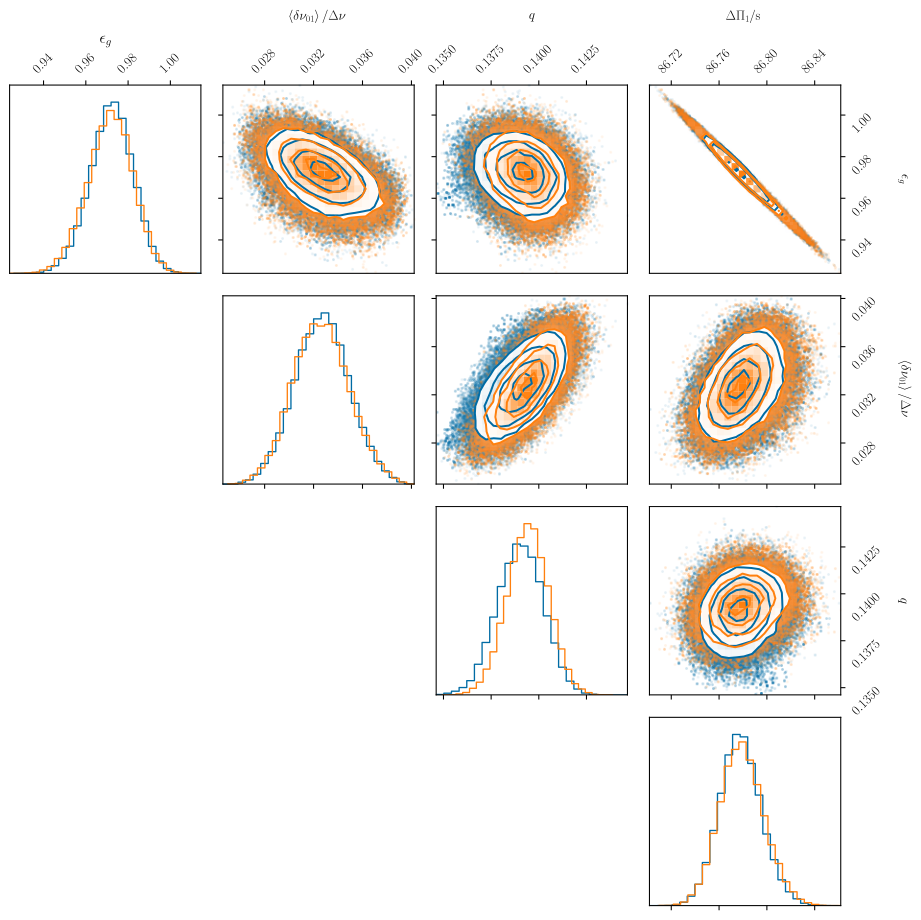
Kepler-56 redux

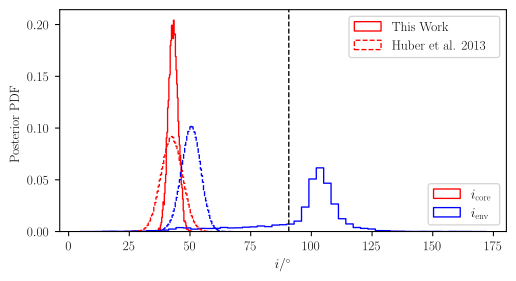
What does this mean???

(most likely scenario given rapid obliquity damping)

Problems:

  • Rapidly rotating despite being cool
  • Spin-orbit misaligned despite being cool
  • Spin-orbit misaligned with multiple planets

Problems:

  • Rapidly rotating despite being cool
  • Spin-orbit misaligned despite being cool
  • Spin-orbit misaligned with multiple planets
  • VERY WEIRD internal rotation profile??
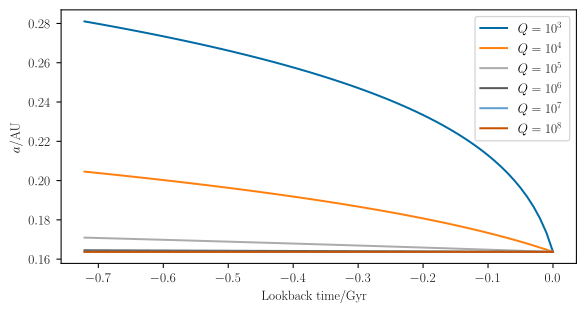
For sake of argument:
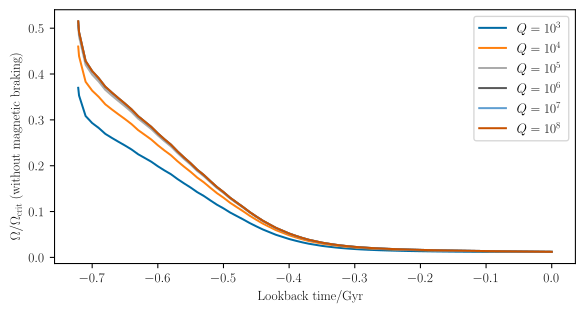
what if spun up by tidal inspiral?

Even unphysically aggressive (low-Q) inspiral
requires rapid rotation at TAMS:
incompatible with magnetic braking!

\implies tidal torques insufficient to supply present AM

(cf. Tokuno 2025 for alternative argument)

TAMS

Today

Engulfment?
Summary

Why is Kepler-56?

As previously understood, Kepler-56
rapidly rotating, misaligned, multitransiting
should not exist.

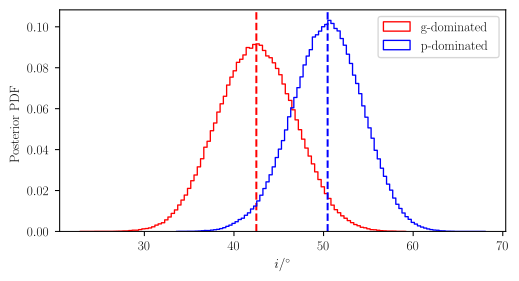
Revisited asteroseismology resolves tension with obliquity damping,
but implied configuration still
cannot be explained by canonical stellar evolution.

Planetary engulfment is most likely explanation.
(so far)

\mathrm{j}\mathrm{o}\mathrm{e}\mathrm{l}\cdot\mathrm{o}\mathrm{n}\mathrm{g}\ \text{@}\ \text{sydney}.\text{edu}.\text{au}

Backup Slides

Parameterising Misalignment

Euler Angles

Matrix Construction

Angular Momentum Matrices

\forall \ell, \exists (2\ell + 1) \times (2\ell + 1) matrices
\mathbf{J}_x^\ell, \mathbf{J}_y^\ell, \mathbf{J}_z^\ell satisfying commutation relations
\left[\mathbf{J}_i, \mathbf{J}_j\right] = -i\epsilon_{ijk}\mathbf{J}_k, with
\mathbf{J}_z \hat{=} \mathrm{diag}(-\ell, -\ell + 1 \ldots \ell - 1, \ell).

Example: \ell = 1

\small\mathbf{J}_x \hat{=} {1 \over \sqrt{2}}\begin{bmatrix}0 & 1 & 0 \\ 1 & 0 & 1 \\ 0 & 1 & 0\end{bmatrix}; \mathbf{J}_y \hat{=} {1 \over \sqrt{2}}\begin{bmatrix}0 & i & 0 \\ -i & 0 & i \\ 0 & -i & 0\end{bmatrix}; \mathbf{J}_z \hat{=} \begin{bmatrix}-1 & 0 & 0 \\ 0 &0 &0 \\ 0& 0 &1\end{bmatrix}.

Rotation as an Eigenvalue Problem

For fixed m (to leading order):

\left(-\mathbf{\Omega}_0^2 + 2 \omega m \mathbf{R} + \omega^2 \mathbf{\Delta}\right)\mathbf{c} = 0

For fixed n (to leading order):

(-\omega_0^2 \mathbb{1}_{2\ell+1} + 2 \omega \mathbf{J}_z R_{n,n} + \omega^2 \mathbb{1}_{2\ell+1})\mathbf{y} = 0

Combined Angular Momentum Operator
(Aligned Case)

\vec{\xi}_{n\ell m}(r, \theta, \varphi) = \vec{\xi}_{n\ell}(r) Y_\ell^m(\theta, \phi) \iff \underbrace{\tilde{R}_{n, n', m, m'} = R_{n,n'} J_{m,m'}}_{\text{this is a }\textbf{tensor product}!}

\implies \left(-\mathbf{\Omega_0}^2 \otimes \mathbb{1}_{2\ell+1} + 2 \omega \underbrace{\mathbf{R} \otimes \mathbf{J}_z}_{\tilde{\mathbf{R}}} + \omega^2 \mathbf{\Delta} \otimes \mathbb{1}_{2\ell+1}\right)\mathbf{x} = 0

The Misaligned Angular Momentum Operator

Let’s associate with each mass shell at r both \Omega(r)
(as is customary), and also an axis \hat{\mathbf{n}}(r) =\sum_i n_i \mathbf{e}_i.

\small \begin{aligned} \mathbf{R}_{n\ell, n\ell} &= b_{n\ell}\int {\mathbf{d}^\ell}^\dagger(\beta(r)) \Omega(r) \mathbf{J}_z {\mathbf{d}^\ell}(\beta(r))\ K(r)\ \mathrm{d} r\\ &= b_{n\ell}\int \Omega(r) (\hat{\mathbf{n}} \cdot \vec{\mathbf{J}})\ K(r)\ \mathrm{d} r\\ &= \boxed{b_{n\ell}\left(\int \vec{\mathbf{\Omega}}(r) K(r)\ \mathrm{d} r\right) \cdot \vec{\mathbf{J}}}. \end{aligned}

\boxed{\tilde{\mathbf{R}} = \int \mathbf{K}\otimes\left(\Omega_\text{rot}(r)\ \hat{\mathbf{n}}\cdot \vec{\mathbf{J}}\right)\ \mathrm{d}r}

\implies For each mode, AM matrix is
specified by usual vector addition.

Mixed Modes

We only assume that the pure p- and g-mode solutions
are separately amenable to separation of variables;
the mixed-mode eigenfunctions need not be.

\small \left(\begin{bmatrix} {\color{grey}\mathbf{L}_{\pi\pi}} & \mathbf{L}_{\pi\gamma} \\ \mathbf{L}_{\pi\gamma}^T & {\color{red}\mathbf{L}_{\gamma\gamma}} \end{bmatrix} \otimes \mathbb{1}_{2\ell+1} + 2 \omega \begin{bmatrix} {\color{forestgreen}\tilde{\mathbf{R}}_\pi} & 0 \\ 0 & {\color{forestgreen}\tilde{\mathbf{R}}_\gamma}\end{bmatrix} + \omega^2 \begin{bmatrix} \mathbb{1} & \mathbf{D} \\ \mathbf{D}^T & \mathbb{1} \end{bmatrix} \otimes \mathbb{1}_{2\ell+1} \right)\mathbf{x} = 0.

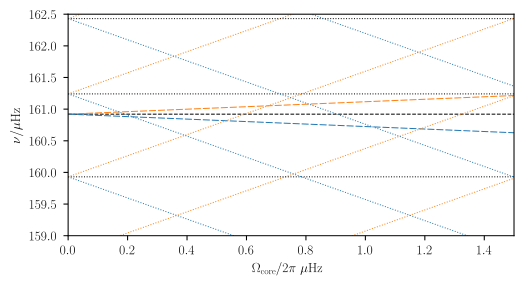
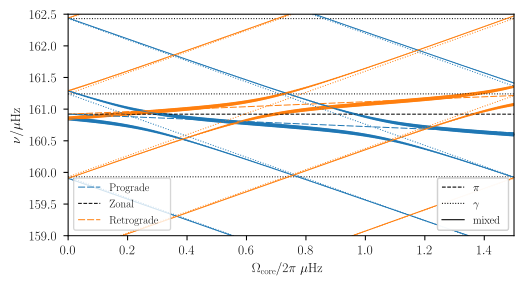
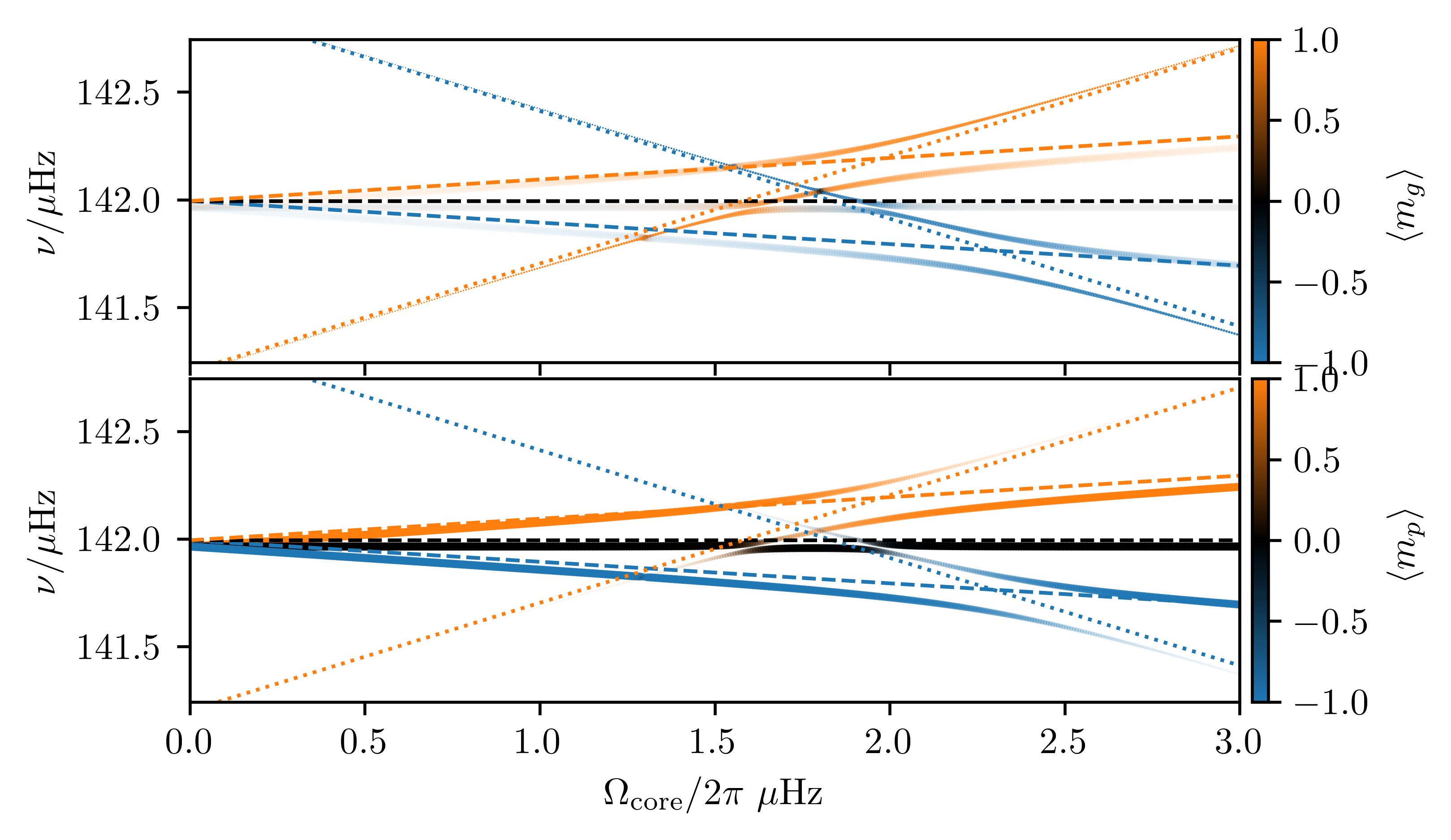
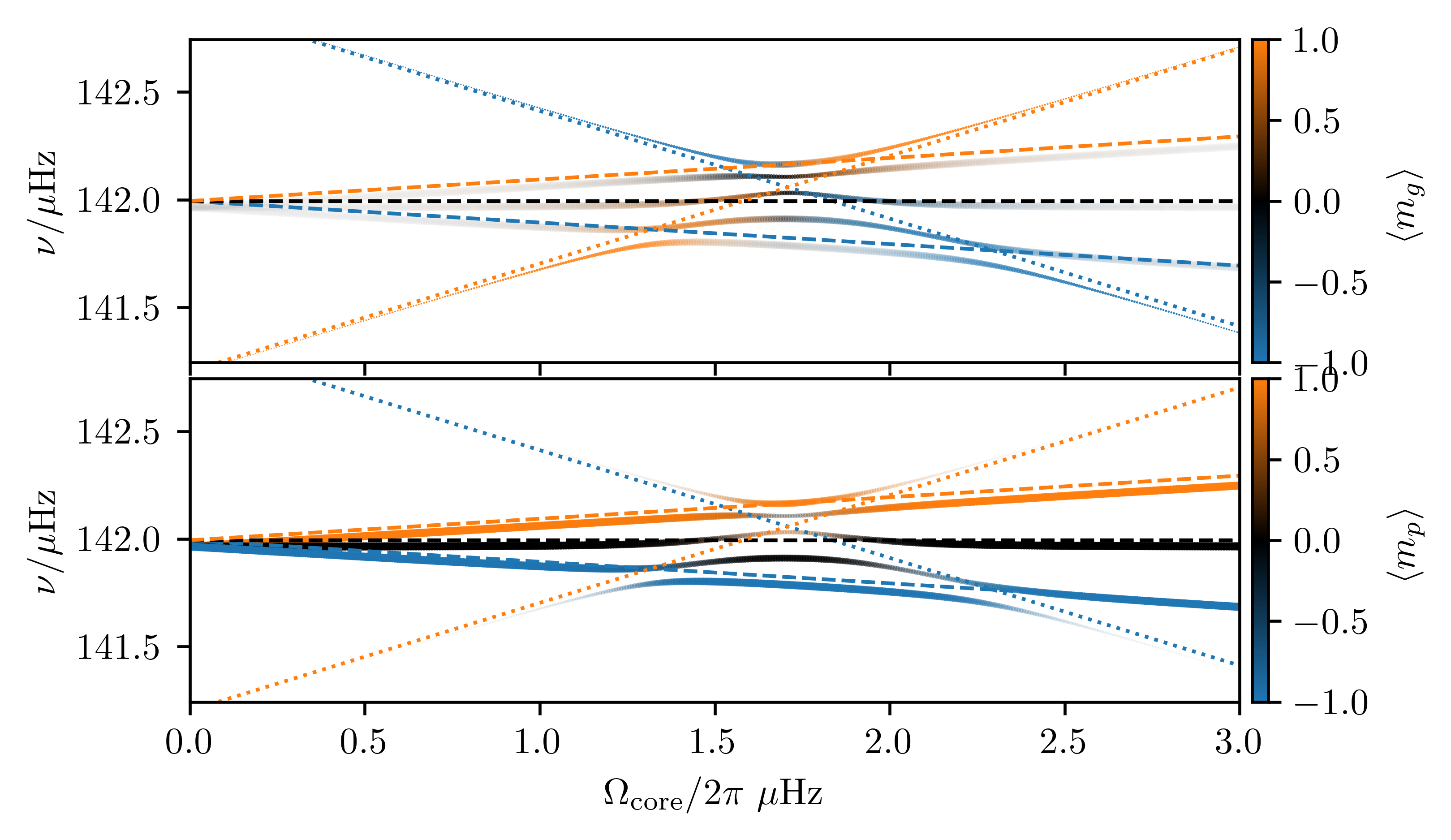
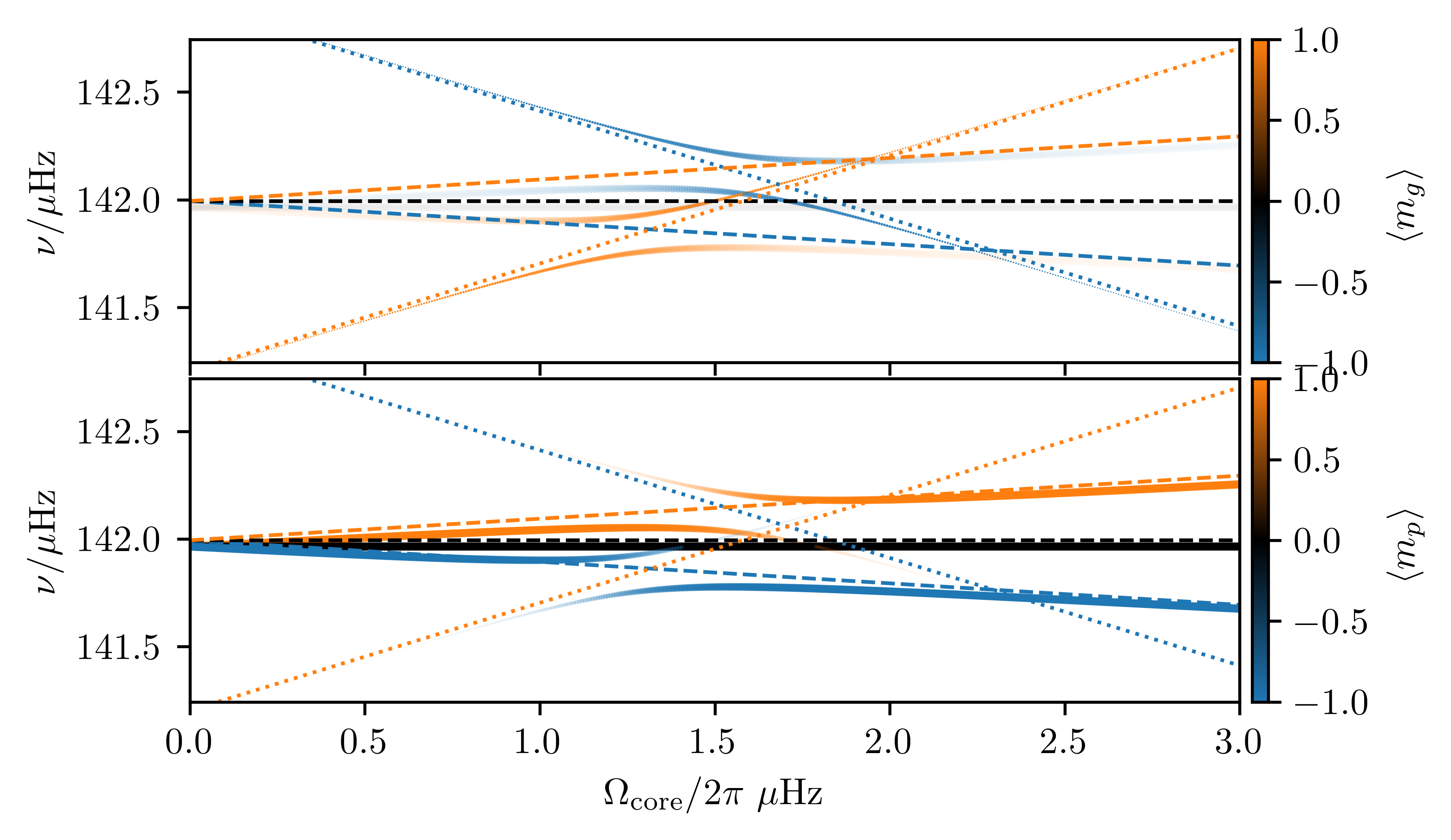
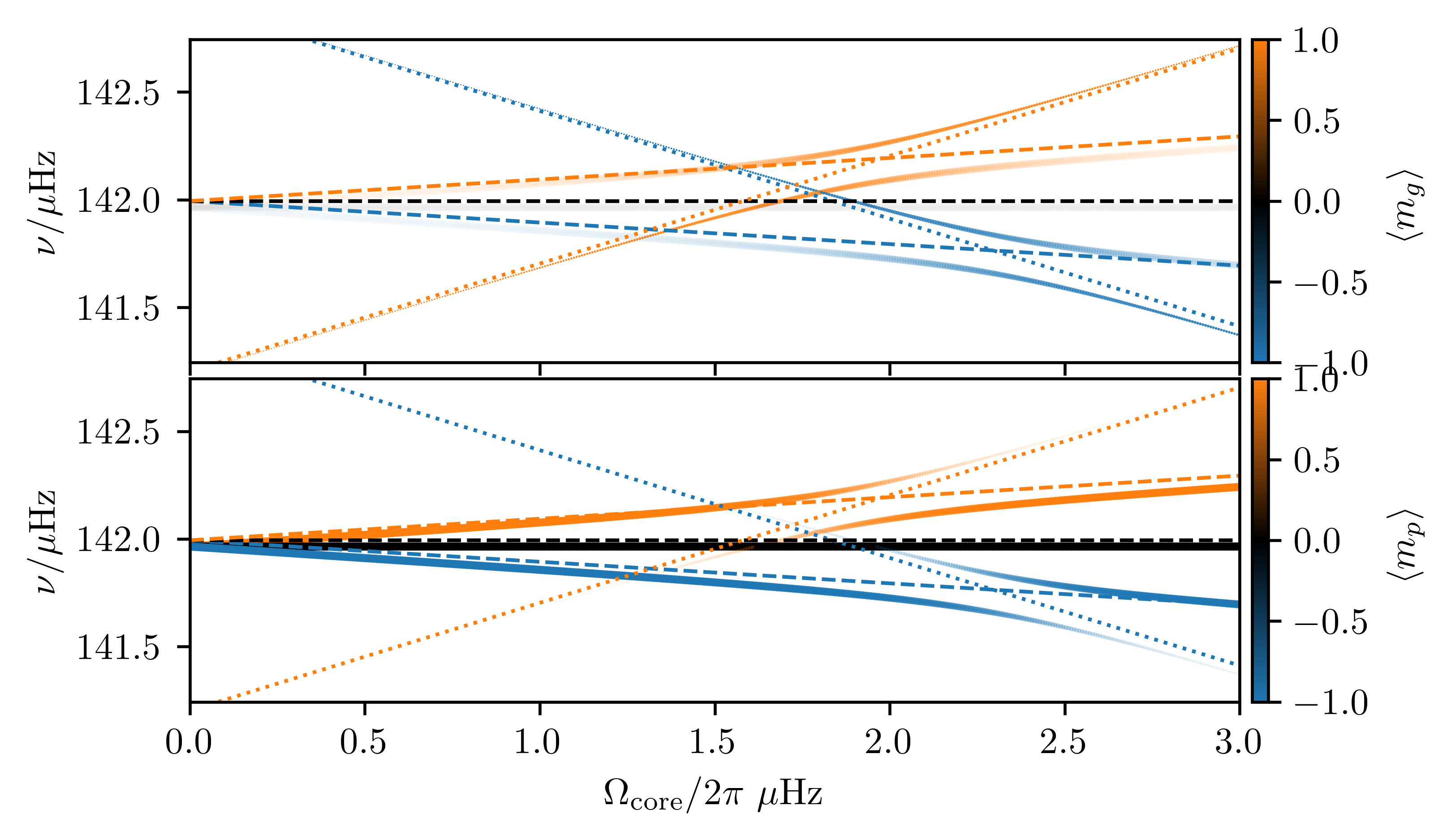
Mode mixing yields avoided crossings
between multiplet components of identical m

(cf. Mosser+ 2012, Ouazzani+ 2013, Deheuvels+ 2017)
\beta = 0

\beta = {\pi\over10}

\beta = {\pi\over2}

\beta = \pi
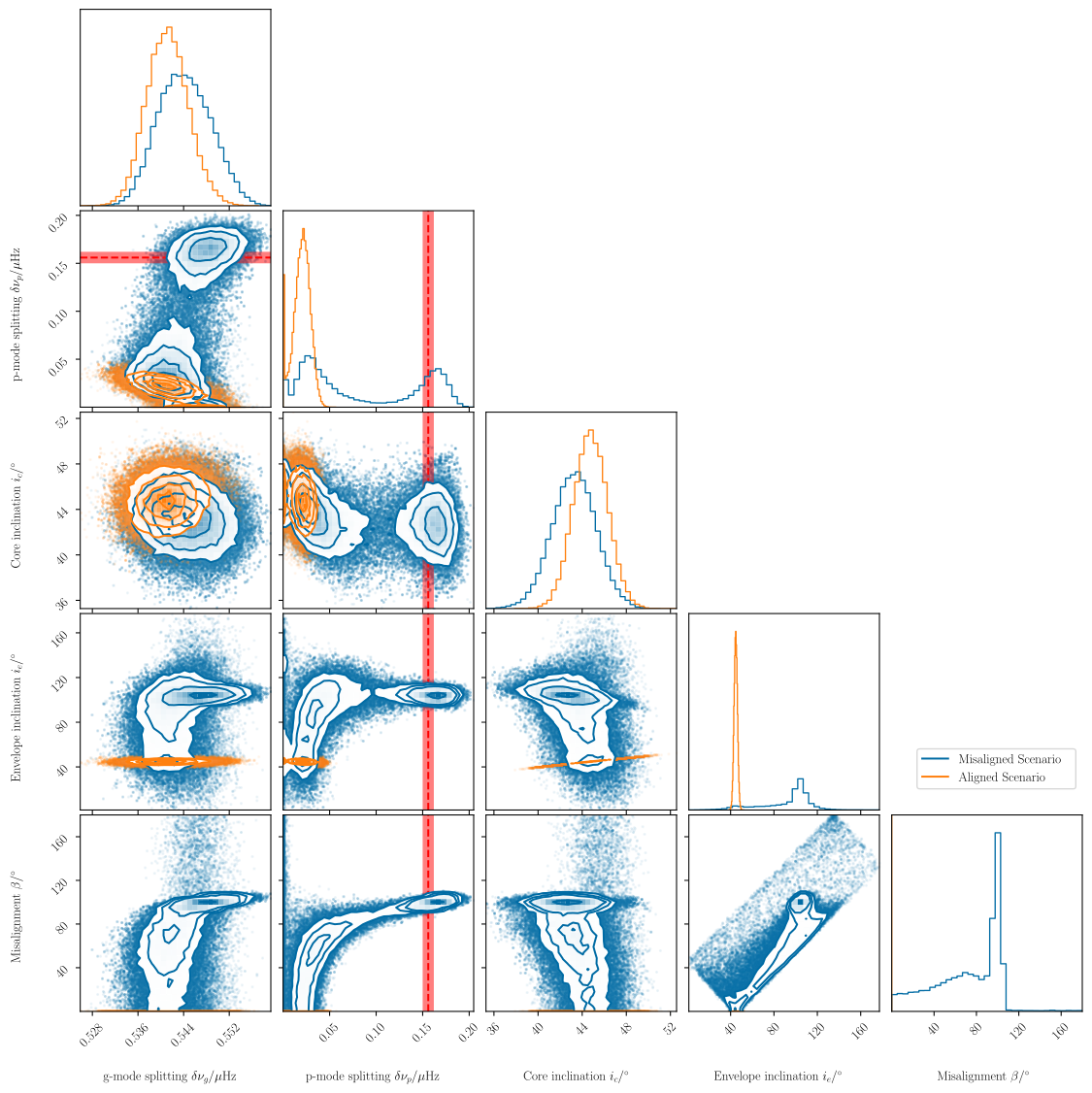
More Kepler-56

R-M Misalignment

Hjorth et al. 2021: Extreme misalignment angles are possible even in a coplanar configuration