Joel Ong
University of Sydney
EPF II | December 10, 2025 | Shanghai
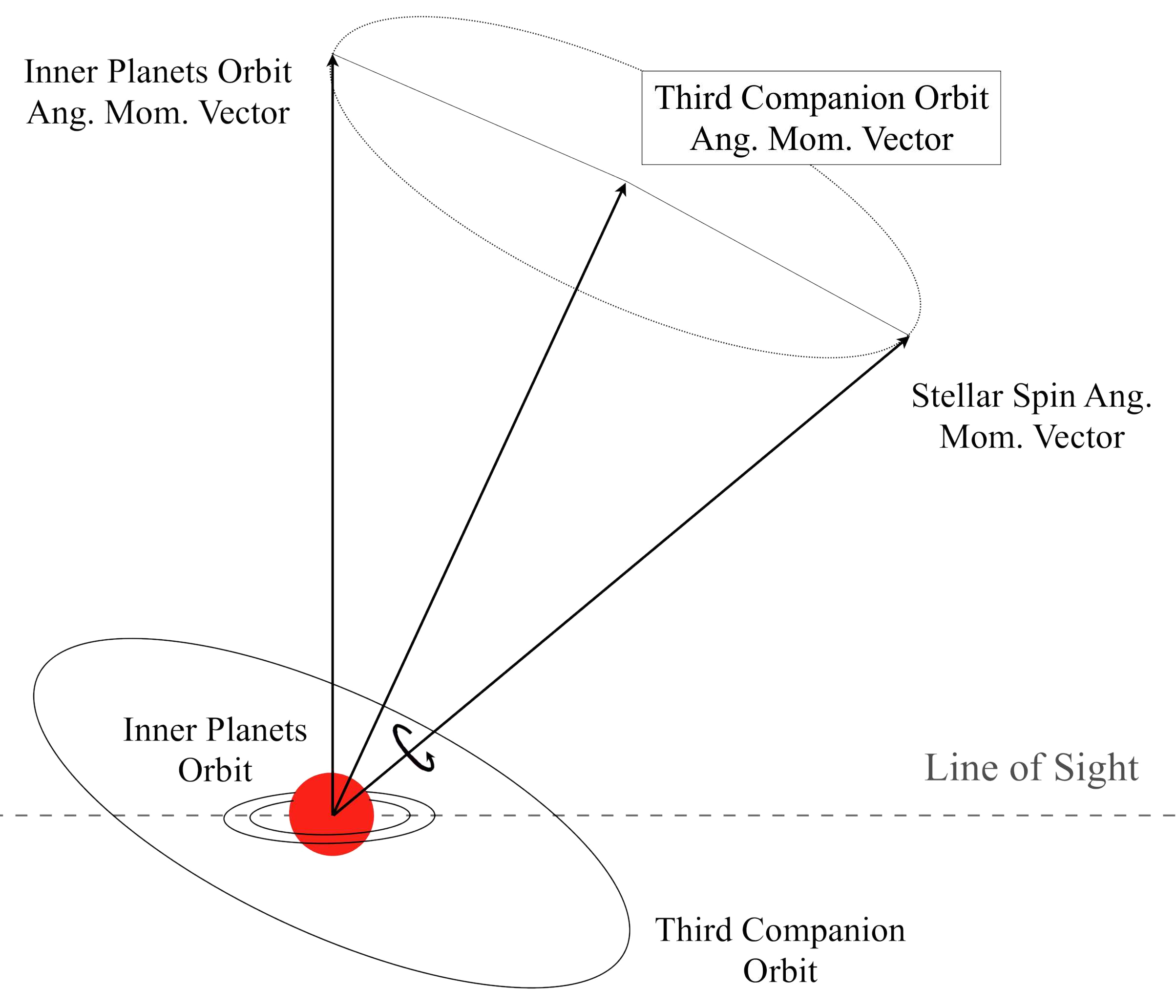
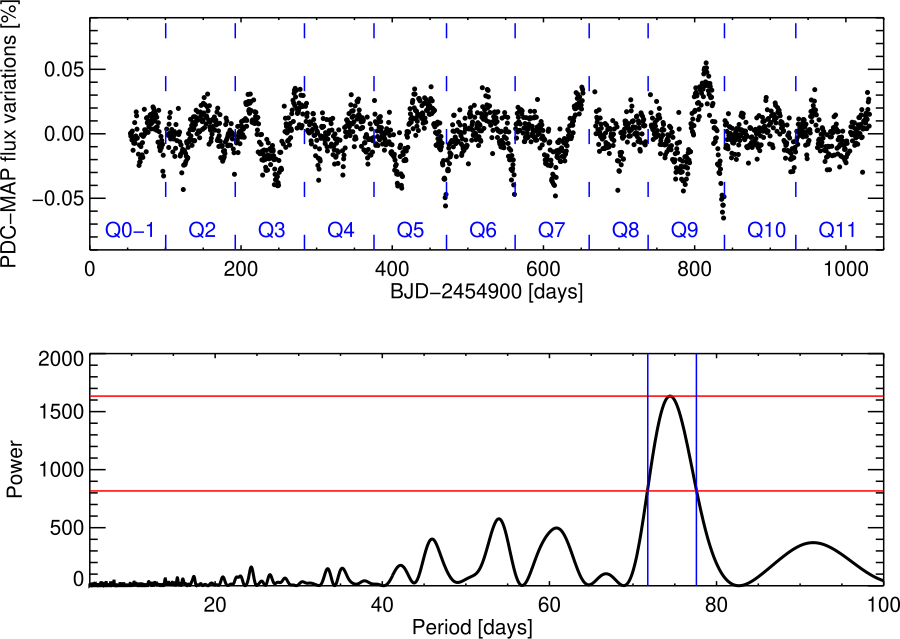
From Huber et al. 2013
Rapidly rotating: P_\text{rot} \sim 74\ \mathrm{d}
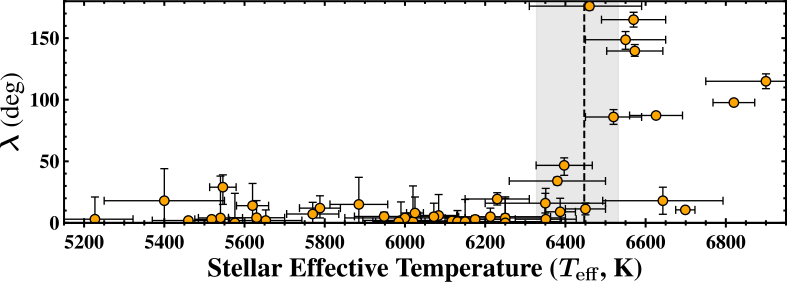
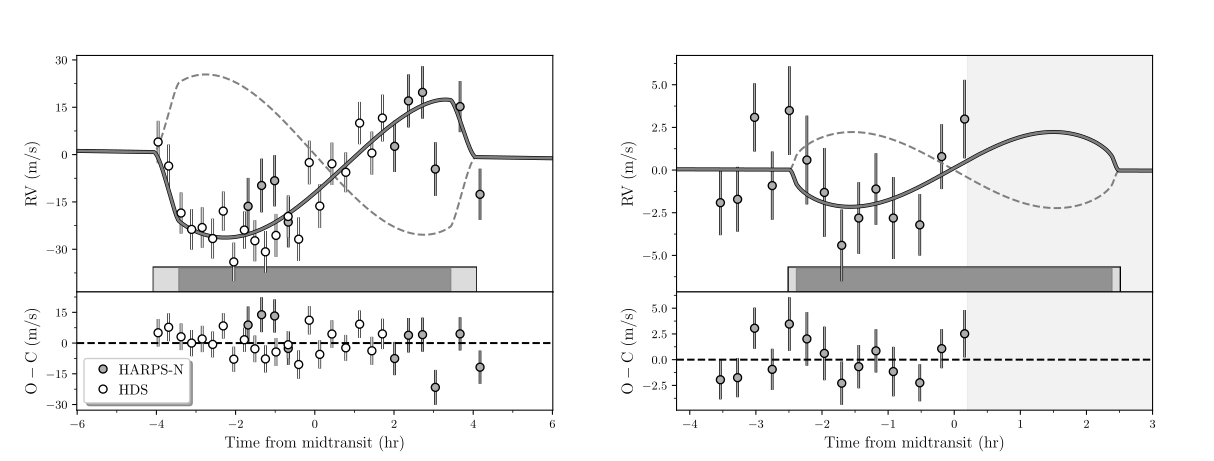
Multitransiting, Spin-Orbit Misaligned.
T_\text{eff} \sim 4840\ \mathrm{K}: Coolward of Kraft Break
\implies should not be (rapidly) rotating
\implies should not be spin-orbit misaligned
+ spin-orbit misalignment vs mutually aligned planets is exceedingly rare
From Wang, Wang & Ong, accepted to ApJL
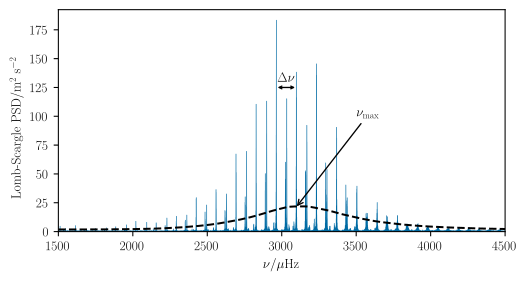
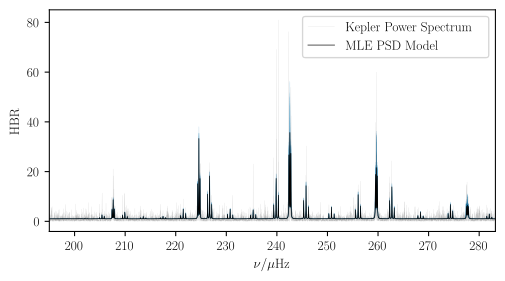
Power spectra of MDI dopplergrams
Cool stars support p-modes (pressure waves).
Mode frequency measurements constrain
internal structure and rotation.
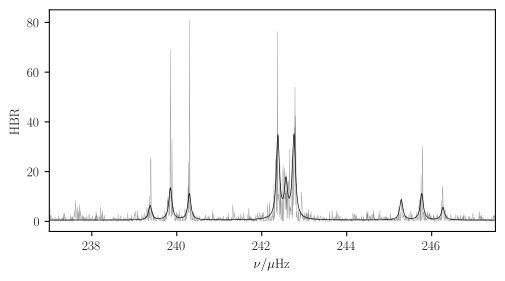
\begin{array}{c} {\scriptsize\text{Power}}\\ \big\uparrow \end{array}
\longrightarrow {\scriptsize\text{Frequency}}
Multiplet splittings give averaged rotation rates: \huge\left\langle\Omega\right\rangle_i = b_i\int K_i(r) \Omega(r) \mathrm d r
Pressure waves (p-modes)
are mainly sensitive
to the envelope.
Buoyancy waves (g-modes)
are mainly sensitive
to the core.
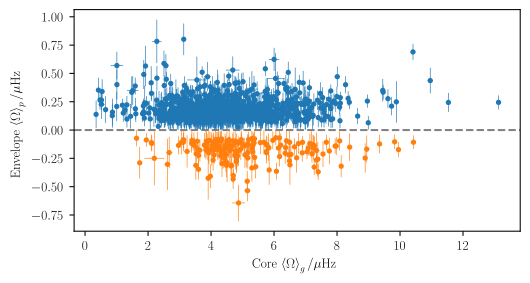
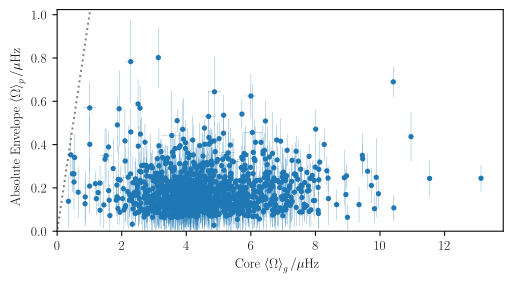
from Li et al. 2024
Asteroseismic rotational surveys suggest
core and envelope angular
momenta
can point in different directions?
for \ell = 1,
\small\mathbf{J}_x \hat{=} {1 \over \sqrt{2}}\begin{bmatrix}0 & 1 & 0 \\ 1 & 0 & 1 \\ 0 & 1 & 0\end{bmatrix}; \mathbf{J}_y \hat{=} {1 \over \sqrt{2}}\begin{bmatrix}0 & i & 0 \\ -i & 0 & i \\ 0 & -i & 0\end{bmatrix}; \mathbf{J}_z \hat{=} \begin{bmatrix}-1 & 0 & 0 \\ 0 &0 &0 \\ 0& 0 &1\end{bmatrix}.
\left(-\mathbf{\Omega}_0^2 + 2 \omega m \mathbf{R} + \omega^2 \mathbf{\Delta}\right)\mathbf{c} = 0
For fixed n (to leading order):
(-\omega_0^2 \mathbb{1}_{2\ell+1} + 2 \omega \mathbf{J}_z R_{n,n} + \omega^2 \mathbb{1}_{2\ell+1})\mathbf{y} = 0
\implies \left(-\mathbf{\Omega_0}^2 \otimes \mathbb{1}_{2\ell+1} + 2 \omega \underbrace{\mathbf{R} \otimes \mathbf{J}_z}_{\tilde{\mathbf{R}}} + \omega^2 \mathbf{\Delta} \otimes \mathbb{1}_{2\ell+1}\right)\mathbf{x} = 0
\small \begin{aligned} \mathbf{R}_{n\ell, n\ell} &= b_{n\ell}\int {\mathbf{d}^\ell}^\dagger(\beta(r)) \Omega(r) \mathbf{J}_z {\mathbf{d}^\ell}(\beta(r))\ K(r)\ \mathrm{d} r\\ &= b_{n\ell}\int \Omega(r) (\hat{\mathbf{n}} \cdot \vec{\mathbf{J}})\ K(r)\ \mathrm{d} r\\ &= \boxed{b_{n\ell}\left(\int \vec{\mathbf{\Omega}}(r) K(r)\ \mathrm{d} r\right) \cdot \vec{\mathbf{J}}}. \end{aligned}
\implies For each mode, AM matrix
is
specified by usual vector addition.
\small \left(\begin{bmatrix} {\color{grey}\mathbf{L}_{\pi\pi}} & \mathbf{L}_{\pi\gamma} \\ \mathbf{L}_{\pi\gamma}^T & {\color{red}\mathbf{L}_{\gamma\gamma}} \end{bmatrix} \otimes \mathbb{1}_{2\ell+1} + 2 \omega \begin{bmatrix} {\color{forestgreen}\tilde{\mathbf{R}}_\pi} & 0 \\ 0 & {\color{forestgreen}\tilde{\mathbf{R}}_\gamma}\end{bmatrix} + \omega^2 \begin{bmatrix} \mathbb{1} & \mathbf{D} \\ \mathbf{D}^T & \mathbb{1} \end{bmatrix} \otimes \mathbb{1}_{2\ell+1} \right)\mathbf{x} = 0.
Mode visibilities are specified by \mathbf{x}^\dagger(\mathbb{1} \otimes \mathbf{P})\mathbf{x}, where \mathbf{P} is the projection matrix onto m=0 in the observer’s coordinate frame.
\vdots
(some assembly required)
(most likely scenario given rapid obliquity damping)
Problems:
Problems:
Most obvious explanation:
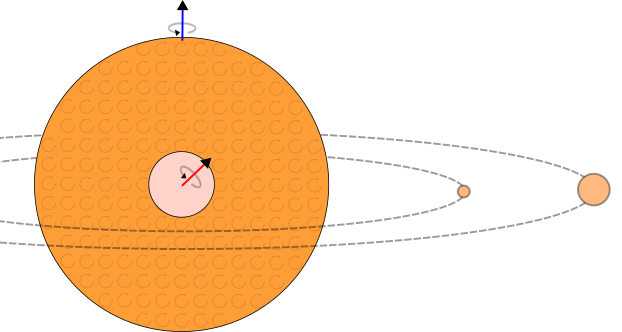
what if spun up by tidal inspiral?
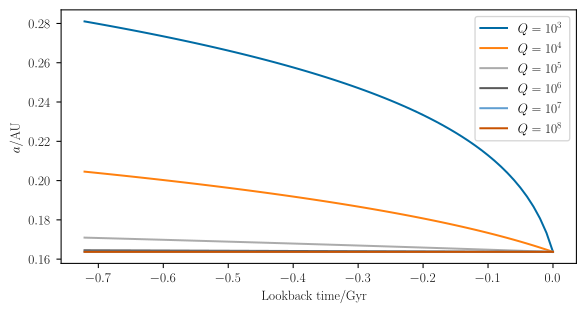
Even unphysically aggressive (low-Q)
inspiral
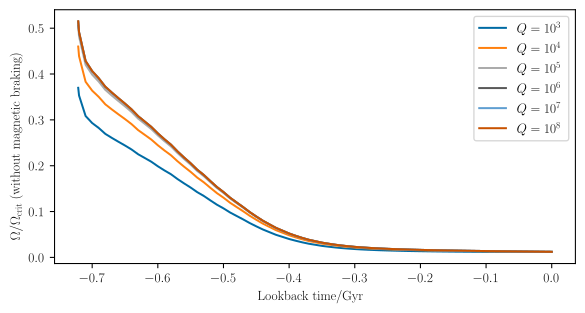
requires rapid rotation at TAMS:
incompatible with magnetic braking!
\implies tidal torques insufficient to supply present AM
(cf. Tokuno 2025 for alternative argument)
TAMS
Today
Engulfment?
As previously understood, Kepler-56
— rapidly rotating, misaligned, multitransiting —
should not exist.
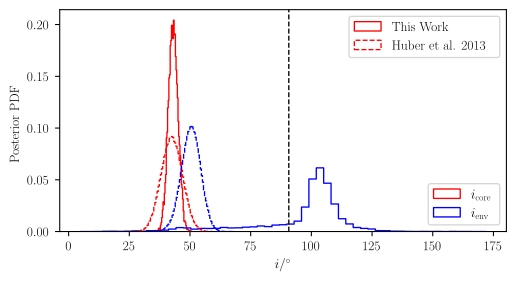
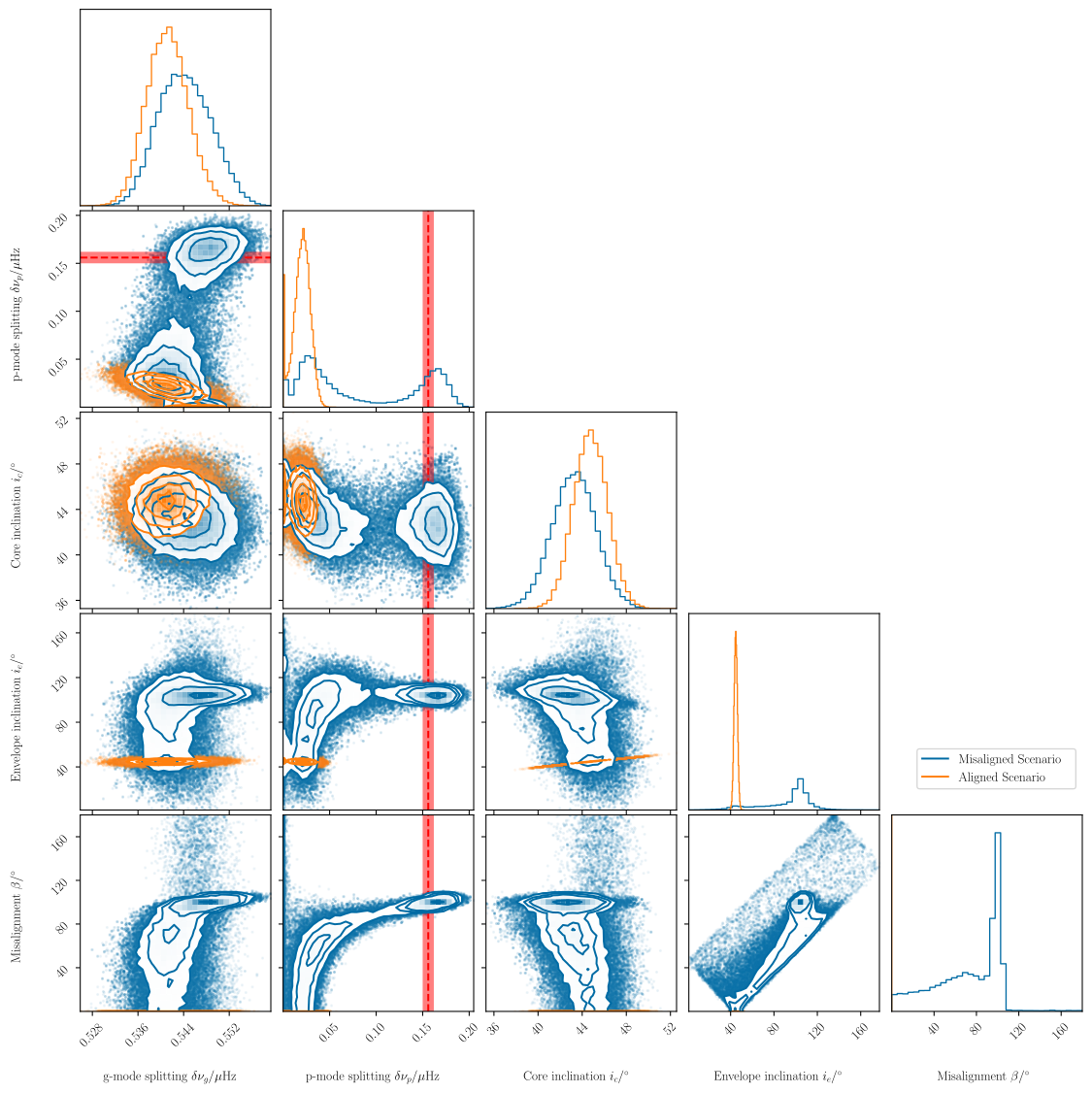
Revisited asteroseismology resolves tension with obliquity damping,
but implied configuration still
cannot be explained by canonical stellar evolution.
Planetary engulfment is most likely
explanation.
(so far)
\mathrm{j}\mathrm{o}\mathrm{e}\mathrm{l}\cdot\mathrm{o}\mathrm{n}\mathrm{g}\ \text{@}\ \text{sydney}.\text{edu}.\text{au}
\left\langle\Omega\right\rangle_g
\left\langle\Omega\right\rangle_p
from Li et al. 2024
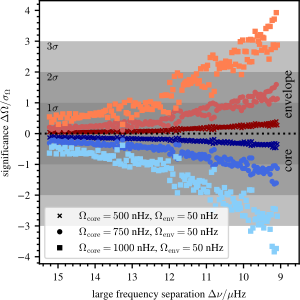
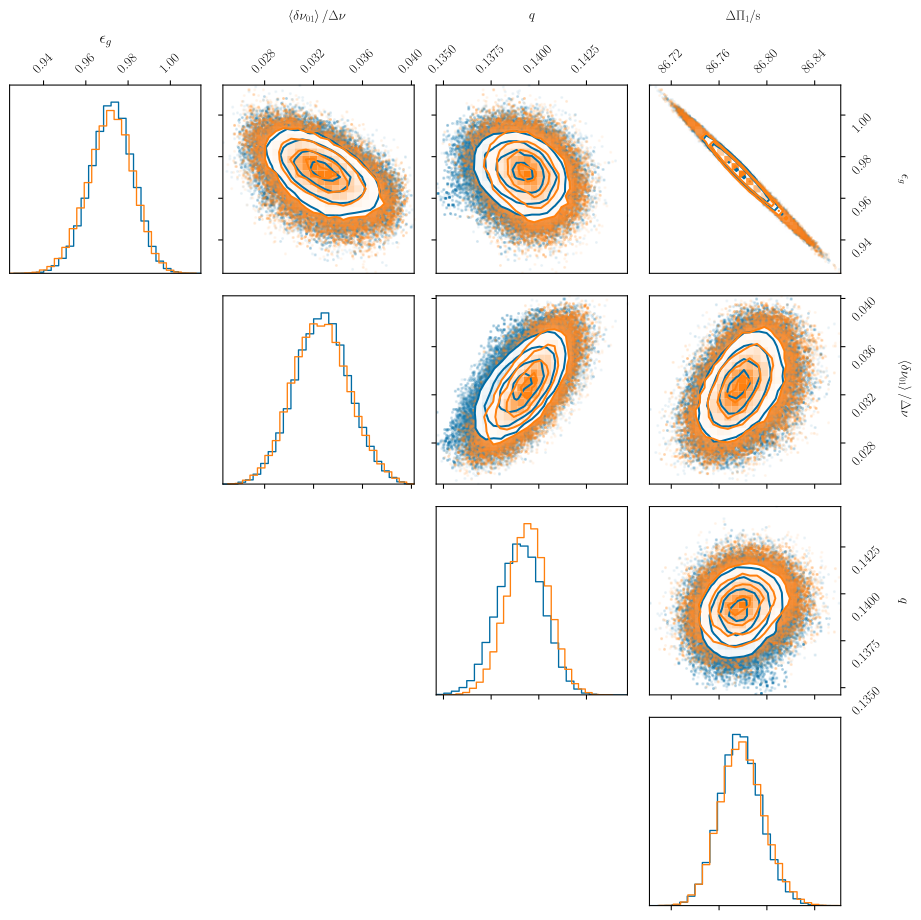
Neglecting avoided-crossing effects means previous estimates of envelope rotation were likely significantly overestimated.
Systematic measurement error (sigmas)
(proxy for age \rightarrow)
from Ahlborn, Ong, et al. 2025
\forall \ell, \exists (2\ell + 1) \times
(2\ell + 1) matrices
\mathbf{J}_x^\ell, \mathbf{J}_y^\ell, \mathbf{J}_z^\ell satisfying commutation
relations
\left[\mathbf{J}_i, \mathbf{J}_j\right] =
-i\epsilon_{ijk}\mathbf{J}_k, with
\mathbf{J}_z \hat{=} \mathrm{diag}(-\ell,
-\ell + 1 \ldots \ell - 1, \ell).
\small\mathbf{J}_x \hat{=} {1 \over \sqrt{2}}\begin{bmatrix}0 & 1 & 0 \\ 1 & 0 & 1 \\ 0 & 1 & 0\end{bmatrix}; \mathbf{J}_y \hat{=} {1 \over \sqrt{2}}\begin{bmatrix}0 & i & 0 \\ -i & 0 & i \\ 0 & -i & 0\end{bmatrix}; \mathbf{J}_z \hat{=} \begin{bmatrix}-1 & 0 & 0 \\ 0 &0 &0 \\ 0& 0 &1\end{bmatrix}.
For fixed m (to leading order):
\left(-\mathbf{\Omega}_0^2 + 2 \omega m \mathbf{R} + \omega^2 \mathbf{\Delta}\right)\mathbf{c} = 0
For fixed n (to leading order):
(-\omega_0^2 \mathbb{1}_{2\ell+1} + 2 \omega \mathbf{J}_z R_{n,n} + \omega^2 \mathbb{1}_{2\ell+1})\mathbf{y} = 0
\vec{\xi}_{n\ell m}(r, \theta, \varphi) = \vec{\xi}_{n\ell}(r) Y_\ell^m(\theta, \phi) \iff \underbrace{\tilde{R}_{n, n', m, m'} = R_{n,n'} J_{m,m'}}_{\text{this is a }\textbf{tensor product}!}
\implies \left(-\mathbf{\Omega_0}^2 \otimes \mathbb{1}_{2\ell+1} + 2 \omega \underbrace{\mathbf{R} \otimes \mathbf{J}_z}_{\tilde{\mathbf{R}}} + \omega^2 \mathbf{\Delta} \otimes \mathbb{1}_{2\ell+1}\right)\mathbf{x} = 0
Let’s associate with each mass shell at r both \Omega(r)
(as is customary), and also an axis \hat{\mathbf{n}}(r) =\sum_i n_i
\mathbf{e}_i.
\small \begin{aligned} \mathbf{R}_{n\ell, n\ell} &= b_{n\ell}\int {\mathbf{d}^\ell}^\dagger(\beta(r)) \Omega(r) \mathbf{J}_z {\mathbf{d}^\ell}(\beta(r))\ K(r)\ \mathrm{d} r\\ &= b_{n\ell}\int \Omega(r) (\hat{\mathbf{n}} \cdot \vec{\mathbf{J}})\ K(r)\ \mathrm{d} r\\ &= \boxed{b_{n\ell}\left(\int \vec{\mathbf{\Omega}}(r) K(r)\ \mathrm{d} r\right) \cdot \vec{\mathbf{J}}}. \end{aligned}
\boxed{\tilde{\mathbf{R}} = \int \mathbf{K}\otimes\left(\Omega_\text{rot}(r)\ \hat{\mathbf{n}}\cdot \vec{\mathbf{J}}\right)\ \mathrm{d}r}
\implies For each mode, AM matrix
is
specified by usual vector addition.
We only assume that the pure p- and g-mode
solutions
are separately amenable to separation of
variables;
the mixed-mode eigenfunctions need not be.
\small \left(\begin{bmatrix} {\color{grey}\mathbf{L}_{\pi\pi}} & \mathbf{L}_{\pi\gamma} \\ \mathbf{L}_{\pi\gamma}^T & {\color{red}\mathbf{L}_{\gamma\gamma}} \end{bmatrix} \otimes \mathbb{1}_{2\ell+1} + 2 \omega \begin{bmatrix} {\color{forestgreen}\tilde{\mathbf{R}}_\pi} & 0 \\ 0 & {\color{forestgreen}\tilde{\mathbf{R}}_\gamma}\end{bmatrix} + \omega^2 \begin{bmatrix} \mathbb{1} & \mathbf{D} \\ \mathbf{D}^T & \mathbb{1} \end{bmatrix} \otimes \mathbb{1}_{2\ell+1} \right)\mathbf{x} = 0.
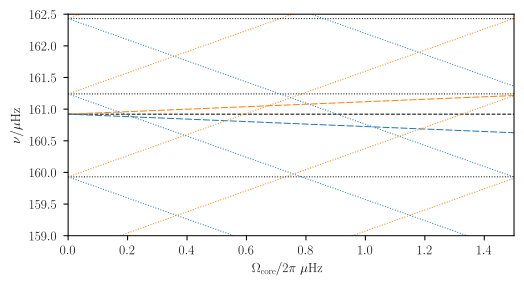
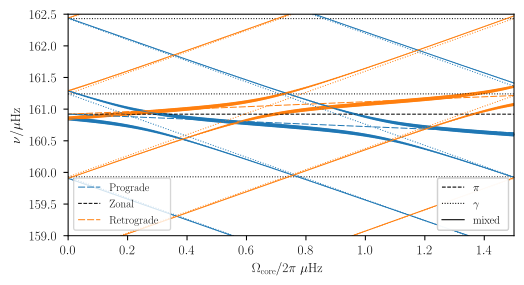
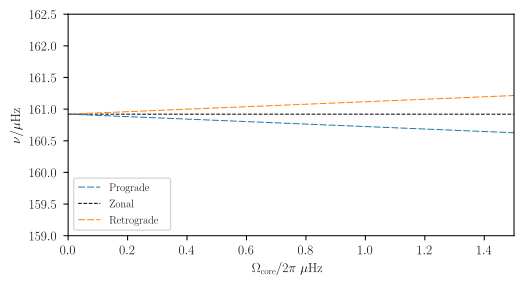
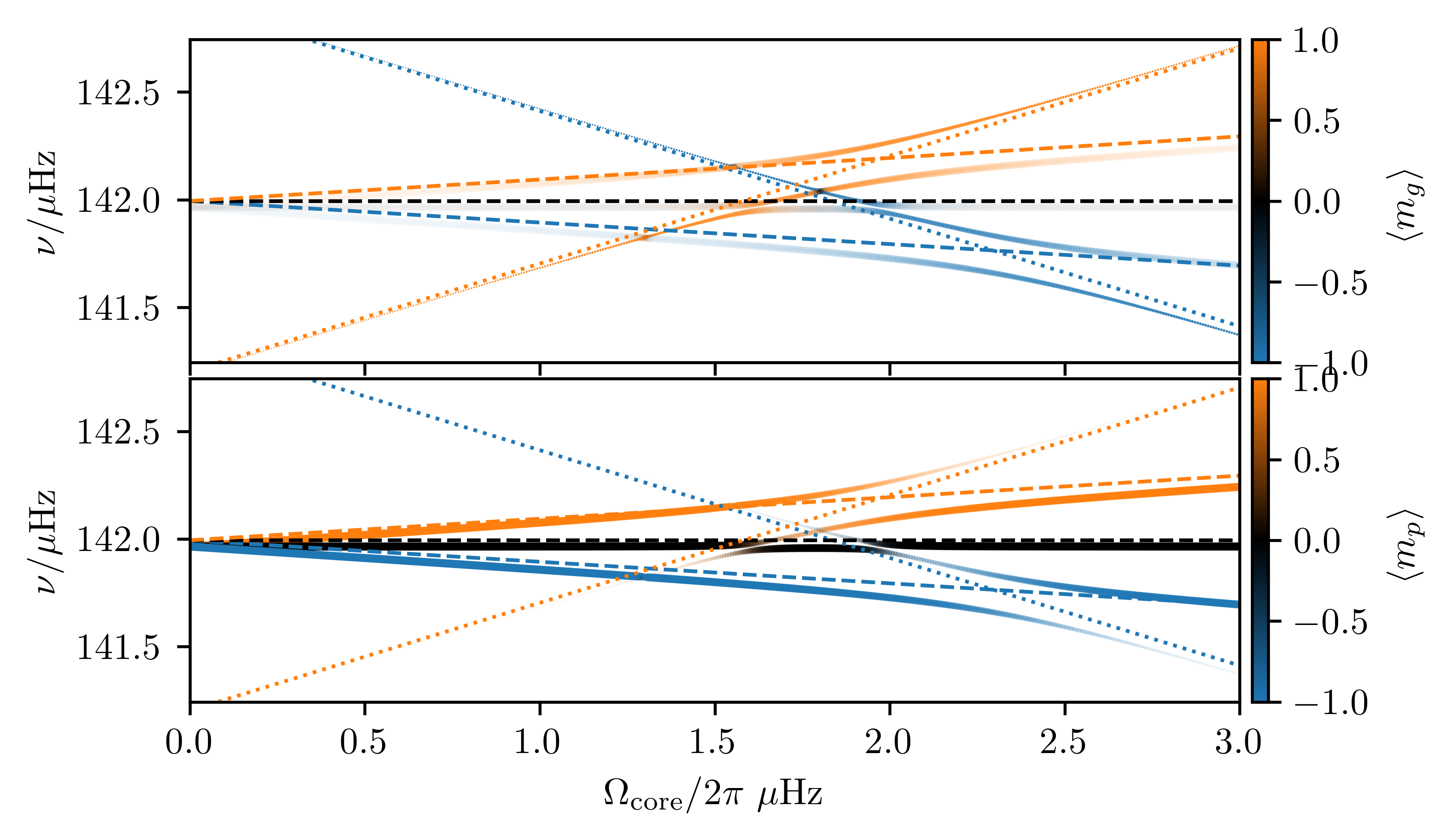
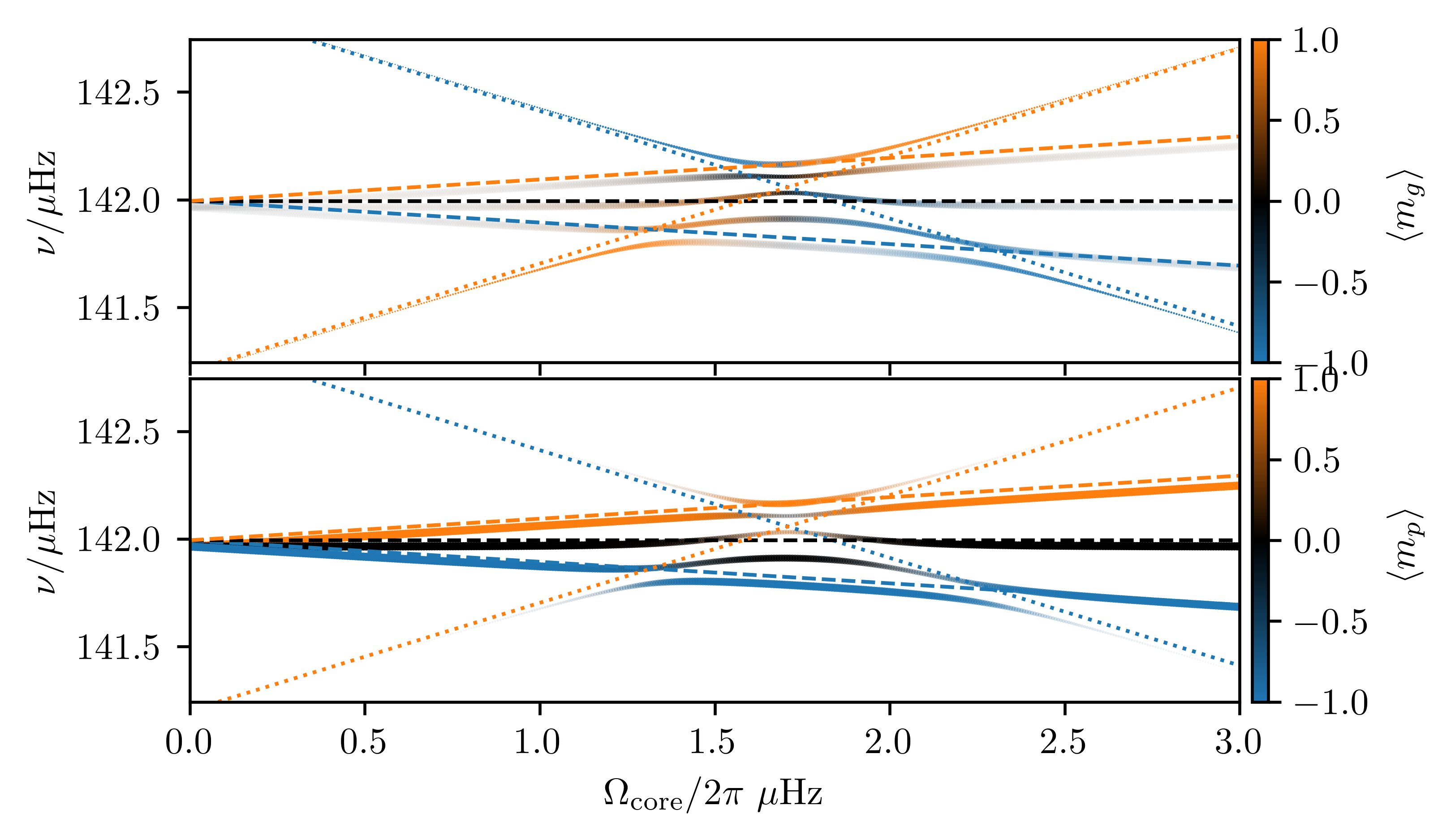
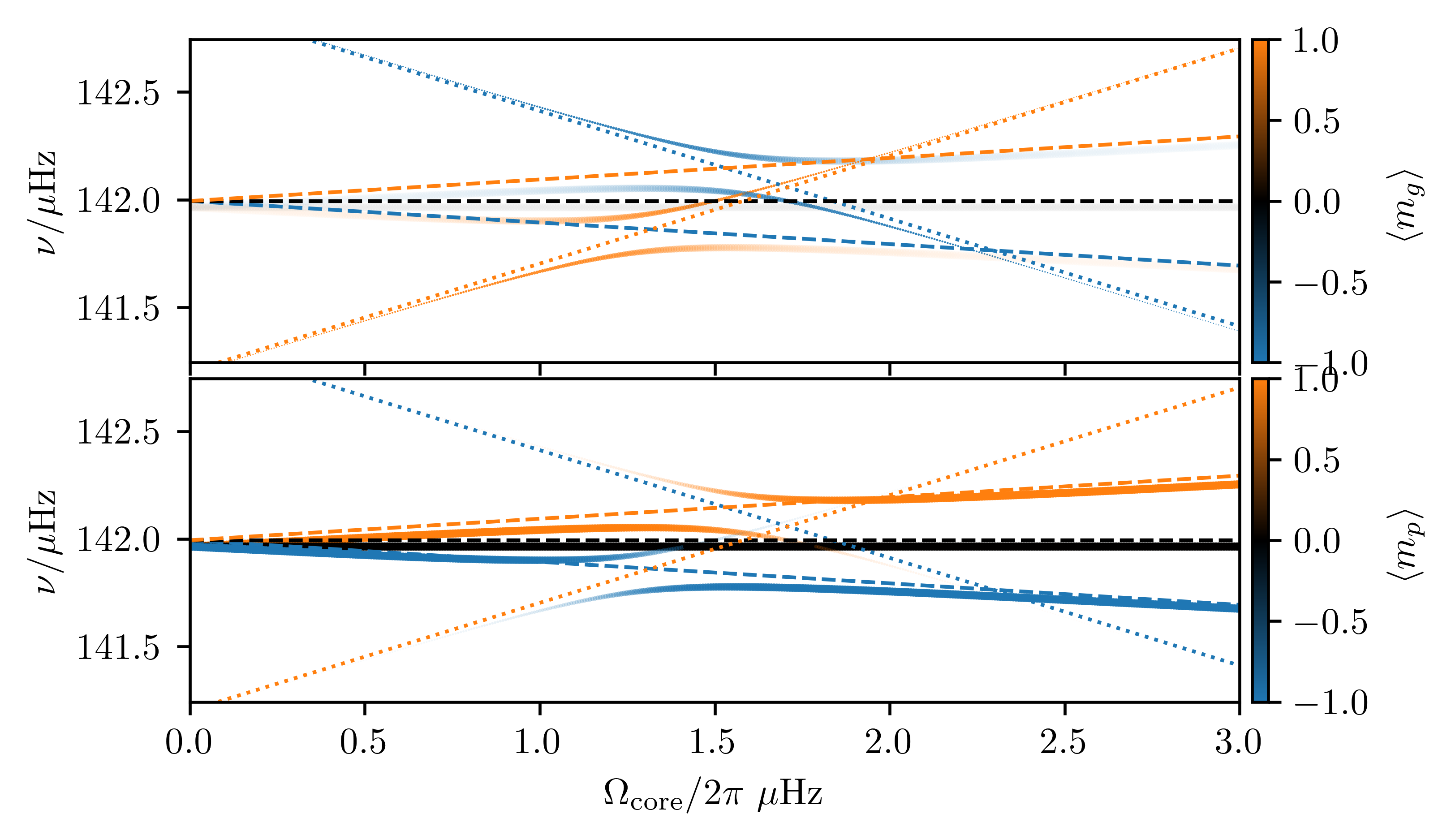
Mode mixing yields avoided crossings
between multiplet components of identical m
(cf. Mosser+ 2012, Ouazzani+ 2013, Deheuvels+ 2017)
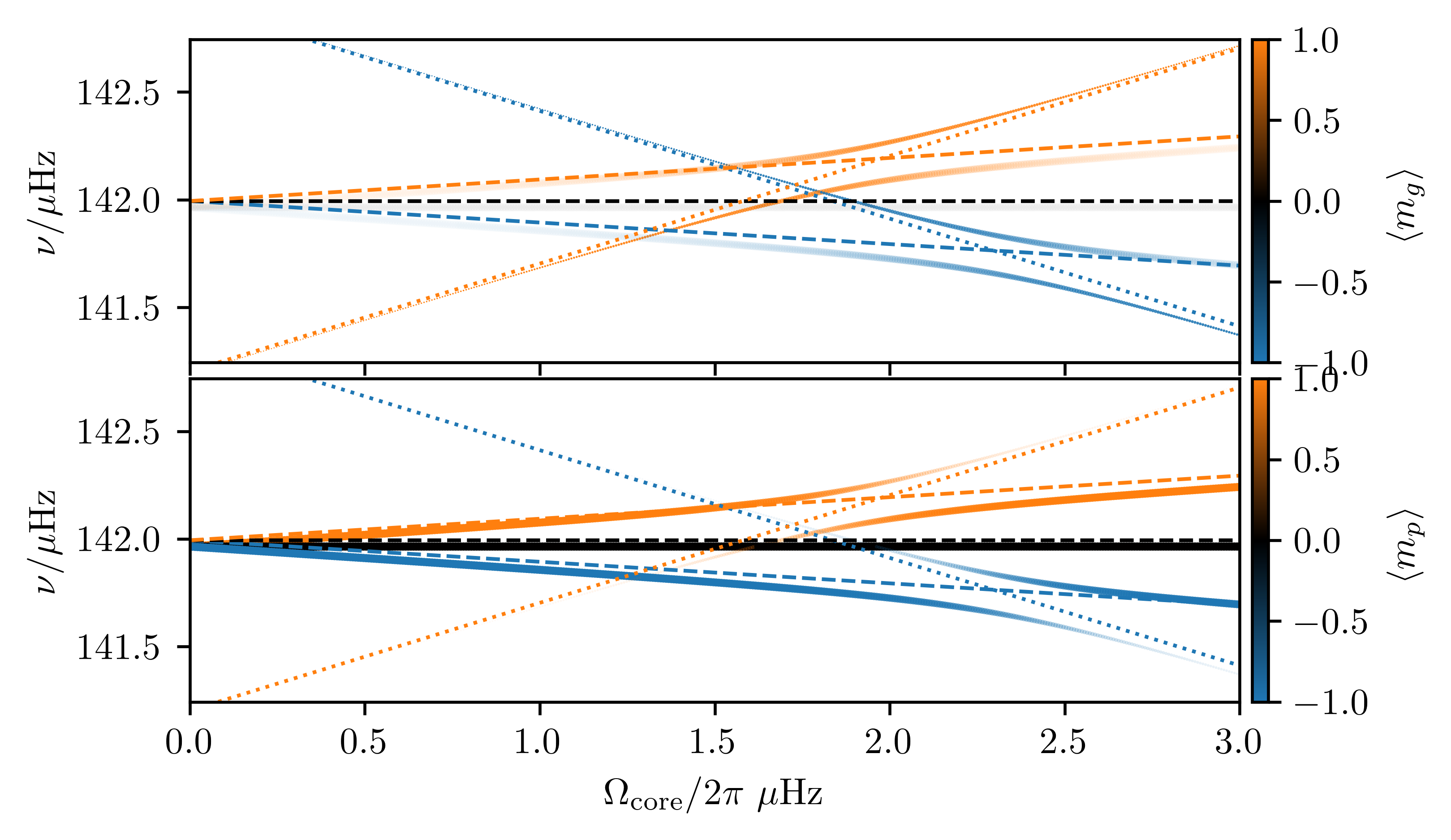
\beta = 0
\beta = {\pi\over10}
\beta = {\pi\over2}
\beta = \pi