The Coming
Asteroseismic Revolution

Joel Ong
Hubble Fellow, Univ. of Hawaiʻi at Mānoa

Center for Astrophysics | Harvard & Smithsonian;
January 28, 2025

I.
The Past
From the Sun to the Stars

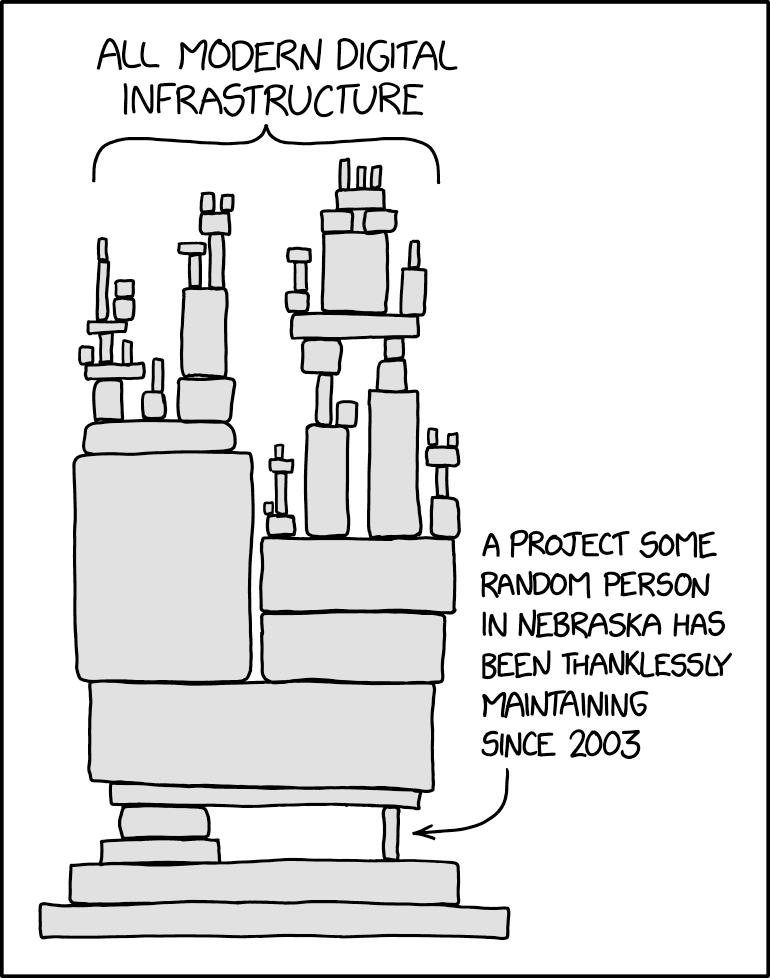
How do we know anything?

xkcd #2347: Munroe (2020)

physics of stellar interiors

quantitative

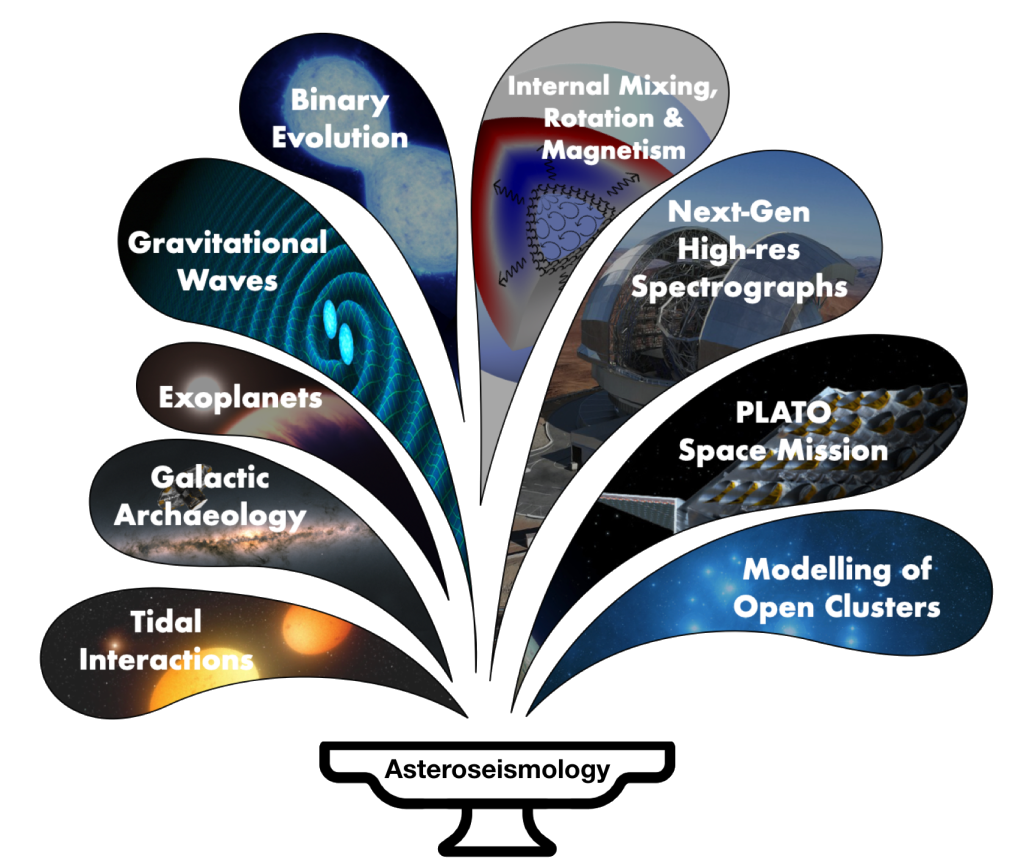
astronomy & astrophysics
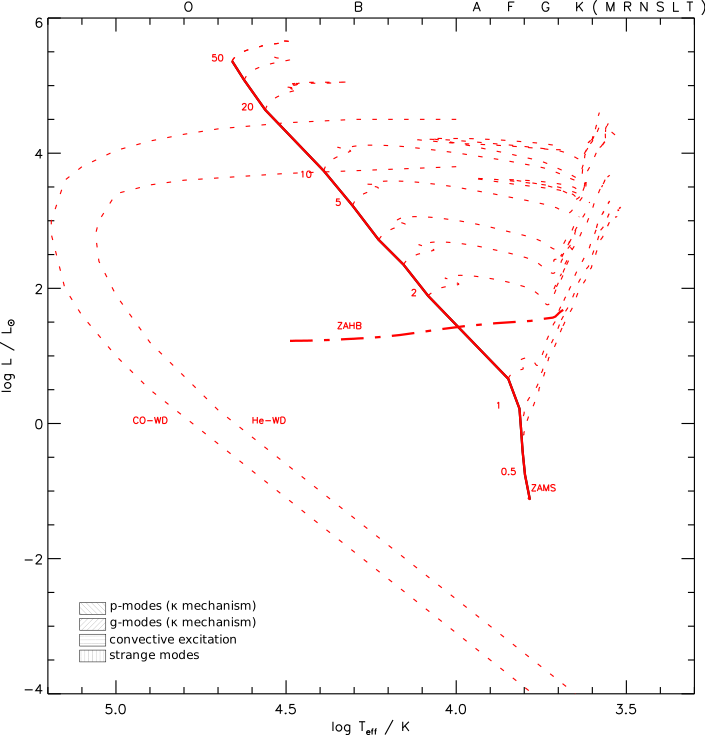
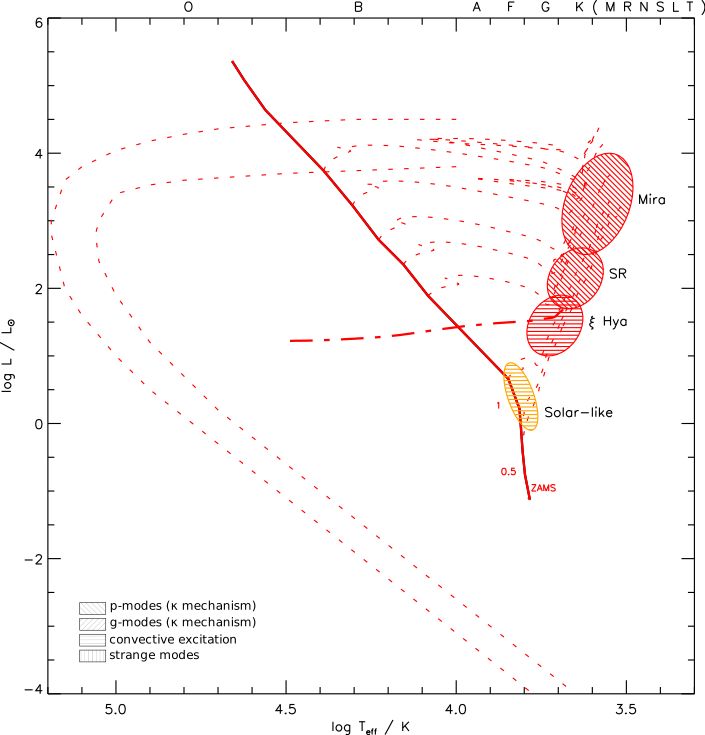
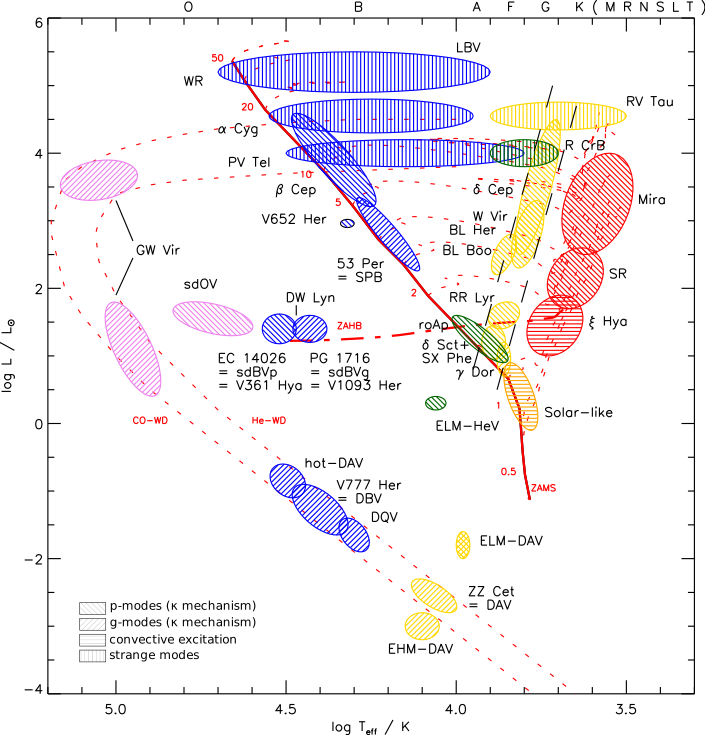
(illustration courtesy of Conny Aerts)

Solar-like Oscillations

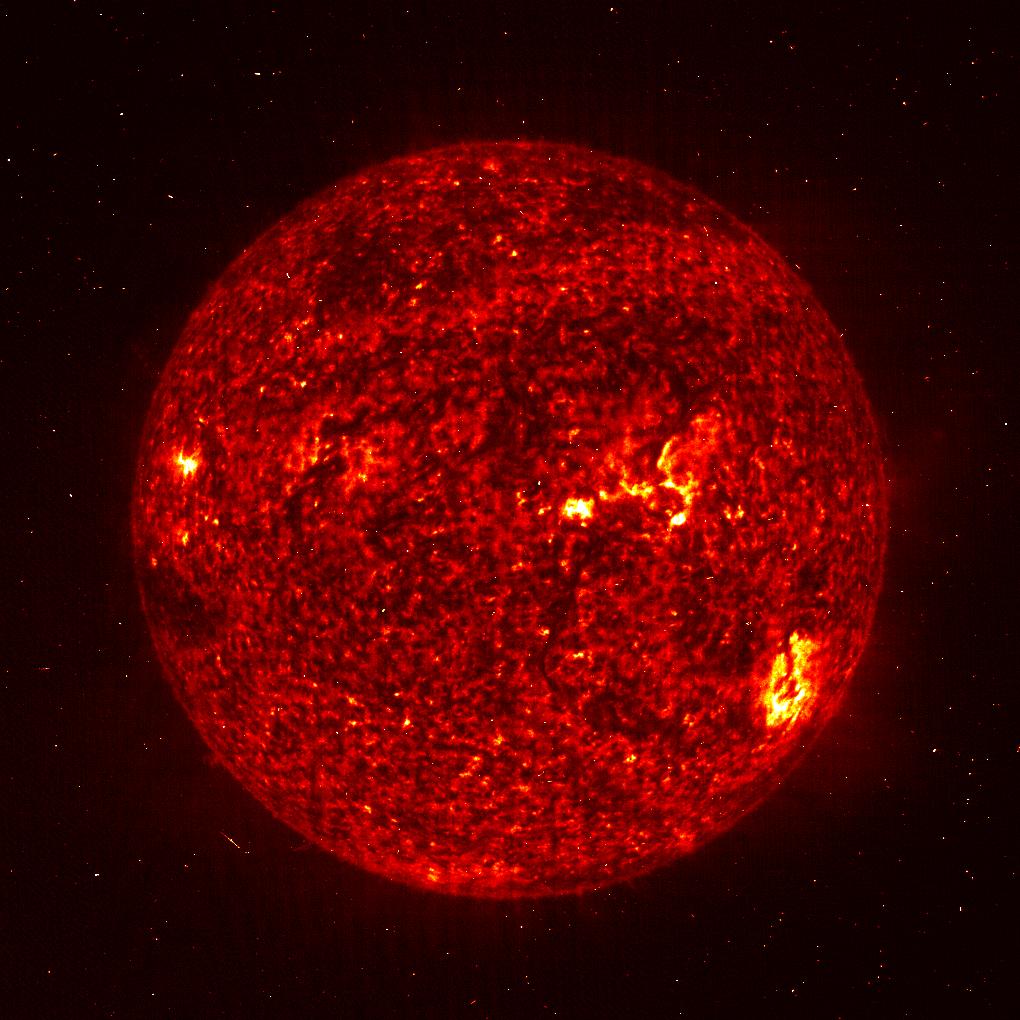
SOHO EIT Image (2016)

HMI Dopplergram (2017)

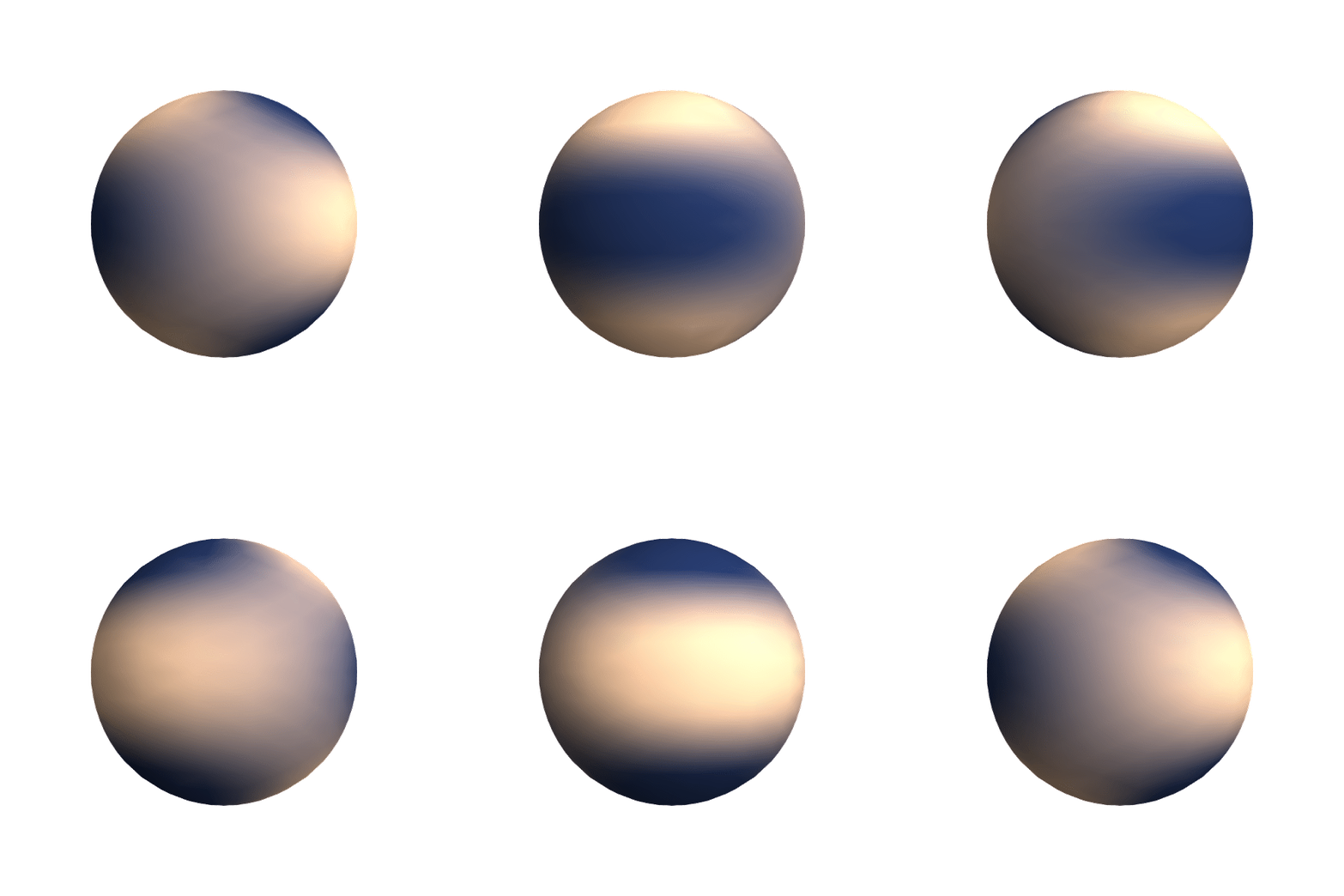
(RHD simulations courtesy of Joel D. Tanner)

Convection excites
pressure waves (p-modes).

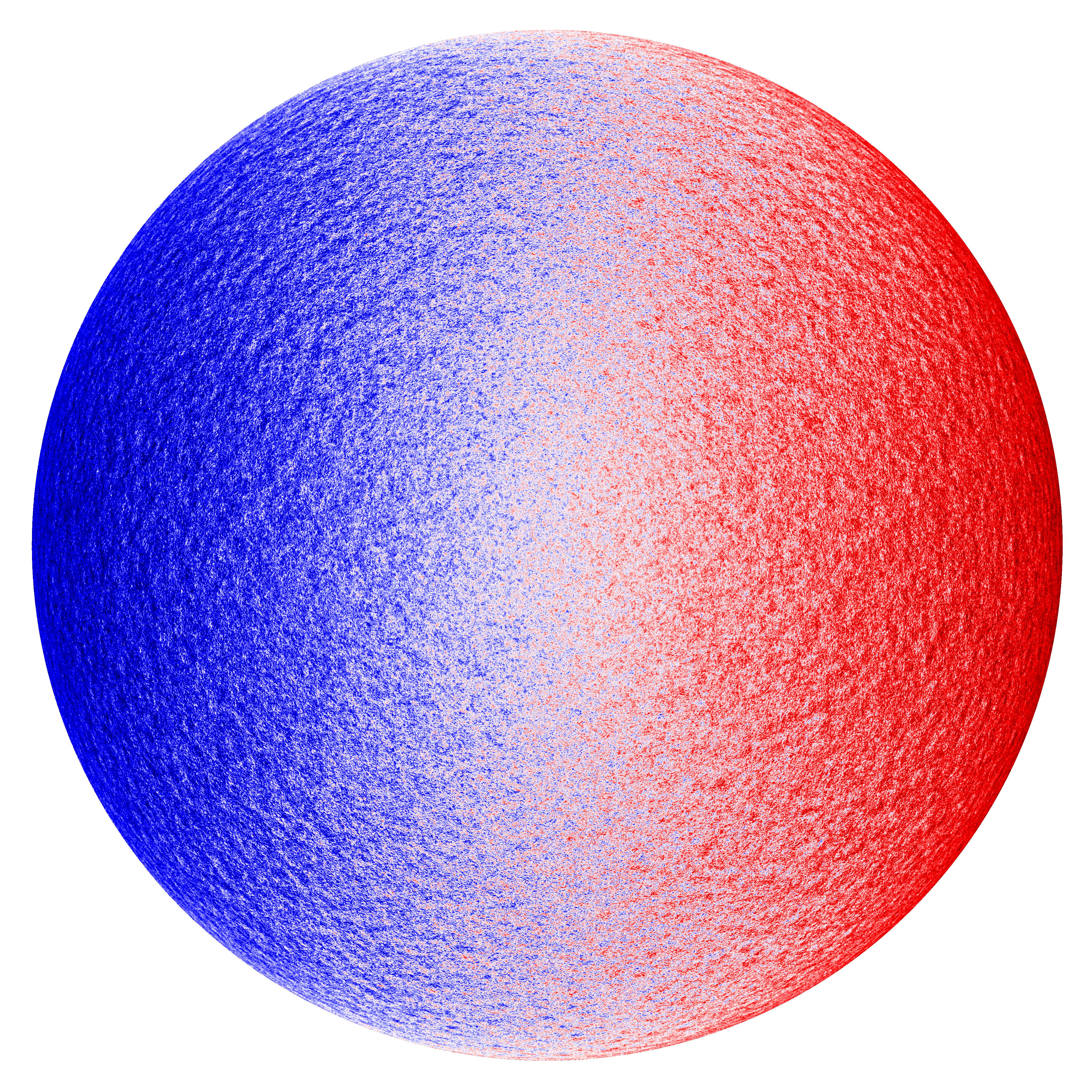
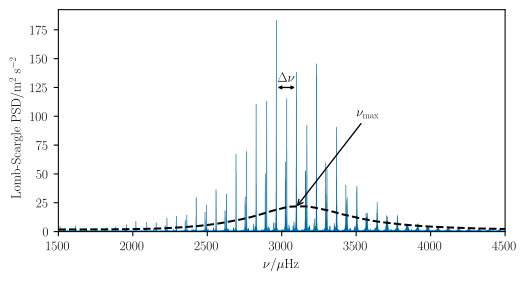
\(\ell = 0\) MDI Doppler velocities
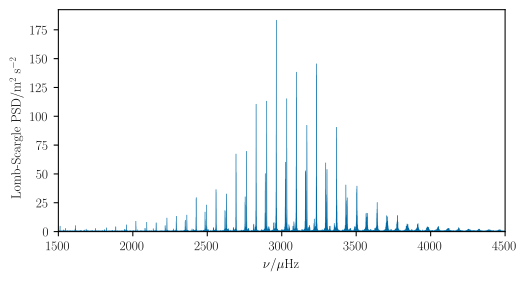
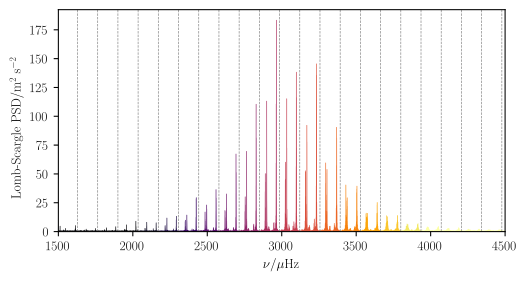
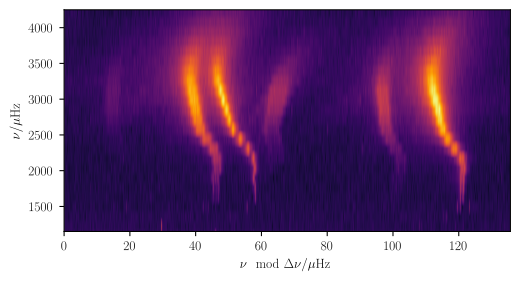
Power spectra of MDI dopplergrams

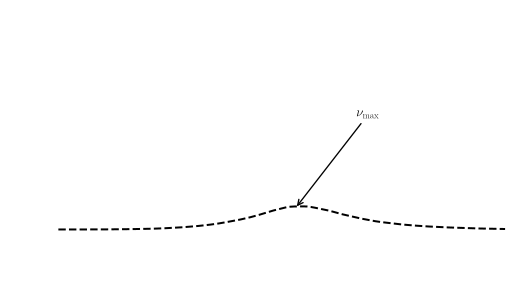
\[ \begin{aligned} {\Delta\nu_\odot} &\sim 135\ \mathrm{\mu Hz} \\ {\nu_{\text{max},\odot}} &\sim 3090\ \mathrm{\mu Hz} \end{aligned} \]

(roughly 5-minute oscillations)

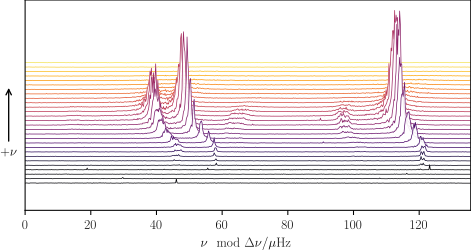
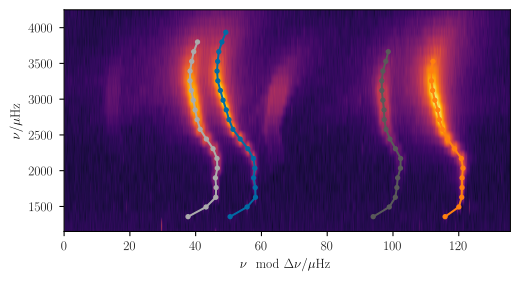
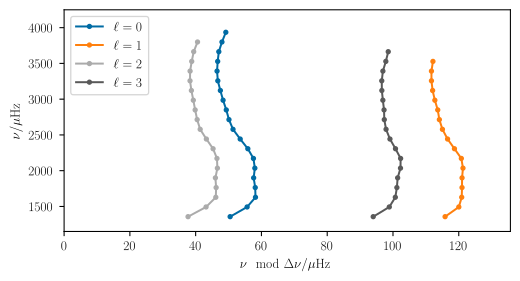
p-mode frequencies satisfy \(\nu_{n\ell} \sim \Delta\nu\left(n + {\ell \over 2} + \epsilon_\ell(\nu)\right) + \mathcal{O}(1/\nu)\)

Stochastic,
broad-band
excitation

Helioseismology: Greatest Hits

  • Solar Neutrino Problem (Nobel!)
  • How do stars work??
  • Rotational Structure
  • Solar Abundance Problem
  • Far-side imaging (helioseismic holography)

\[\vdots\]

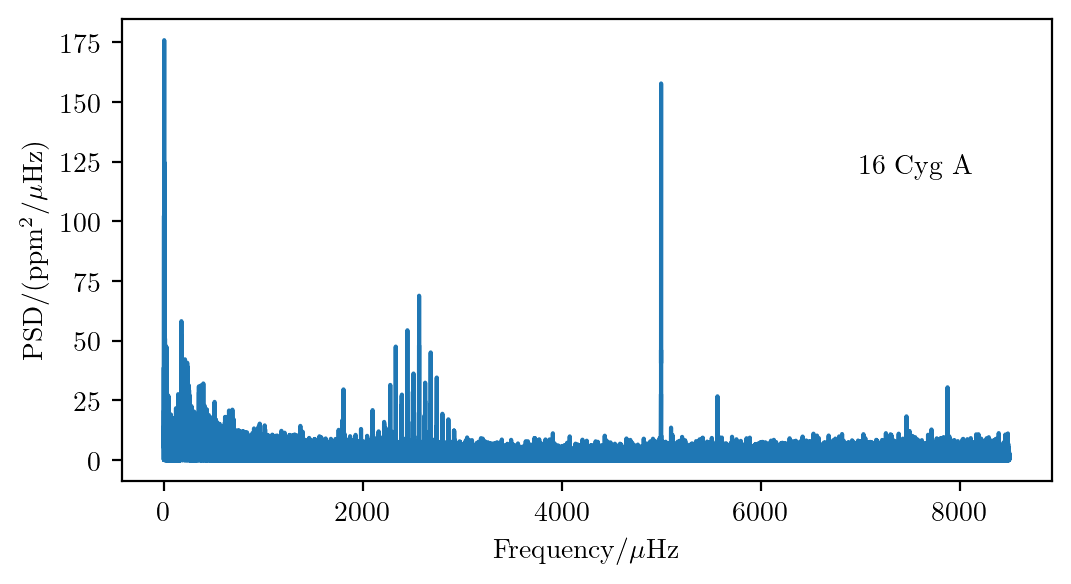
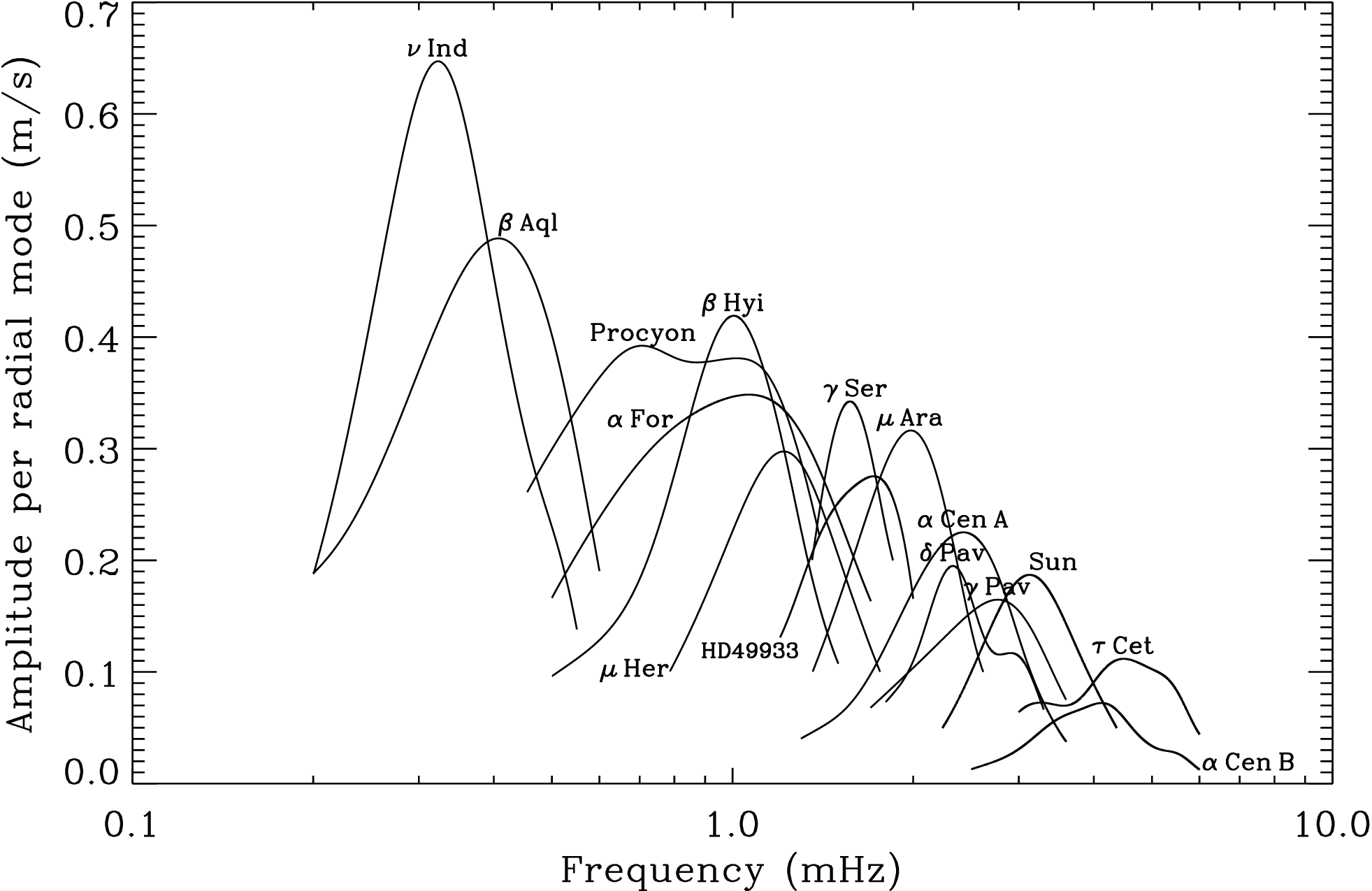
Solar-like oscillators from 1995 onwards: n = 15; from Arentoft+ (2008)

Telescopes can only point at one star at time…
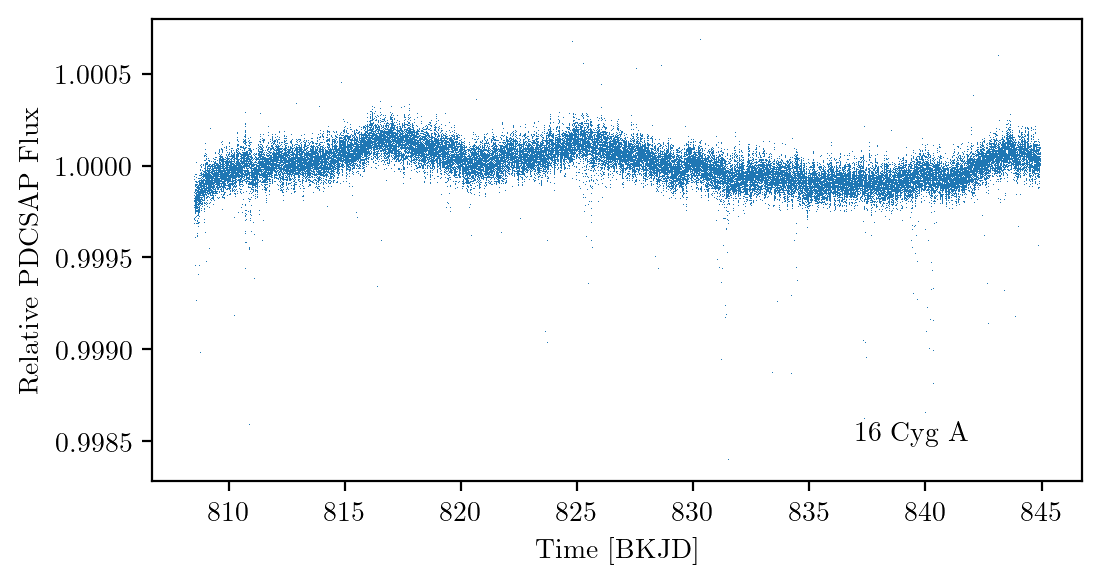
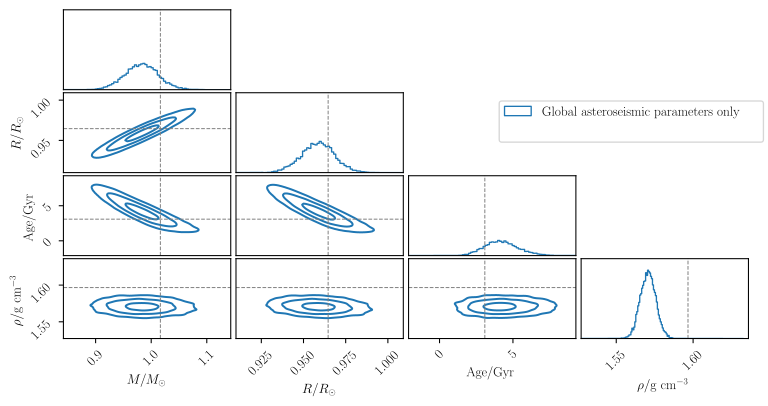
…and not all interesting stars are bright.

Required photometric stability not achievable from ground
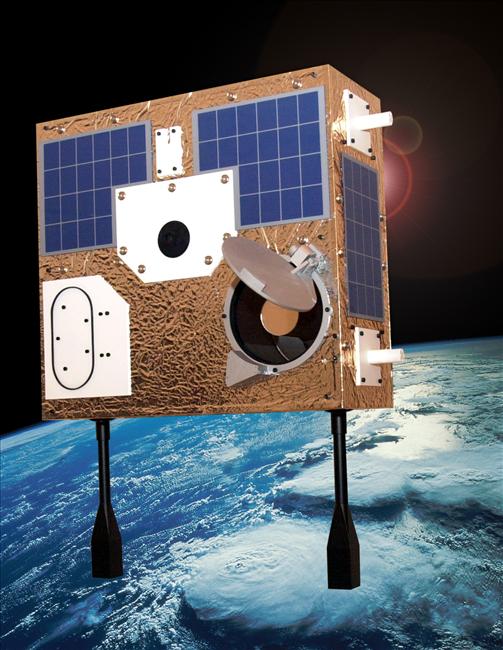
MOST (2003-2014)
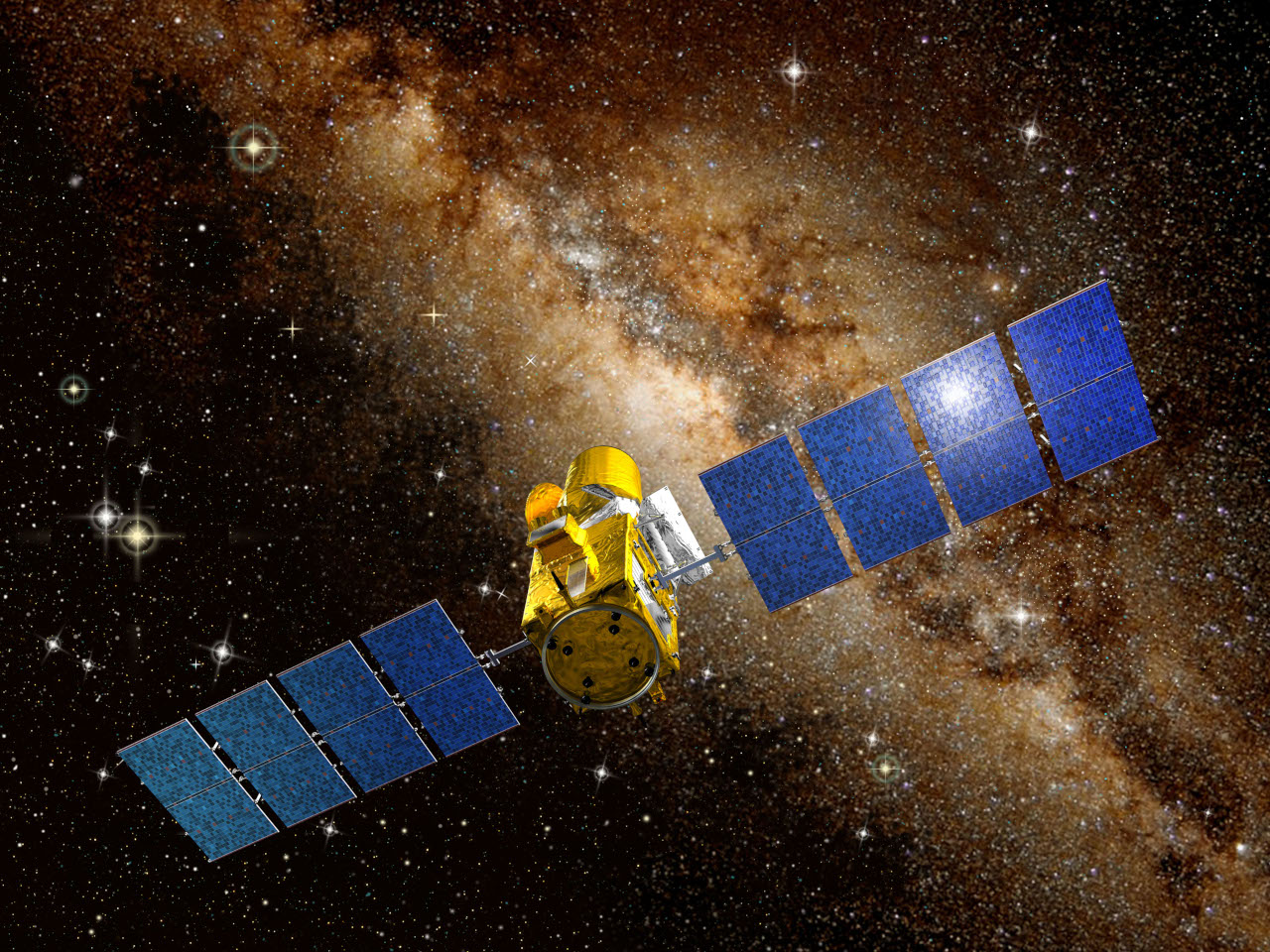
CoRoT (2006-2013)
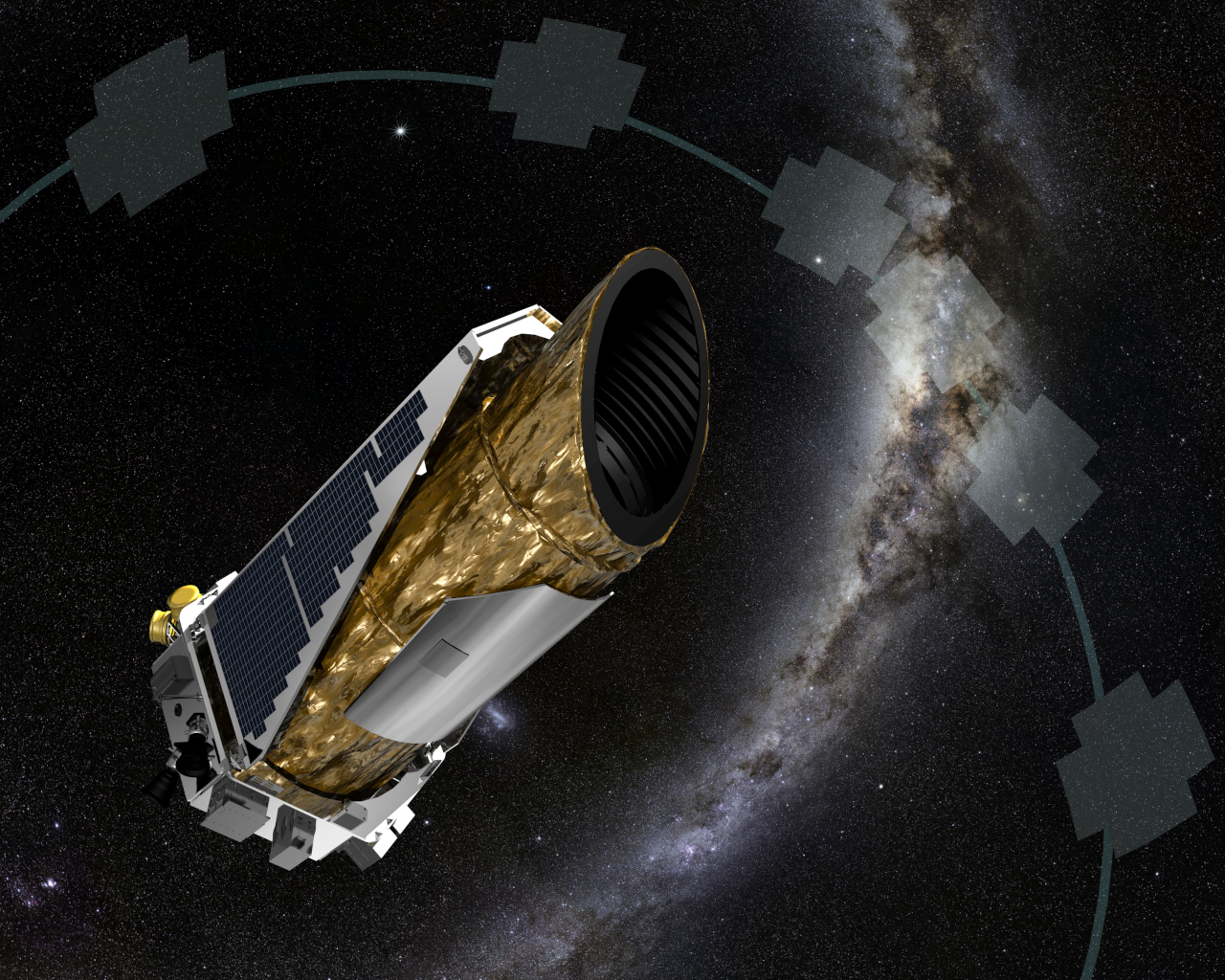
Kepler & K2 (2009-2016)
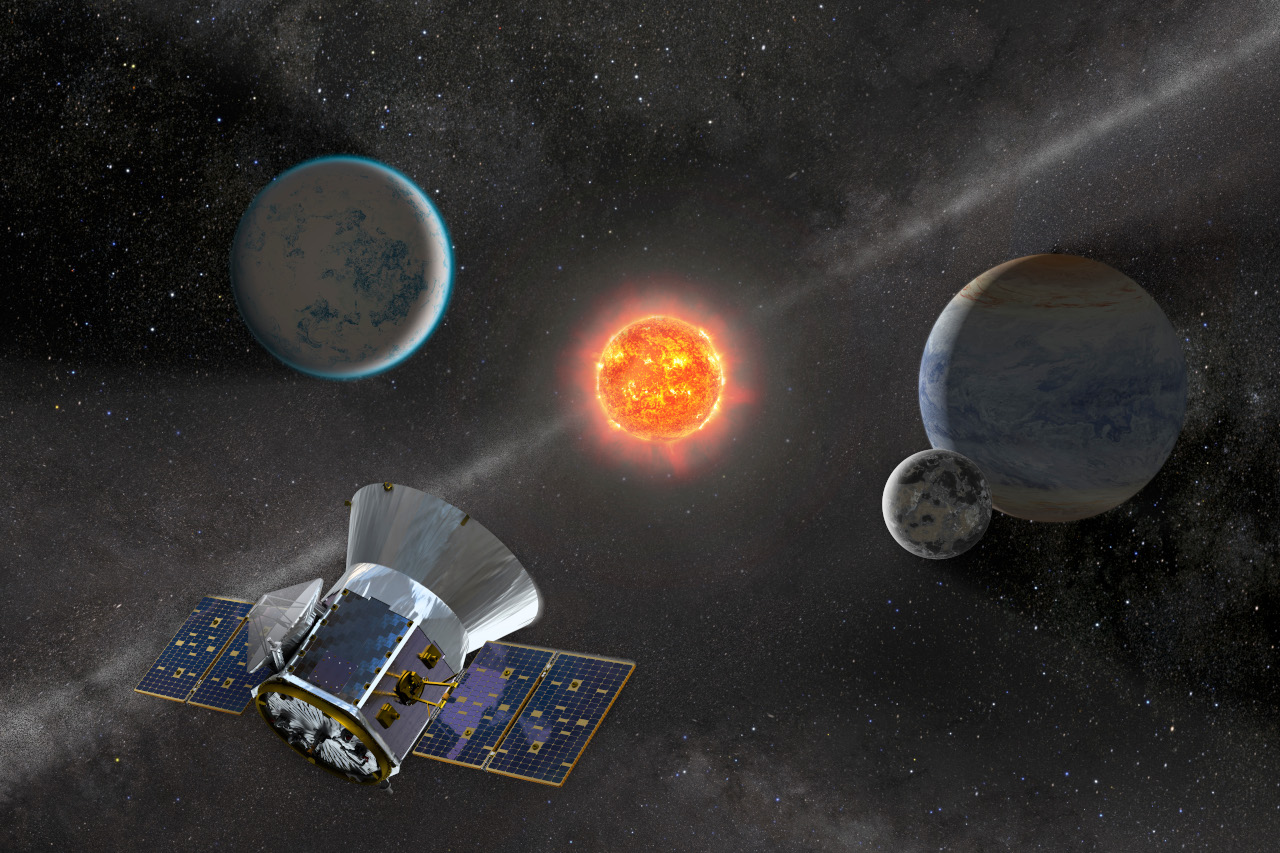
TESS (2018—)

II.
The Asteroseismic Revolution
Seismology as a Tool

3 Main Uses:

  • Fundamental Properties
  • Dynamic and Activity
  • Internal Structure

\[ \begin{aligned} {\Delta\nu} & \sim 1/t_\text{cross} \sim \sqrt{M/R^3}\\ {\nu_{\text{max}}} &\sim{g/c_s} \sim {M/R^2\sqrt{T_\text{eff}}} \end{aligned} \]

\[V_\text{osc} \sim L / M\]

Global Properties give Masses and Radii

\[ \begin{aligned} {\Delta\nu} &\sim \sqrt{M/R^3}\\ {\nu_{\text{max}}} &\sim {M/R^2\sqrt{T_\text{eff}}} \end{aligned} \]

\[ \begin{aligned} {M \over M_\odot} &\sim \left(\nu \over \nu_{\text{max},\odot}\right)^{3}\left(\Delta\nu \over \Delta\nu_\odot\right)^{-4} \left(T_\text{eff} \over T_{\text{eff},\odot}\right)^{3/2} \\ {R \over R_\odot} &\sim \left(\nu \over \nu_{\text{max},\odot}\right)\left(\Delta\nu \over \Delta\nu_\odot\right)^{-2} \left(T_\text{eff} \over T_{\text{eff},\odot}\right)^{1/2} \end{aligned} \]

(better scaling relations: Ong & Basu 2019a,b)

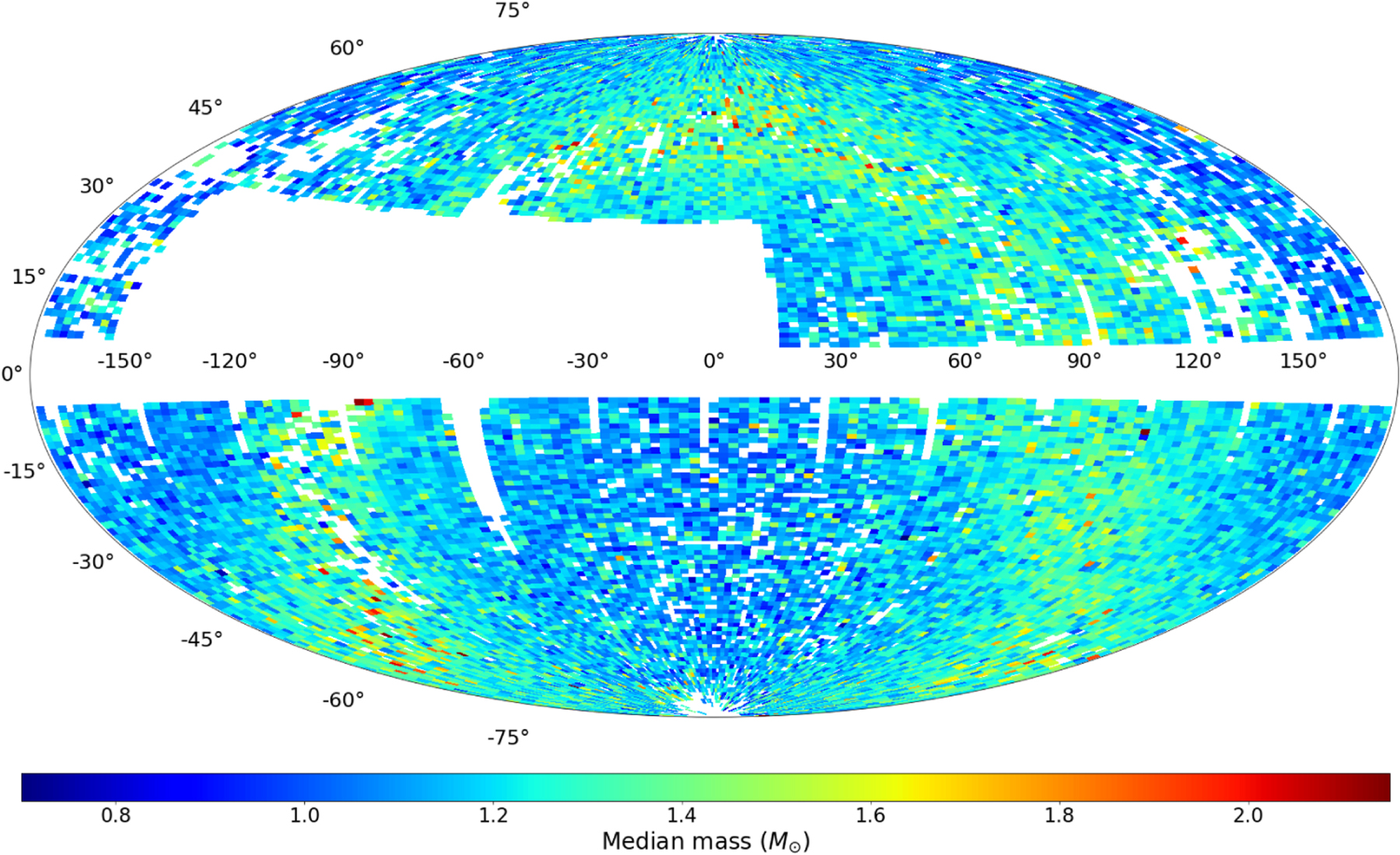
All-Sky Mass Mapping: Hon+ 2021

Modelling with Seismology gives Precision and Ages

Hare “Zebedee”, Cunha+ incl. Ong (2021);
HPC & pipeline: Ong+ 2021a

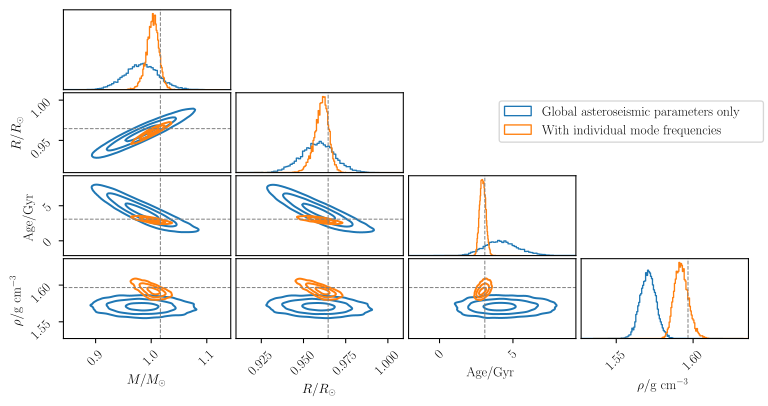
Precise measurements of field stars: \[ {\sigma_R \over R} \lesssim 2 \%;\ {\sigma_M \over M} \lesssim 5 \%;\ \sigma_\text{Age} \lesssim 0.4\ \mathrm{Gyr} \]

  • Fundamental Properties
  • Dynamics and Activity
  • Internal Structure

Multiplet Splittings give Rotation and Orientation

\[\begin{array}{c} {\scriptsize\text{Power}}\\ \big\uparrow \end{array}\]

\[\longrightarrow {\scriptsize\text{Frequency}}\]

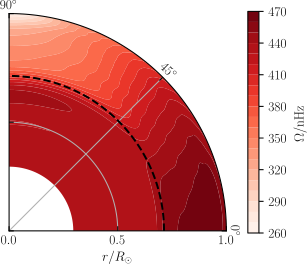
Many Multiplets give Internal Rotation

Rotational inversions constrain differential rotation

(e.g. Backus & Gilbert 1968; Gough 1985;
Pijpers & Thompson 1992; Schunker 2016;
Ong 2024 etc.)
  • Rapid Rotation \(\to\) Planet Engulfments
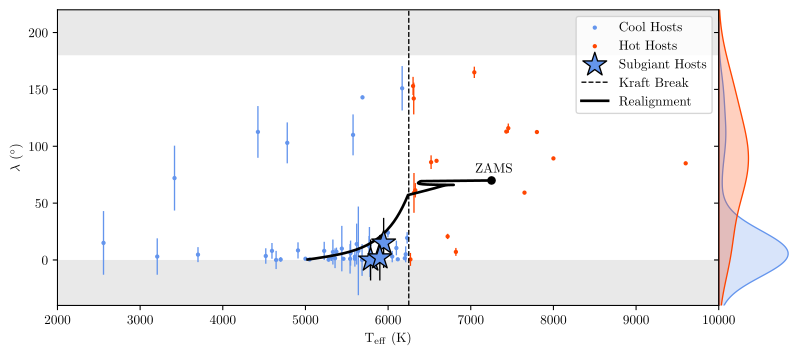
  • Spin-Orbit Misalignment
  • Rotational Shear \(\to\) Magnetic Dynamos

(e.g. Ong et al. 2024, Ong 2025)

  • Fundamental Properties
  • Dynamics and Activity
  • Internal Structure

Many Mode Frequencies constrain Structure

Probes of the internal states of stars … now return constraints on stellar structure previously only theorized. —Astro 2020
Decadal Survey

(e.g. Bellinger+ 2017,2019;Ong & Basu 2019a,b;
Lindsay, Ong, Basu 2022, 2023, 2024;
Vanlaer+ 2023; Buchele+ 2024, 2025)

†: mentoree paper
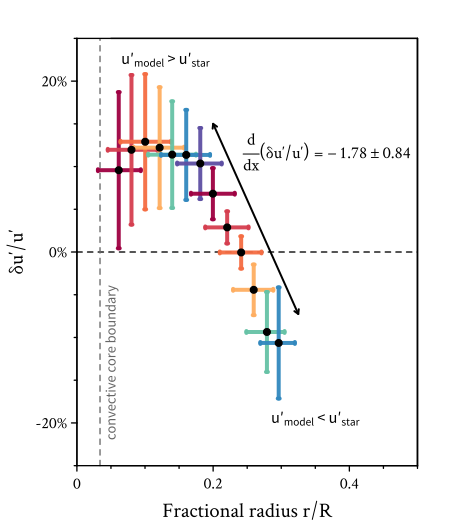
Bellinger+ 2019

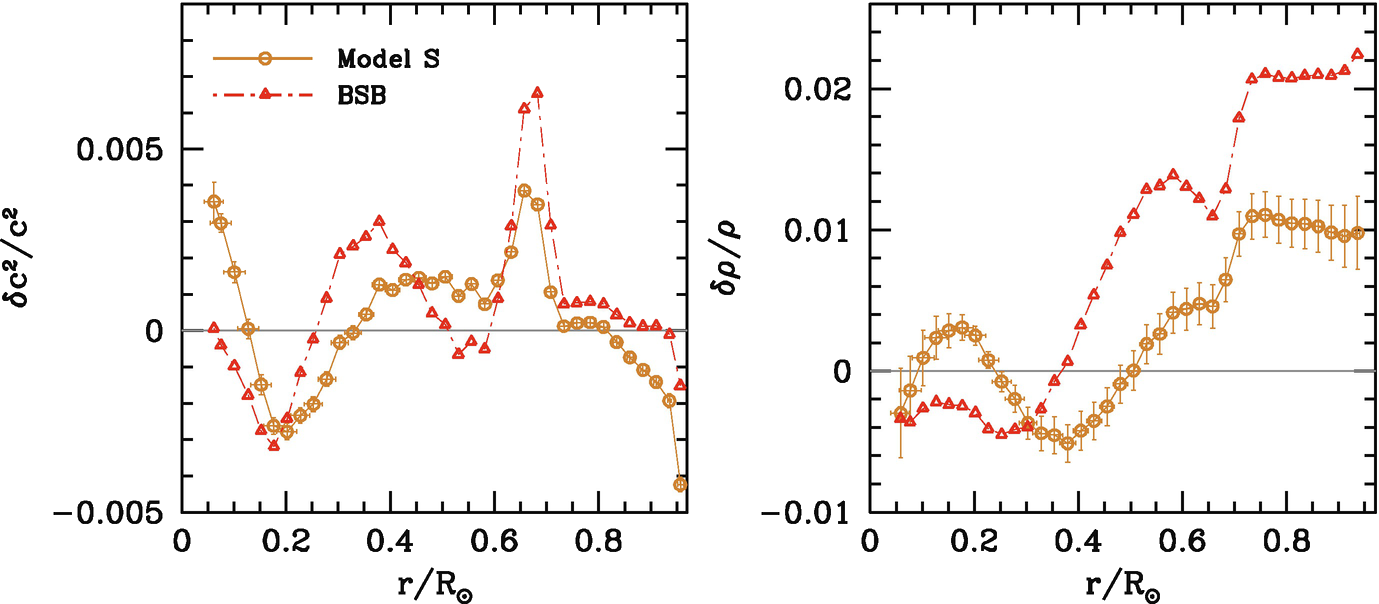
Relative difference in isothermal sound speed

Summary

Asteroseismology is a low-investment
yet versatile conceptual instrument
that has revolutionised stellar metrology,
both global and local.

III.
The State of Play
Where do we go from here?

TESS (Ongoing)
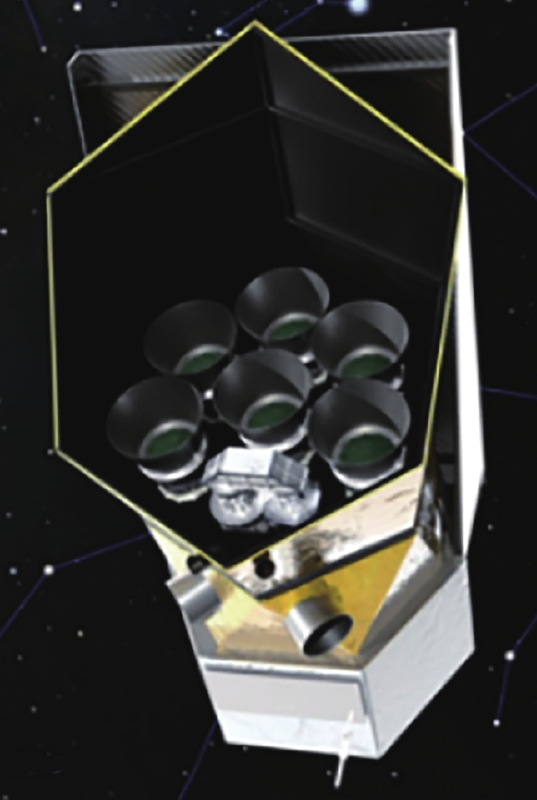
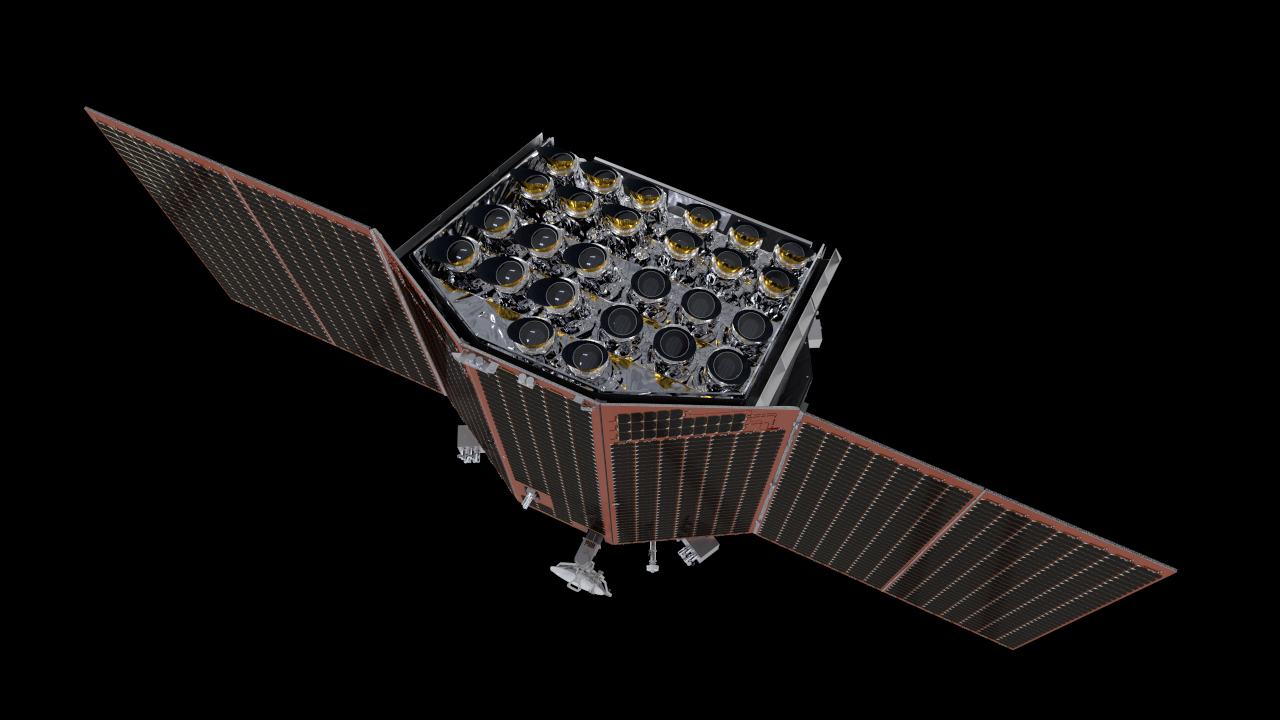
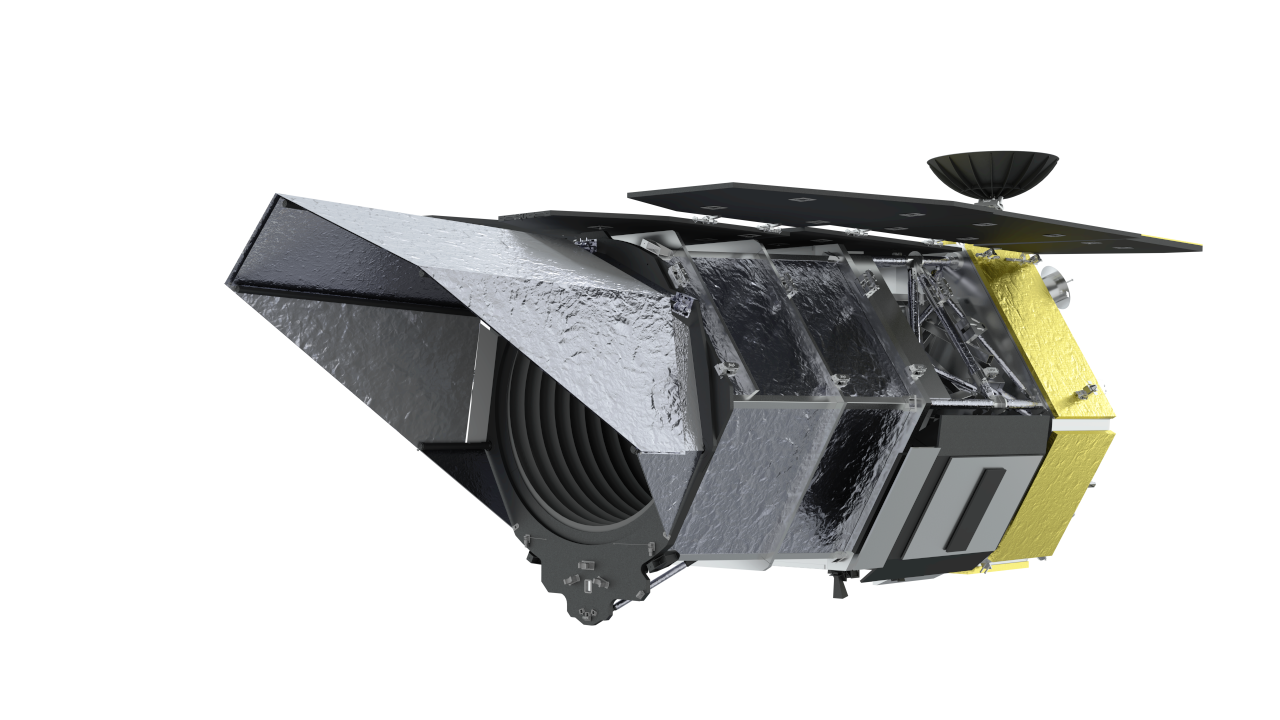
Earth 2.0: 2028 (Planned)
PLATO Mission: 2026 (Planned)
Roman: 2027 (Planned)

We are drowning in data.

More Data = More Problems

The Wrong Trousers: Park et al. 1993

big data deluge

physical interpretation

analytic theory
computational technique
statistical methodology

\[ {\large\textbf{Theory}} \longrightarrow \text{Single Stars} \longrightarrow \text{Populations} \longrightarrow \text{Astrophysics} \]

Technique
Development

Interpretation

Data Volume

Case Study: Post-Main-Sequence Pulsations

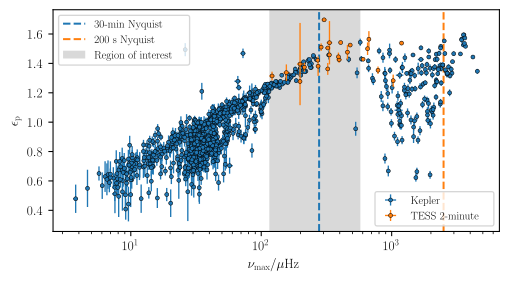
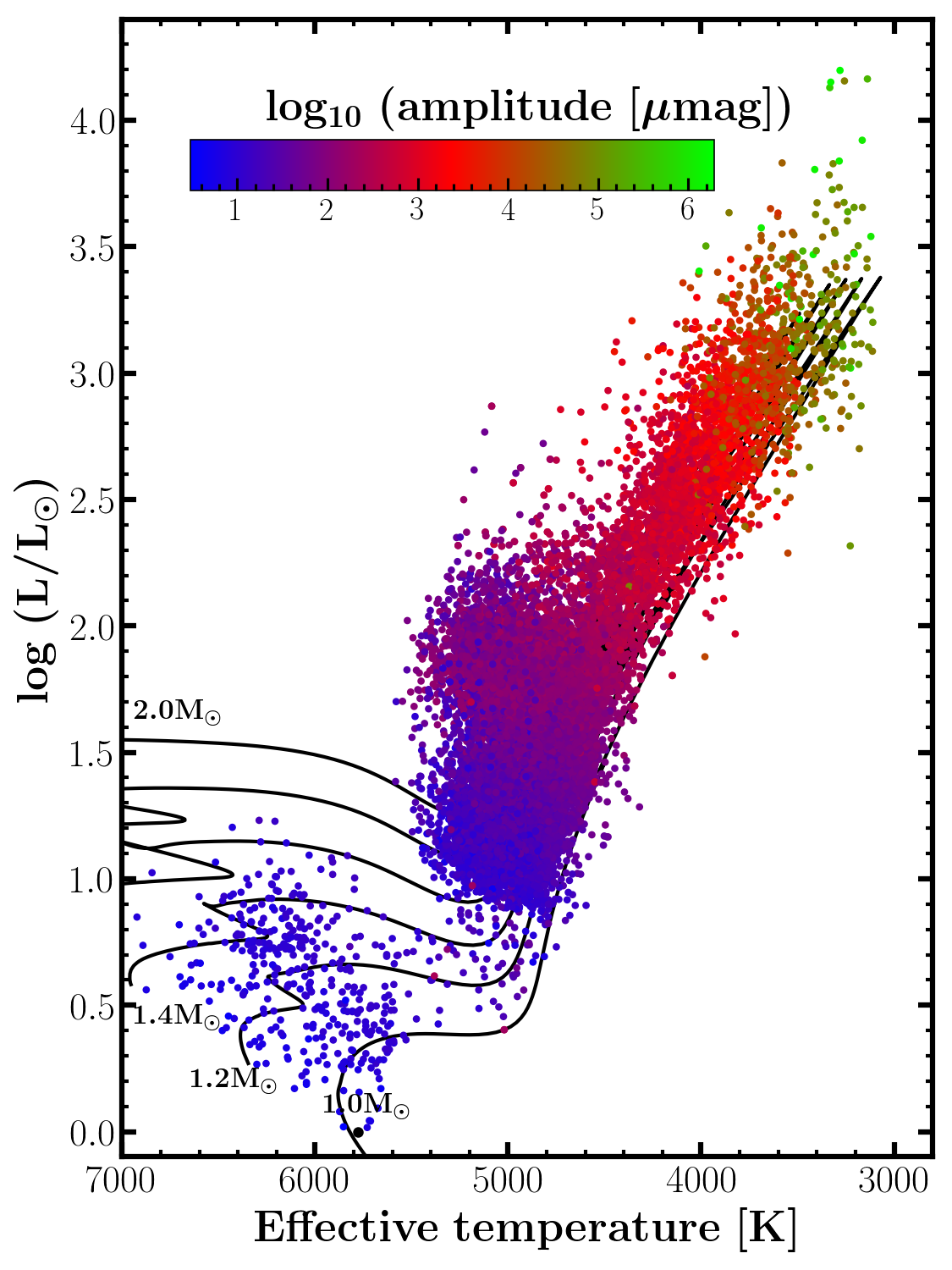
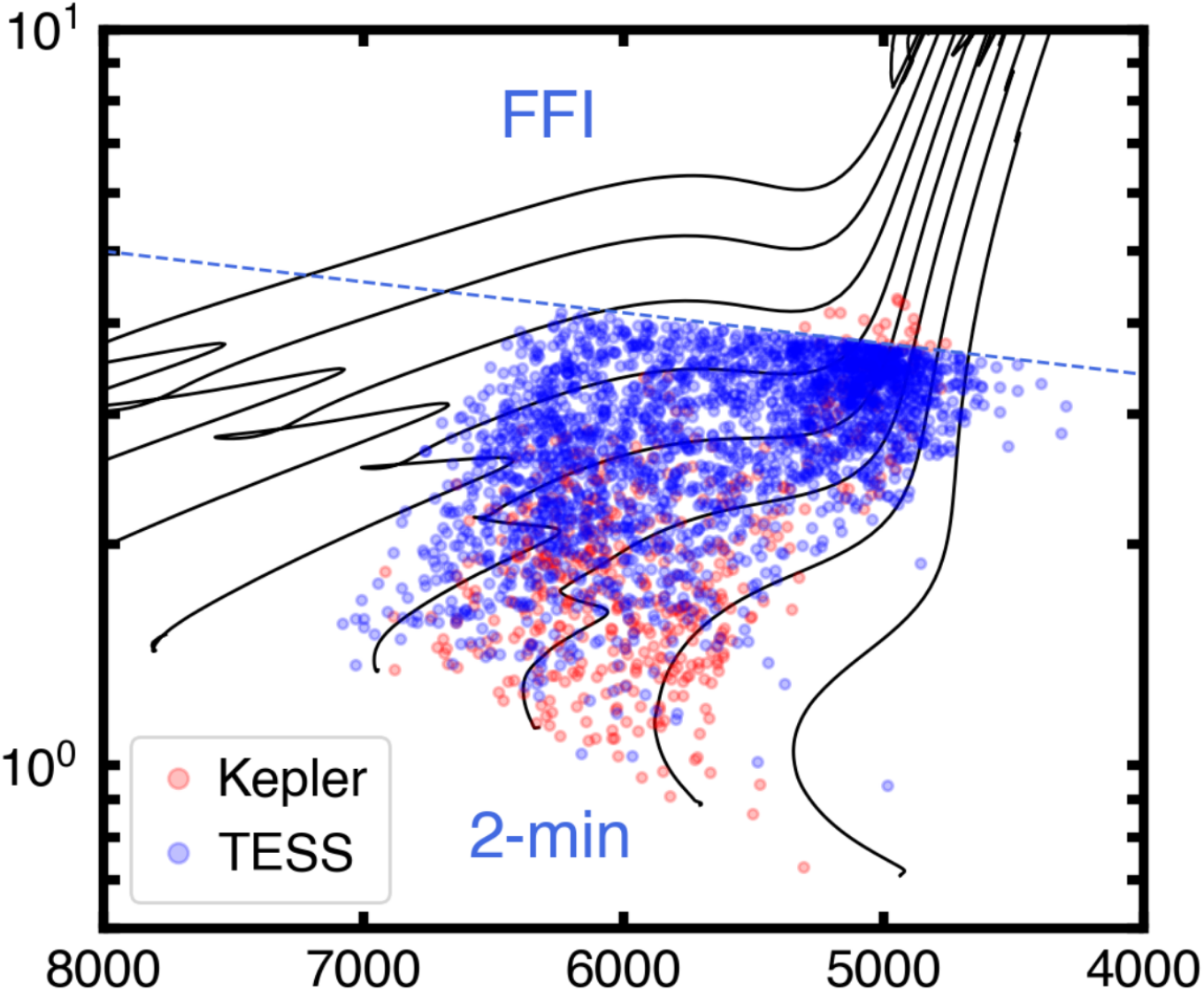
Evolved stars dominate our asteroseismic sample.

(e.g. only \(\sim 100\) Kepler main-sequence stars)

\[\large V_\text{osc} \sim L/M\]

(from Yu+ 2020)
(from Schofield+ 2019)

\(T_\text{eff}/\mathrm{K}\)

\(R/R_\odot\)
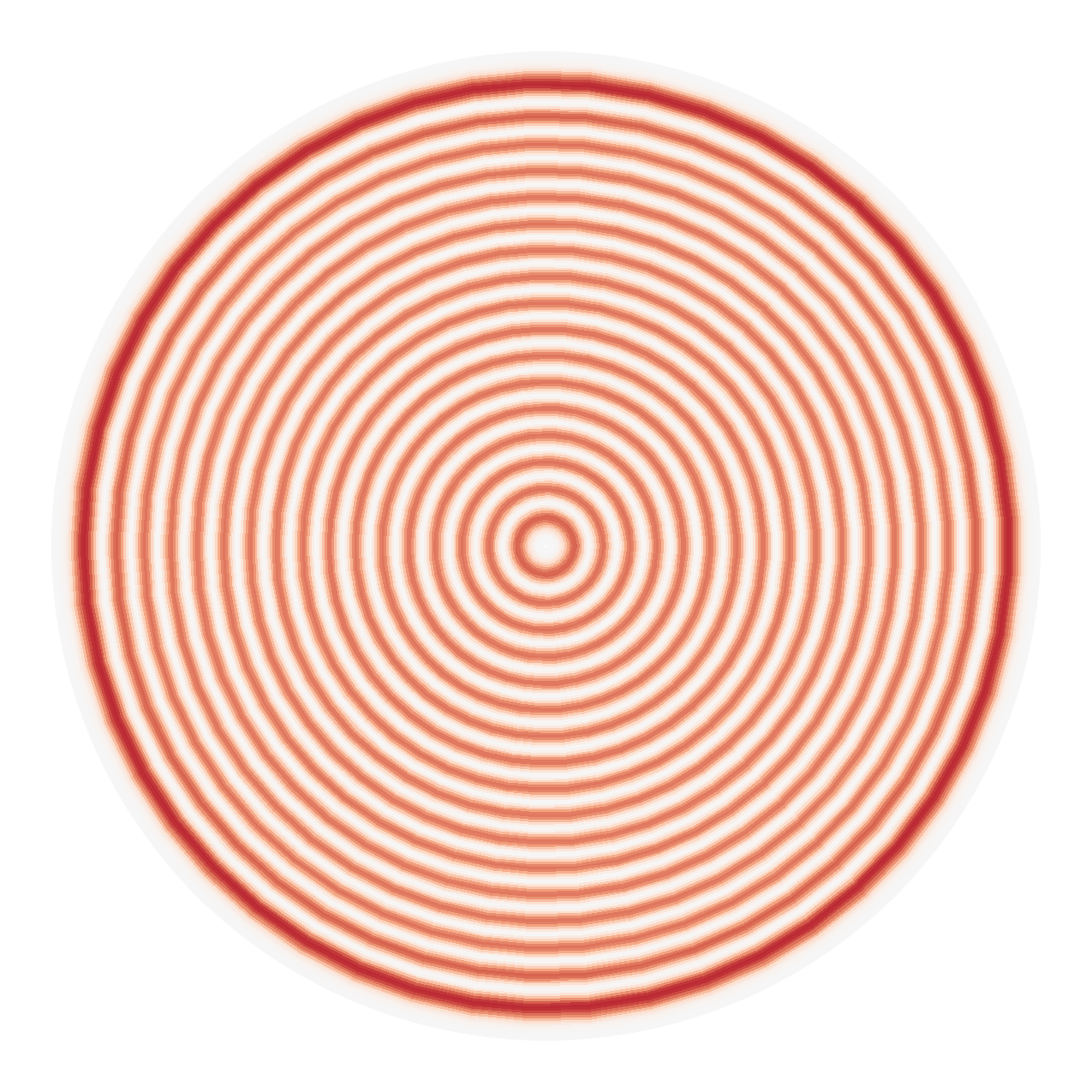
Pressure waves (p-modes)
propagate isotropically.

p-modes:
Characteristic overtone frequency spacing \(\Delta\nu\)

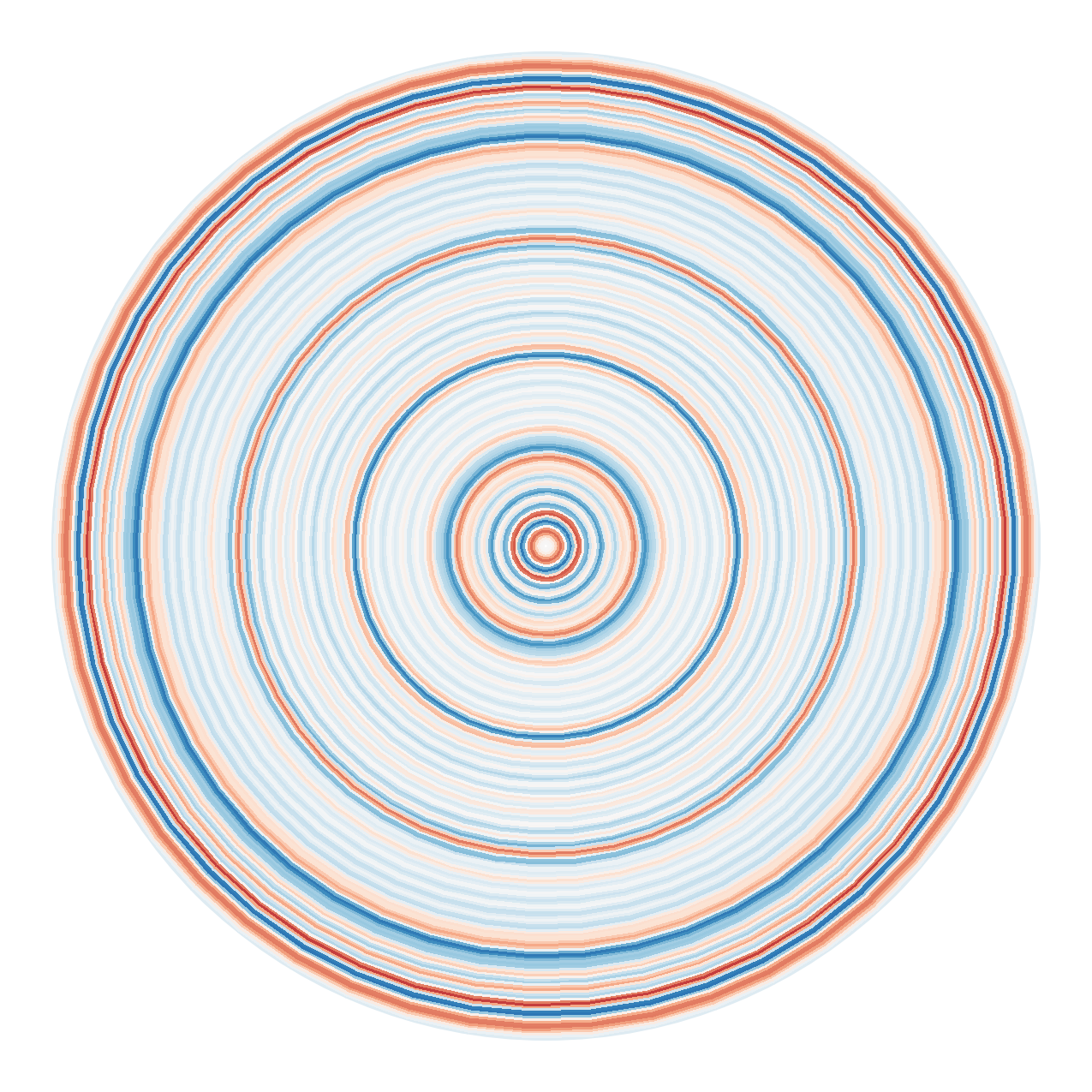
Buoyancy waves (g-modes)
propagate anisotropically.

g-modes:
Characteristic overtone period spacing \(\Delta\Pi_\ell\)

Mixed Modes: Evolutionary Diagnostics

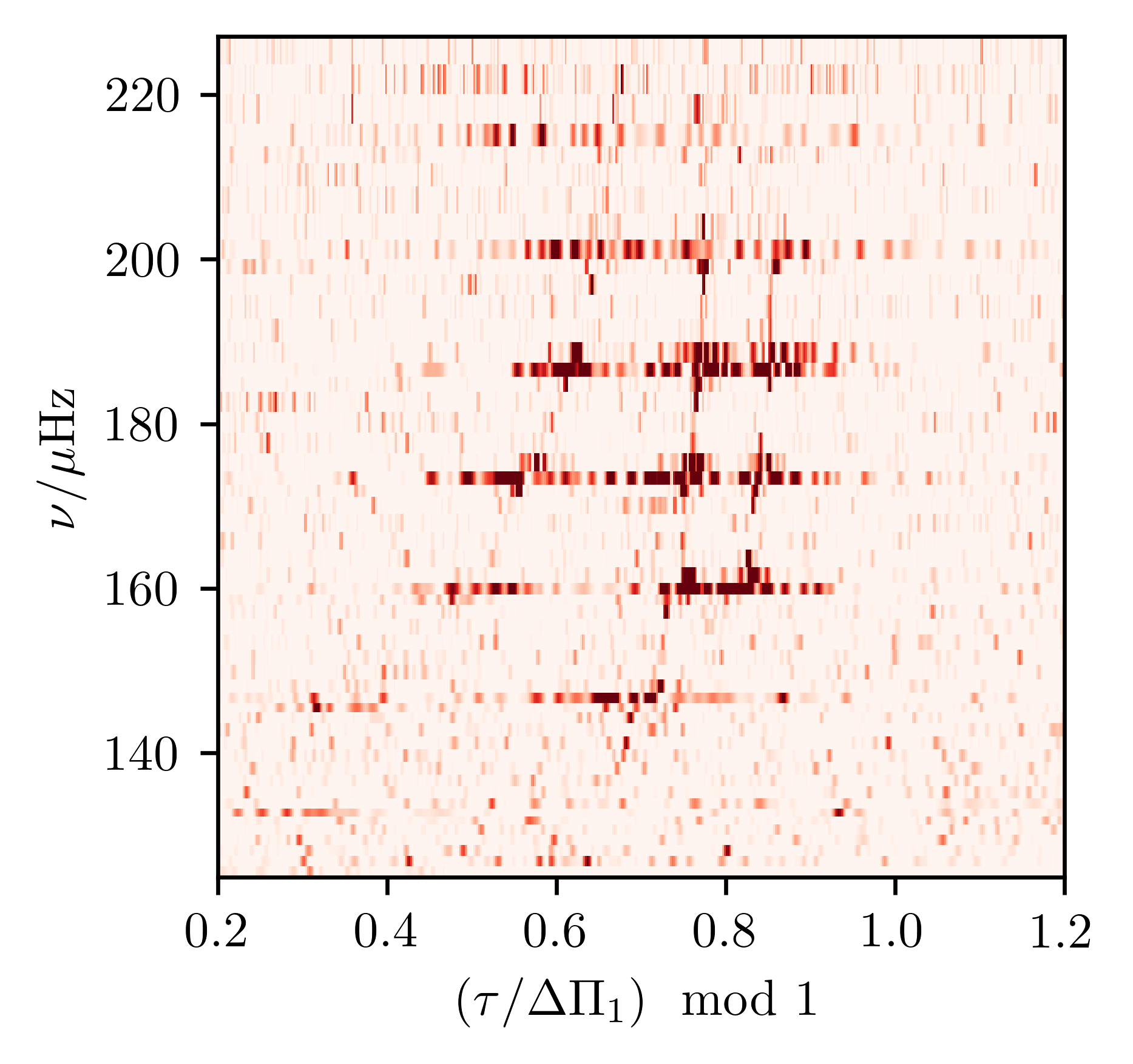
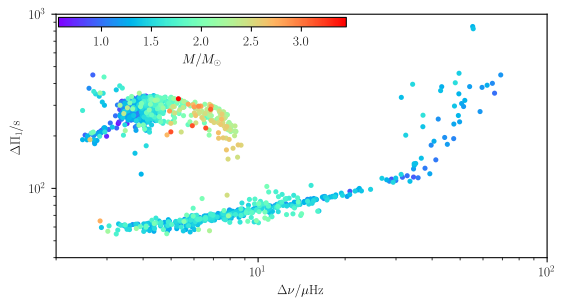
g-mode Period Spacing \(\Delta\Pi_1/\mathrm{s}\)

p-mode Frequency Spacing \(\Delta\nu/\mu\mathrm{Hz}\)

from Mosser+ (2014)

Single-star electron degeneracy sequence:
deviations → merger remnants?
(Rui and Fuller 2021, Deheuvels+ 2021)

clump stars

first-ascent RGs
\[\begin{array}{c} {\scriptsize\text{Power}}\\ \big\uparrow \end{array}\]

\[\longrightarrow {\scriptsize\text{Frequency}}\]

(proxy for age \(\to\))

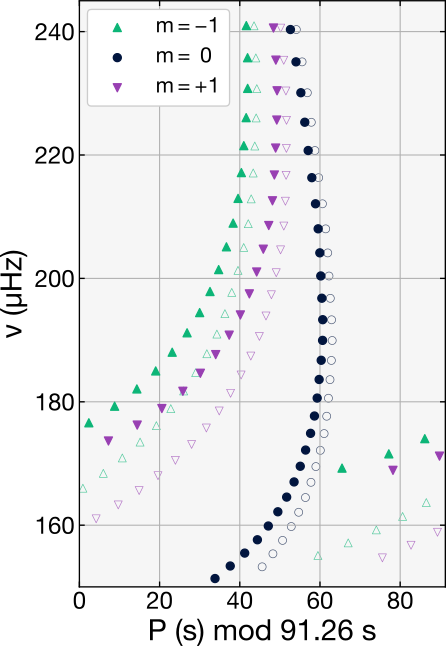
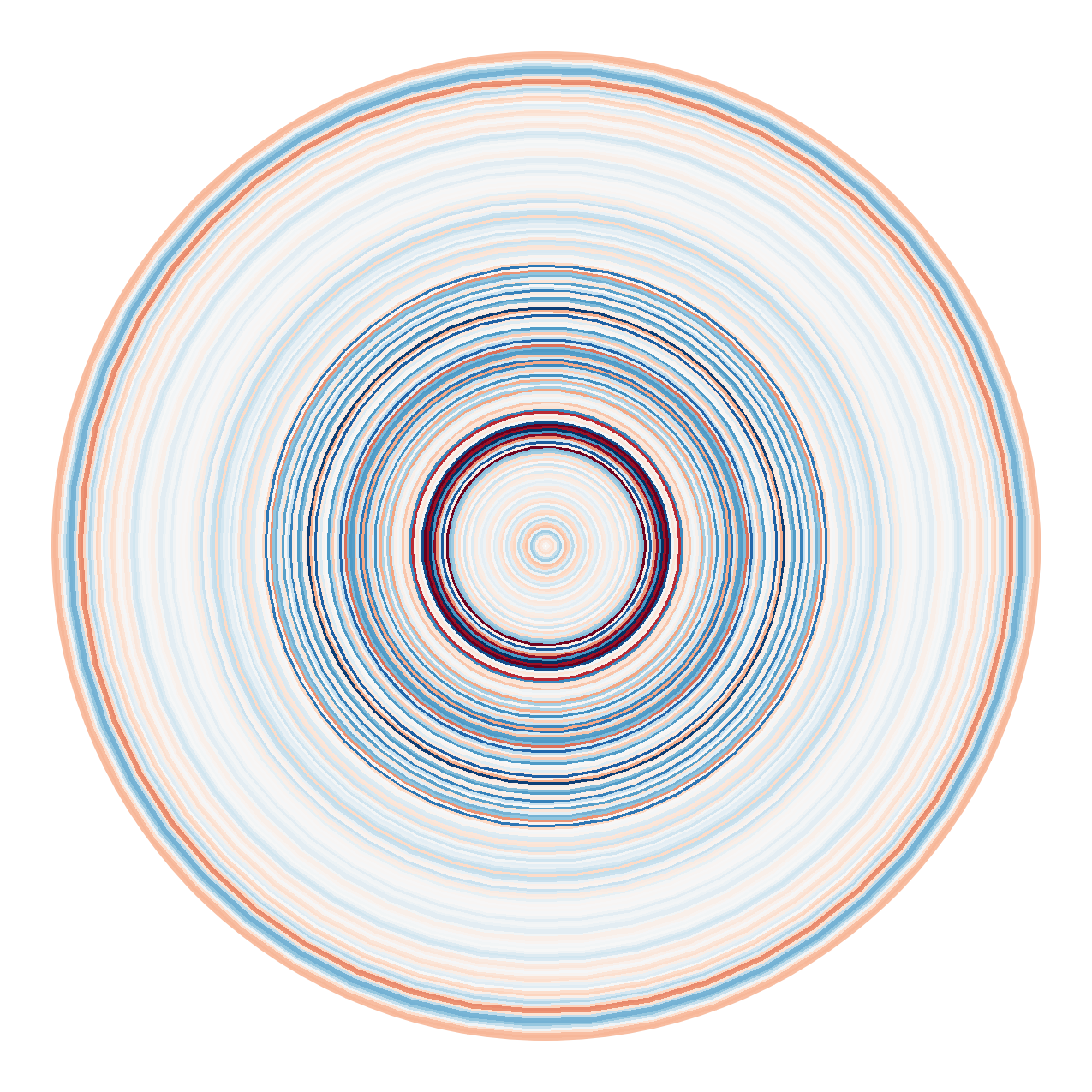
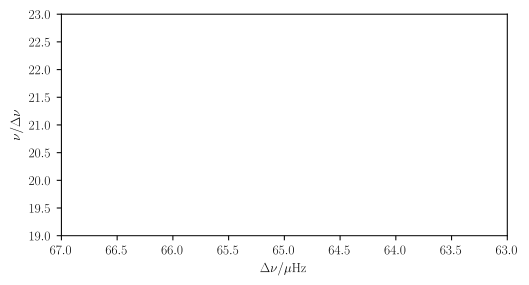
Mixed modes exhibit avoided crossings
between underlying p- and g-modes.

IV.
Theory and Technique
Case Study: Mixed-Mode Asteroseismology

A Crash Course in Wave Propagation:
The JWKB Approximation

Simple Wave Equation

\[\huge {\partial^2 \over \partial t^2}f(t, \mathbf{x}) = c_s^2 \nabla^2 f(t, \mathbf{x})\]

\[\huge -\omega^2 \hat{f}(\omega, \mathbf{k}) = -c_s^2 |\mathbf{k}|^2 \hat{f}(\omega, \mathbf{k})\]

Dispersion relation: \[\boxed{\huge \omega^2 = c_s^2 |\mathbf{k}|^2}\]

More Complicated Wave Equation

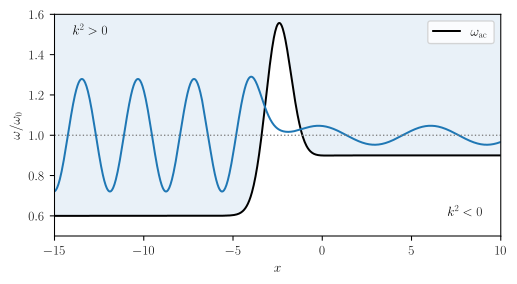
\[\huge {\partial^2 \over \partial t^2}f = \left(c_s^2 \nabla^2 - \omega^2_\text{ac}(\mathbf{x})\right) f\]

\[\huge \underbrace{-\nabla^2 f}_{\equiv k^2f} = -\left(\omega^2 - \omega^2_\text{ac}(\mathbf{x}) \over c_s^2\right) f\]

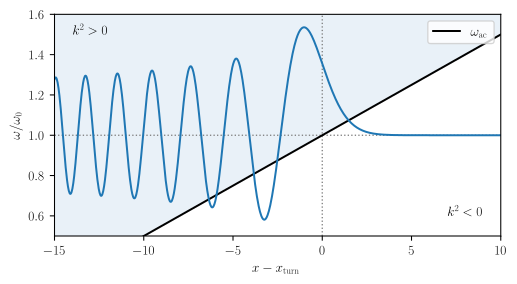
Wave propagates where \(k^2(r, \omega) > 0\),
and decays where \(k^2(r, \omega) < 0\).

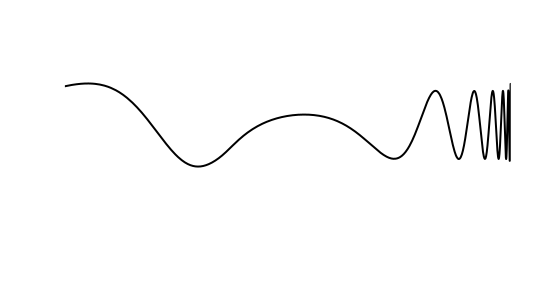
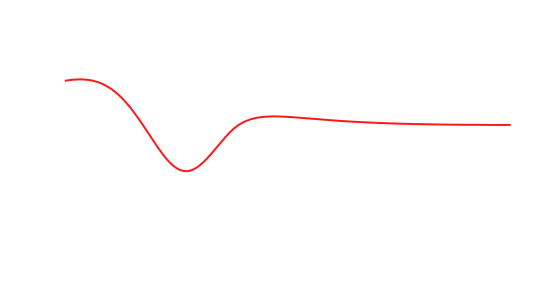
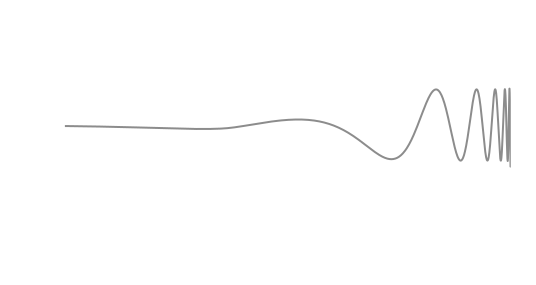
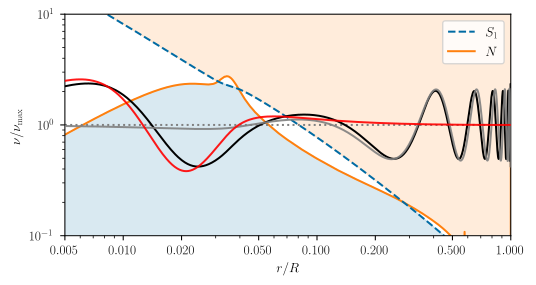
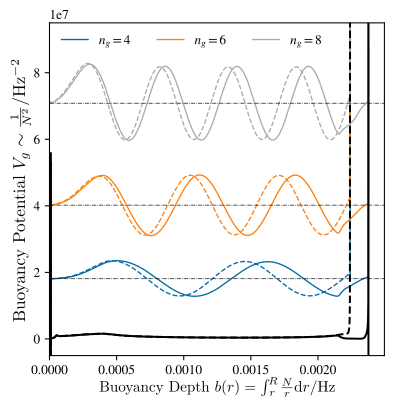
\[{c_s^2 k_r^2 \sim \omega^2 \left(1 - {{\color{blue} S_\ell}^2 \over \omega^2}\right)\left(1 - {{\color{darkorange}N}^2 \over \omega^2}\right)}\]

\[\small N^2 = {- g}\left.{\partial \log \rho \over \partial s}\right|_P{\mathrm d s \over \mathrm d r}\] entropy gradient (\(=0\) in CZ)

\[\small S_\ell^2 = c_s^2 k_h^2 = {\ell(\ell+1) c_s^2 \over r^2}\] wave angular momentum

\[\Large \omega_-^2 \sim N^2 {k_h^2 \over |\mathbf{k}|^2}\]

\[{\color{red} \omega_g < N, S_\ell}\]

\[\Large \omega_+^2 \sim c_s^2 |\mathbf{k}|^2\]

\[{\color{gray} \omega_p > S_\ell, N}\]

Brute-force numerical solution (quantitative)
vs
JWKB approximation (qualitative)
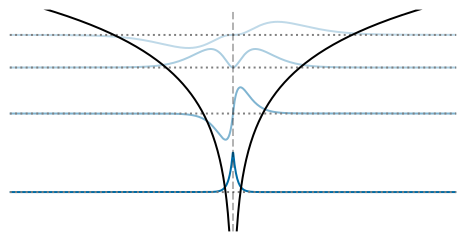
Can we apply physical insights in the field?

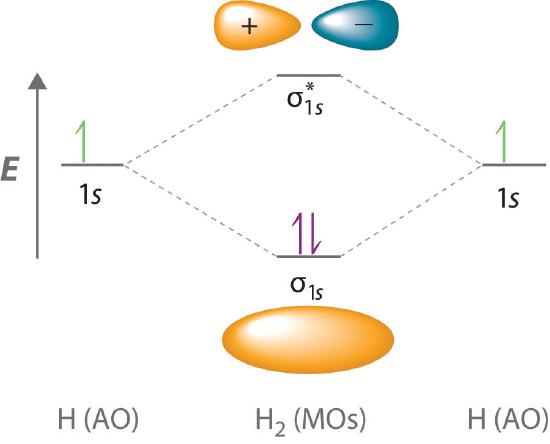
I stole this from a chemistry textbook

\[\Large \hat H \left|n\right> = \left(\hat T + \hat V\right)\left|n\right> = E_n \left|n\right>\]
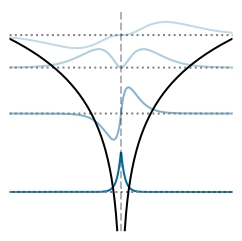
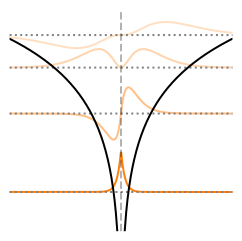
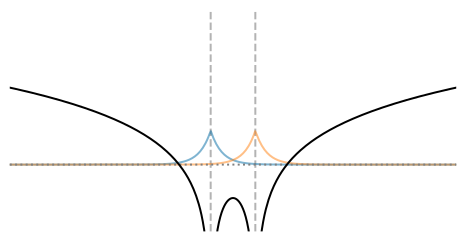
\[\large {\color{blue}{\hat H_1}} \left|n\right> = \left(\hat T + \hat V_1\right)\left|n\right> = {\color{blue}E_n \left|n\right>}\]

\[\large {\color{orange}{\hat H_2}} \left|n\right> = \left(\hat T + \hat V_2\right)\left|n\right> = {\color{orange}E_n \left|n\right>}\]

\[\huge \hat H = \hat T + \hat V_1 + \hat V_2 = {\color{blue}{\hat H_1}} + \hat V_2 = \hat V_1 + {\color{orange}{\hat H_2}}\]
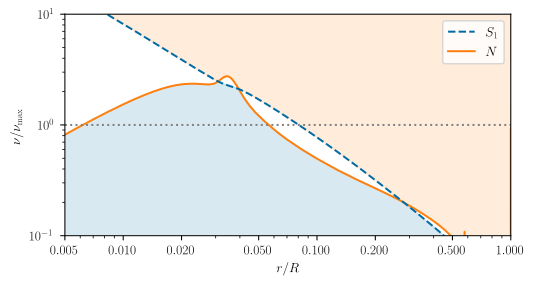
Energies and Mixing Coefficients
of Molecular Orbitals

\[\left|\psi_\text{mol}\right> = {\color{blue}\sum_i c_{1,i}\left|\psi_{1,i}\right>} + {\color{orange}\sum_j c_{2,j}\left|\psi_{2,j}\right>}.\]

Energy eigenvalues and mixing coefficients are solutions to the
Generalised Hermitian Eigenvalue Problem

\[ \mathbf{H} \begin{bmatrix} {\color{blue}\mathbf{c}_1} \\ {\color{orange}\mathbf{c}_2} \end{bmatrix} = E \cdot \mathbf{D} \begin{bmatrix} {\color{blue}\mathbf{c}_1} \\ {\color{orange}\mathbf{c}_2} \end{bmatrix} \] \[ \small H_{{\color{blue}i}{\color{orange}j}} = \langle {\color{blue}\psi_i}|\hat{H}|{\color{orange}\psi_j}\rangle;~~~~D_{{\color{blue}i}{\color{orange}j}} = \langle {\color{blue}\psi_i}|{\color{orange}\psi_j}\rangle \]

\[\Large \hat{\mathcal{L}} \xi_n = -\omega_n^2 \xi_n\]

\[\Large \hat{\mathcal{L}} = {\color{red}\hat{\mathcal{L}}_\gamma} + \hat{\mathcal{R}}_\gamma\]

\[\Large {\color{red}\hat{\mathcal{L}}_\gamma \xi_{\gamma,n} = -\omega^2_{\gamma,n}\xi_{\gamma,n}}\]

\[\Large \hat{\mathcal{L}} = \hat{\mathcal{R}}_\pi + {\color{grey}\hat{\mathcal{L}}_\pi}\]

\[\Large {\color{grey}\hat{\mathcal{L}}_\pi \xi_{\pi,n} = -\omega^2_{\pi,n}\xi_{\pi,n}}\]

\[\Large \hat{\mathcal{L}} = {\color{grey}\hat{\mathcal{L}}_\pi} + \hat{\mathcal{R}}_\pi = \hat{\mathcal{R}}_\gamma + {\color{red}\hat{\mathcal{L}}_\gamma}\]

\[\Large \xi_\text{mixed} \sim {\color{grey}c_\pi \xi_\pi} + {\color{red}c_\gamma \xi_\gamma}\]

Mixed Modes as
Acoustic “Molecular Orbitals”

\[\xi_\text{mixed} \sim {\color{grey} \sum_i c_{\pi, i} \xi_{\pi,i}} + {\color{red} \sum_j c_{\gamma, j} \xi_{\gamma,j}}\]

Mixed mode frequencies and mixing coefficients can likewise be found by solving the
Generalised Hermitian Eigenvalue Problem:
\[ \scriptsize \begin{bmatrix} {\color{grey}\mathbf{L}_{\pi\pi}} & \mathbf{L}_{\pi\gamma} \\ \mathbf{L}_{\pi\gamma}^T & {\color{red}\mathbf{L}_{\gamma\gamma}} \end{bmatrix} \begin{bmatrix} {\color{grey}\mathbf{c}_\pi} \\ {\color{red}\mathbf{c}_\gamma} \end{bmatrix} = -\omega^2 \begin{bmatrix} \mathbb{1} & \mathbf{D} \\ \mathbf{D}^T & \mathbb{1} \end{bmatrix} \begin{bmatrix} {\color{grey}\mathbf{c}_\pi} \\ {\color{red}\mathbf{c}_\gamma} \end{bmatrix}. \] \[ \small L_{{\color{grey}i}{\color{red}j}} = \langle {\color{grey}\xi_i}, \hat{\mathcal{L}}{\color{red}\xi_j}\rangle;~~~~D_{{\color{grey}i}{\color{red}j}} = \langle {\color{grey}\xi_i}, {\color{red}\xi_j}\rangle \]

(Ong & Basu 2020; Ong & Gehan 2023; Ong 2025)

State of the art for determining (sub)giant structure and properties (Ong+ 2021a, b, c),
and internal rotation (Ong+ 2022; Ong 2024, 2025).

We know more about giant cores
than about the core of our own Sun!

  • Fundamental Properties ✔️
  • Dynamics and Activity
  • Internal Structure
  • Rotational Shear \(\to\) Magnetic Dynamos
  • Spin-Orbit Misalignment
  • Rapid Rotation \(\to\) Planet Engulfments

(e.g. Ong et al. 2024, Ong 2025)

\[\begin{array}{c} {\scriptsize\text{Power}}\\ \big\uparrow \end{array}\]

\[\longrightarrow {\scriptsize\text{Frequency}}\]

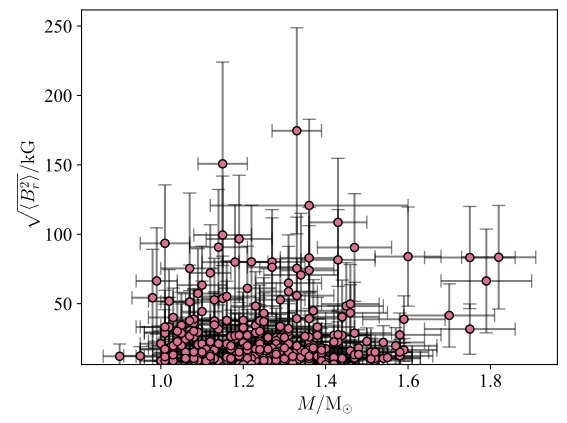
g-modes: Core Magnetism

Li et al. Nat. 2022:
Asymmetric splittings probe
core magnetic fields

(Li+ 2023, Deheuvels+ 2023;
Rui, Ong, Mathis, 2024)

Population studies
of rotation vs. magnetism

(Hatt, Ong, et al., 2024)

\[\scriptsize \delta \nu_{\text{mag}, g, \ell=1} \sim {m^2 \over \nu^3}\]

†: mentoree paper
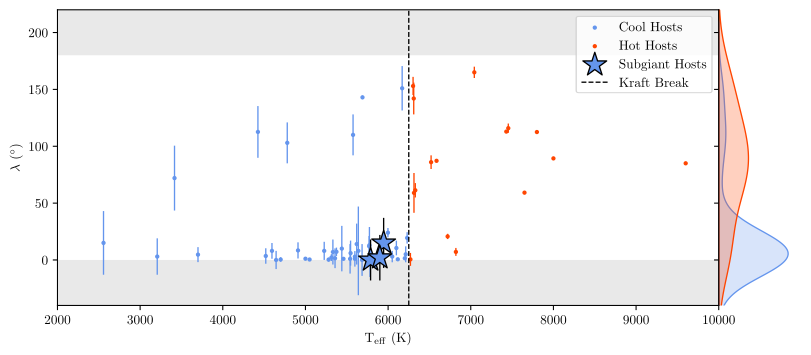
  • Rotational Shear and Magnetic Dynamos
  • Spin-Orbit Misalignment
  • The Star-Planet Connection

  • Stars tend to have (and interact with) companions: binaries, planetary systems, engulfments…
  • Seismic rotational measurements indicate anomalies?

Saunders et al. 2024

  1. \(\forall \ell, \exists (2\ell + 1) \times (2\ell + 1)\) matrices
    \(\mathbf{J}_x^\ell\), \(\mathbf{J}_y^\ell\), \(\mathbf{J}_z^\ell\) satisfying commutation relations
    \(\left[\mathbf{J}_i, \mathbf{J}_j\right] = -i\epsilon_{ijk}\mathbf{J}_k\), with
    \(\mathbf{J}_z \hat{=} \mathrm{diag}(-\ell, -\ell + 1 \ldots \ell - 1, \ell).\)

for \(\ell = 1,\)

\[\small\mathbf{J}_x \hat{=} {1 \over \sqrt{2}}\begin{bmatrix}0 & 1 & 0 \\ 1 & 0 & 1 \\ 0 & 1 & 0\end{bmatrix}; \mathbf{J}_y \hat{=} {1 \over \sqrt{2}}\begin{bmatrix}0 & i & 0 \\ -i & 0 & i \\ 0 & -i & 0\end{bmatrix}; \mathbf{J}_z \hat{=} \begin{bmatrix}-1 & 0 & 0 \\ 0 &0 &0 \\ 0& 0 &1\end{bmatrix}.\]

  1. For fixed \(m\) (to leading order):

\[\left(-\mathbf{\Omega}_0^2 + 2 \omega m \mathbf{R} + \omega^2 \mathbf{\Delta}\right)\mathbf{c} = 0\]

For fixed \(n\) (to leading order):

\[(-\omega_0^2 \mathbb{1}_{2\ell+1} + 2 \omega \mathbf{J}_z R_{n,n} + \omega^2 \mathbb{1}_{2\ell+1})\mathbf{y} = 0\]

  1. Under separation of variables, \[\vec{\xi}_{n\ell m}(r, \theta, \varphi) = \vec{\xi}_{n\ell}(r) Y_\ell^m(\theta, \phi) \iff \underbrace{\tilde{R}_{n, n', m, m'} = R_{n,n'} J_{m,m'}}_{\text{this is a }\textbf{tensor product}!}\]

\[\implies \left(-\mathbf{\Omega_0}^2 \otimes \mathbb{1}_{2\ell+1} + 2 \omega \underbrace{\mathbf{R} \otimes \mathbf{J}_z}_{\tilde{\mathbf{R}}} + \omega^2 \mathbf{\Delta} \otimes \mathbb{1}_{2\ell+1}\right)\mathbf{x} = 0\]

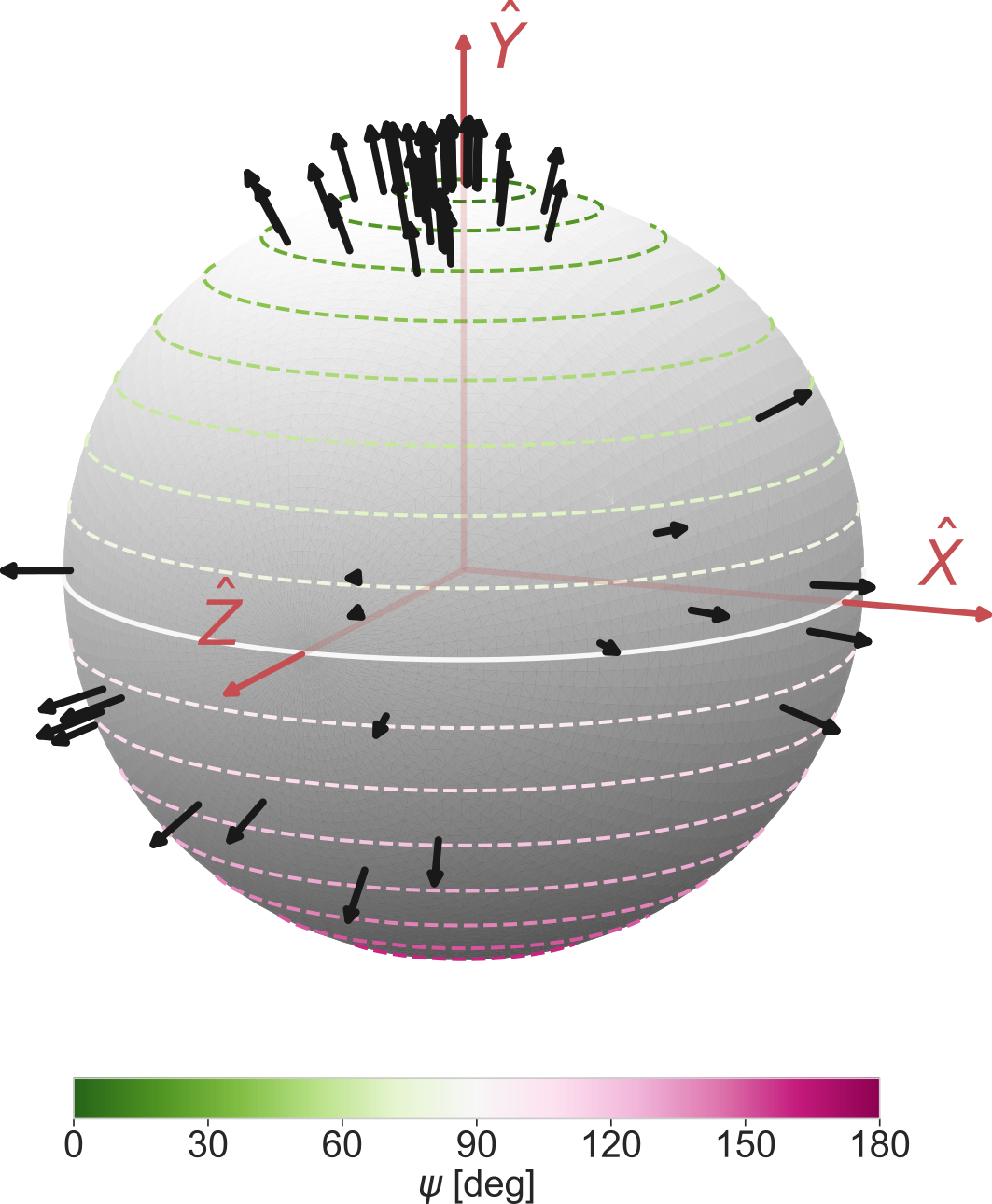
  1. Let’s associate with each mass shell at \(r\) both \(\Omega(r)\)
    (as is customary), and also a rotational axis
    \(\hat{\mathbf{n}}(r) =\sum_i n_i \mathbf{e}_i\).

\[\small \begin{aligned} \mathbf{R}_{n\ell, n\ell} &= b_{n\ell}\int {\mathbf{d}^\ell}^\dagger(\beta(r)) \Omega(r) \mathbf{J}_z {\mathbf{d}^\ell}(\beta(r))\ K(r)\ \mathrm{d} r\\ &= b_{n\ell}\int \Omega(r) (\hat{\mathbf{n}} \cdot \vec{\mathbf{J}})\ K(r)\ \mathrm{d} r\\ &= \boxed{b_{n\ell}\left(\int \vec{\mathbf{\Omega}}(r) K(r)\ \mathrm{d} r\right) \cdot \vec{\mathbf{J}}}. \end{aligned} \]

\(\implies\) For each mode, AM matrix is
specified by usual vector addition.

  1. We only assume that the pure p- and g-mode solutions
    are separately amenable to separation of variables;
    the mixed-mode eigenfunctions need not be.

\[ \small \left(\begin{bmatrix} {\color{grey}\mathbf{L}_{\pi\pi}} & \mathbf{L}_{\pi\gamma} \\ \mathbf{L}_{\pi\gamma}^T & {\color{red}\mathbf{L}_{\gamma\gamma}} \end{bmatrix} \otimes \mathbb{1}_{2\ell+1} + 2 \omega \begin{bmatrix} {\color{forestgreen}\tilde{\mathbf{R}}_\pi} & 0 \\ 0 & {\color{forestgreen}\tilde{\mathbf{R}}_\gamma}\end{bmatrix} + \omega^2 \begin{bmatrix} \mathbb{1} & \mathbf{D} \\ \mathbf{D}^T & \mathbb{1} \end{bmatrix} \otimes \mathbb{1}_{2\ell+1} \right)\mathbf{x} = 0. \]

Mode visibilities are specified by \(\mathbf{x}^\dagger(\mathbb{1} \otimes \mathbf{P})\mathbf{x}\), where \(\mathbf{P}\) is the projection matrix onto \(m=0\) in the observer’s coordinate frame.

\[ \vdots \]

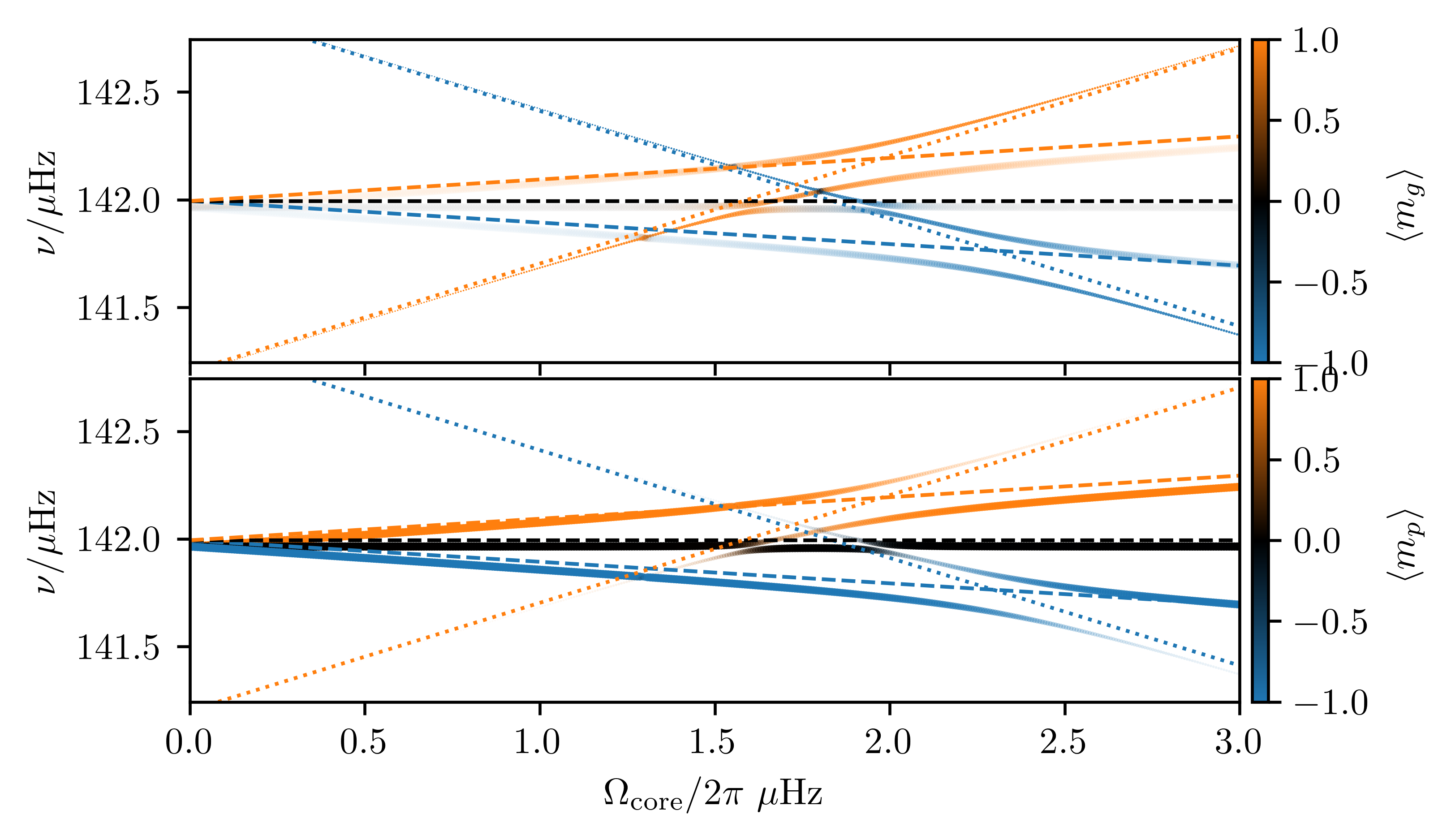
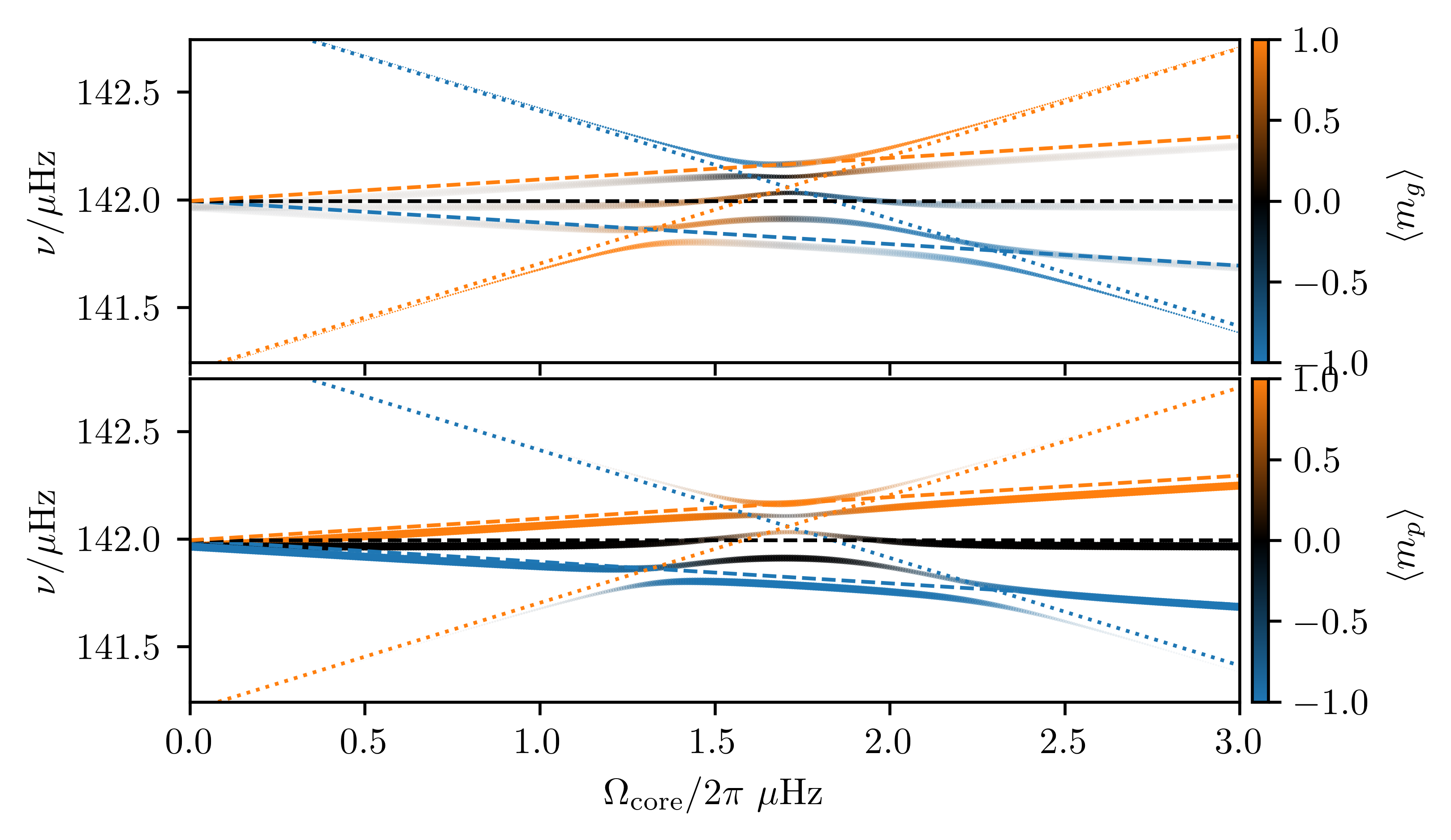
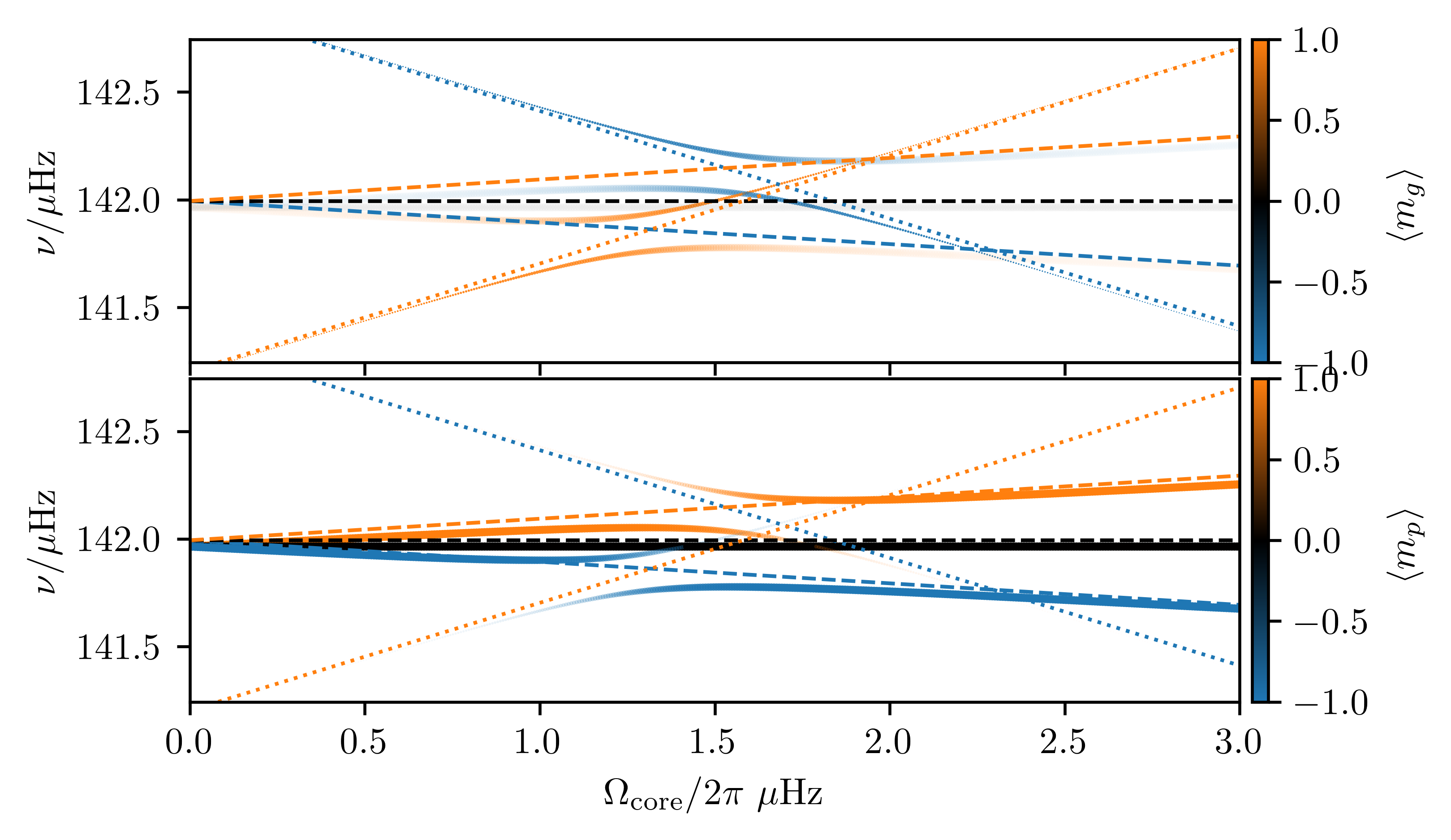
New Theory
(Ong 2025)

\[\begin{array}{c} {\scriptsize\text{Power}}\\ \big\uparrow \end{array}\]

\[\longrightarrow {\scriptsize\text{Frequency}}\]

Ong 2025

Ong 2025

Probing the star-planet connection, and non-canonical evolution

e.g. Ong 2025; Ong et al. 2024;
Hon et al. (incl Ong) Nat. 2023

(also incl. Ong: Huber+ 2019, 2022; …)

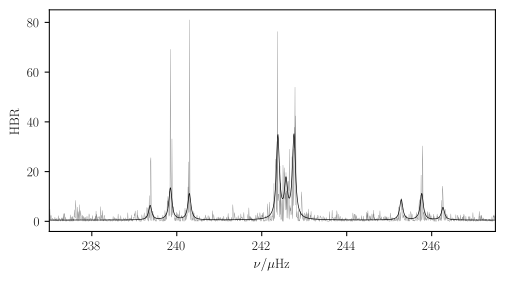
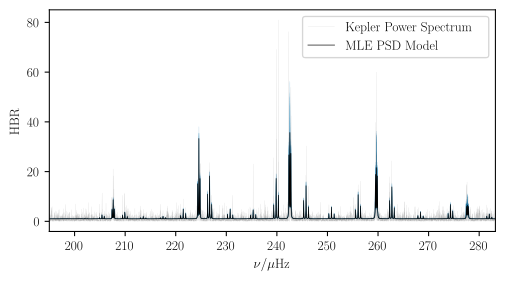
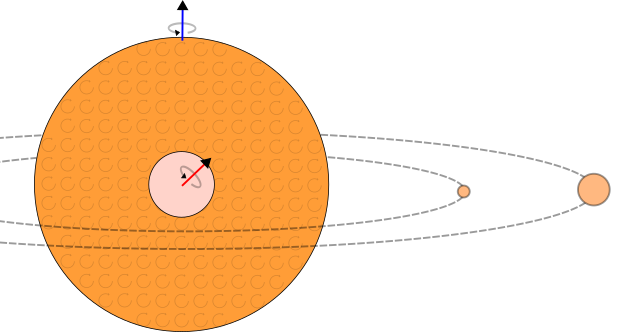
Kepler-56’s core and envelope
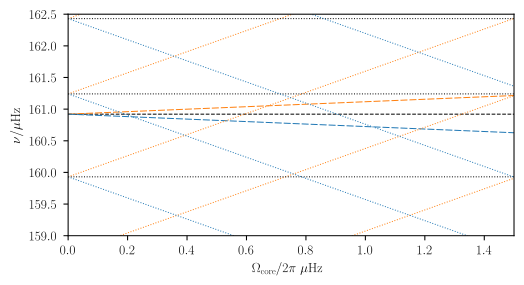
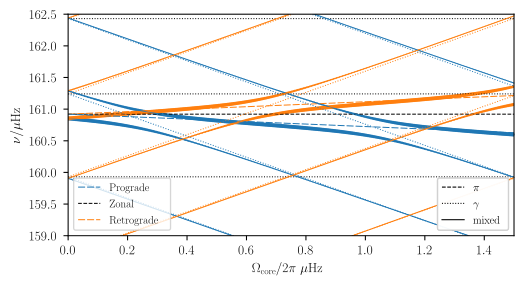
rotate around different axes.

(Ong 2025)

Zvrk rotates too fast to
not have eaten something recently.

(Ong et al. 2024)

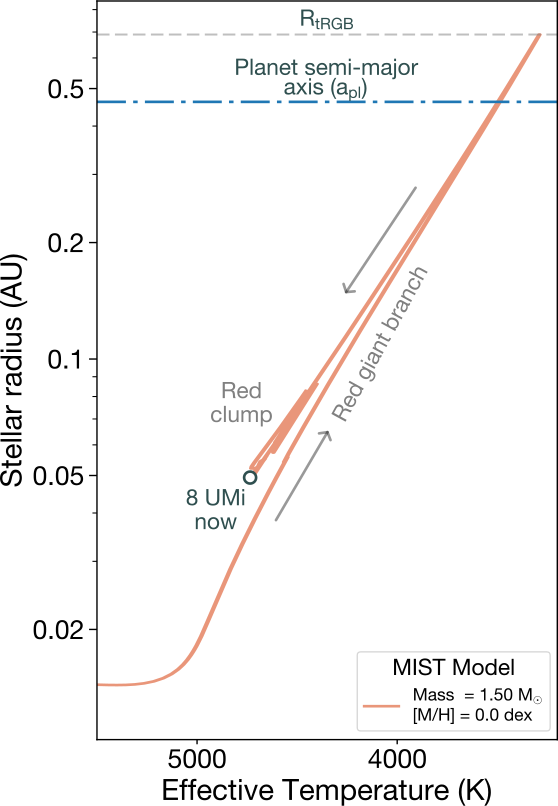
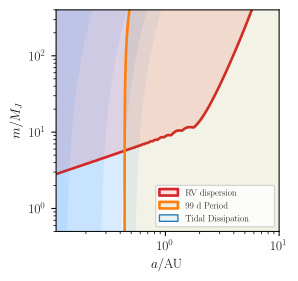
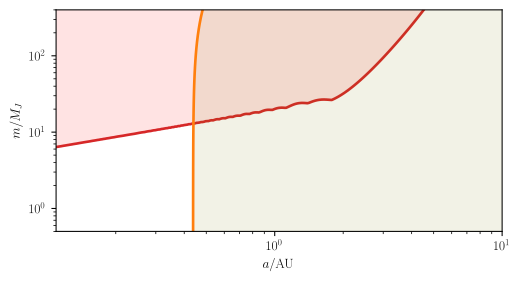
8 UMi b should have
been consumed, but wasn’t?

(Hon+ 2023 incl. Ong)

Summary

In the data-rich régime,
technique development and
theoretical interpretation are
rate-limiting steps to discovery.

What I Bring

\[ {\large\color[RGB]{0, 120, 0}\textbf{Theory} \longrightarrow} \mathrm{Single~Stars} \longrightarrow \text{Populations} {\color[RGB]{0, 120, 0}\longrightarrow} \large\text{Astrophysics} \]

Technique
Development

Interpretation

Data Volume

V.
The Future

  • Data
  • Technique
  • Theory

TESS (Ongoing)
Earth 2.0: 2028 (Planned)
PLATO Mission: 2026 (Planned)
Roman: 2027 (Planned)

Statistical sample (Ong: WP 120, 128)

\(\sim 10^6\) red giants in galactic bulge & globular clusters

Long temporal baselines

(Ong: TASOC WG1, WG2, WG7)

\(\sim100 \to 10,000++\) stars:
How do we cope with
a deluge of new data?

e.g. Hey, Huber, Ong, et al. in review;
Nielsen, Ong, et al., in review.
(incl. Ong: Cunha+ 2021; Nielsen+ 2021; Campante+ 2023)
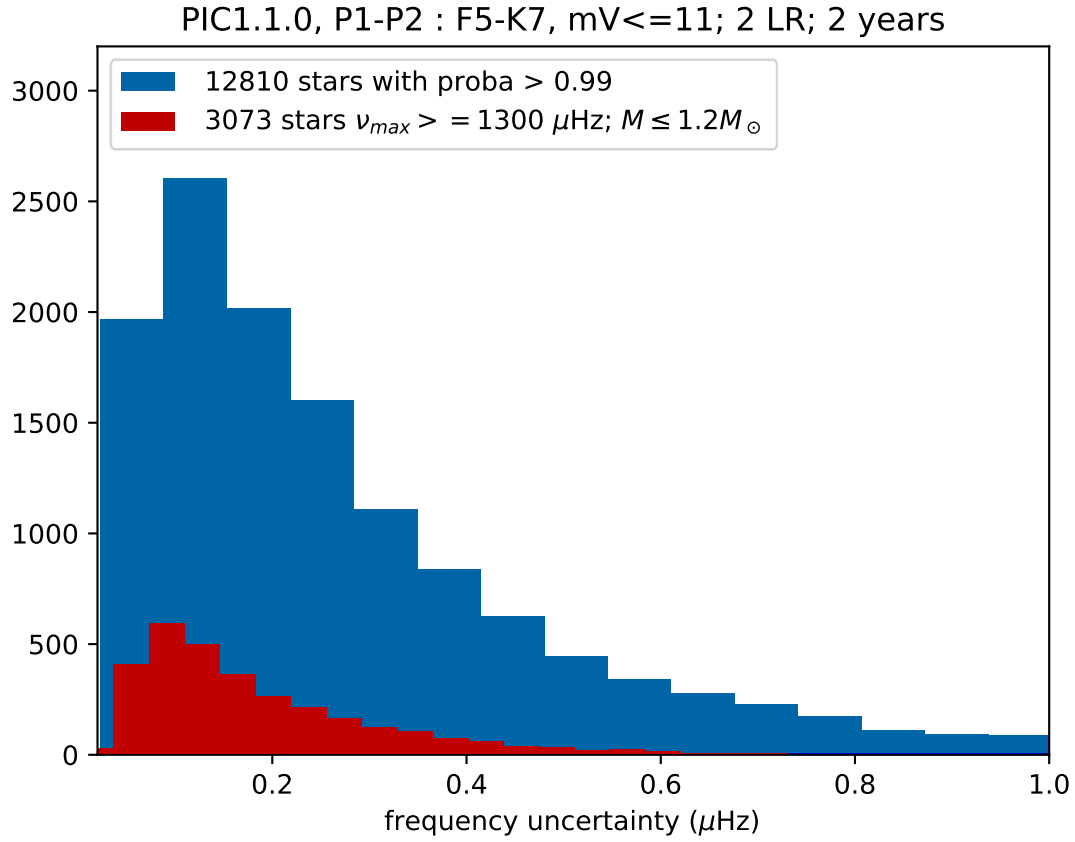
Ong: TASOC WG1, WG2; PLATO WP120, 128

?

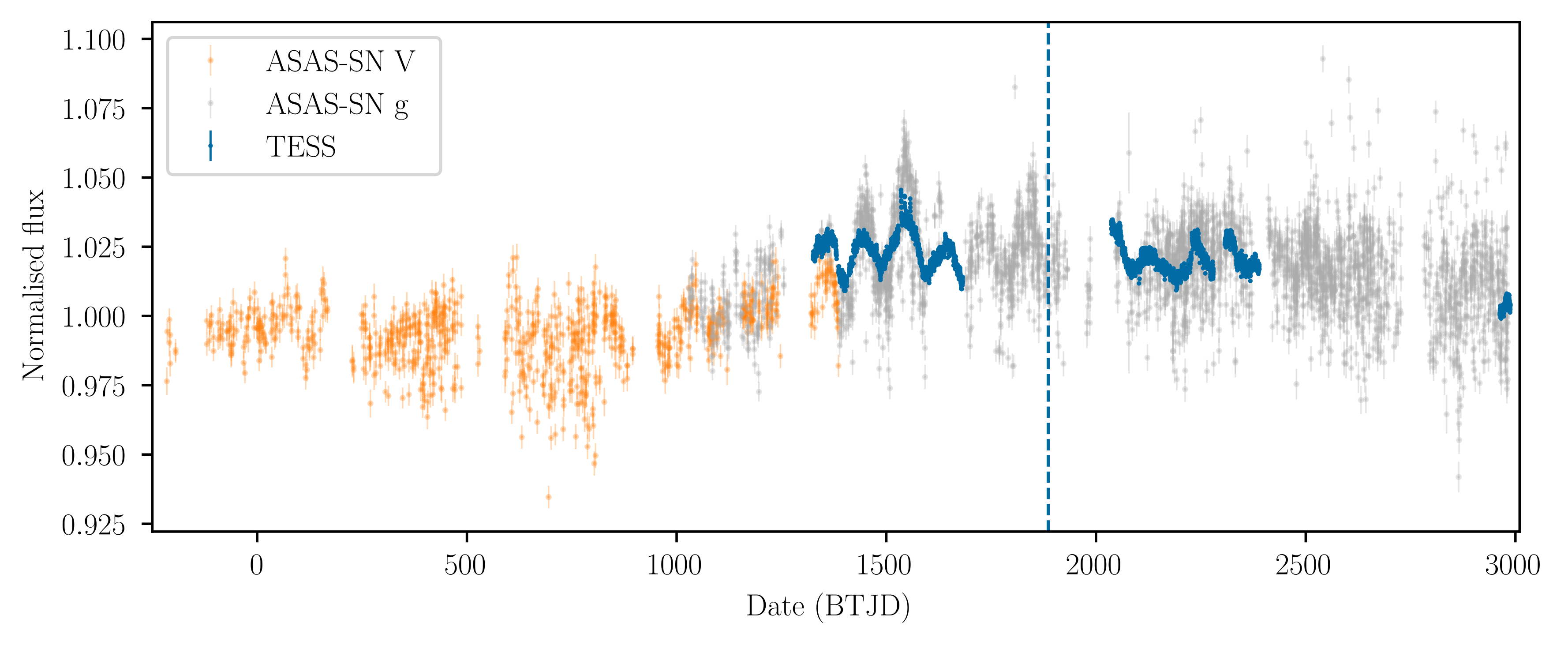
Data: Synergies on the ground

Combining with Photometric surveys — e.g. Ong et al. (2024); Hart+ incl. Ong (2023)
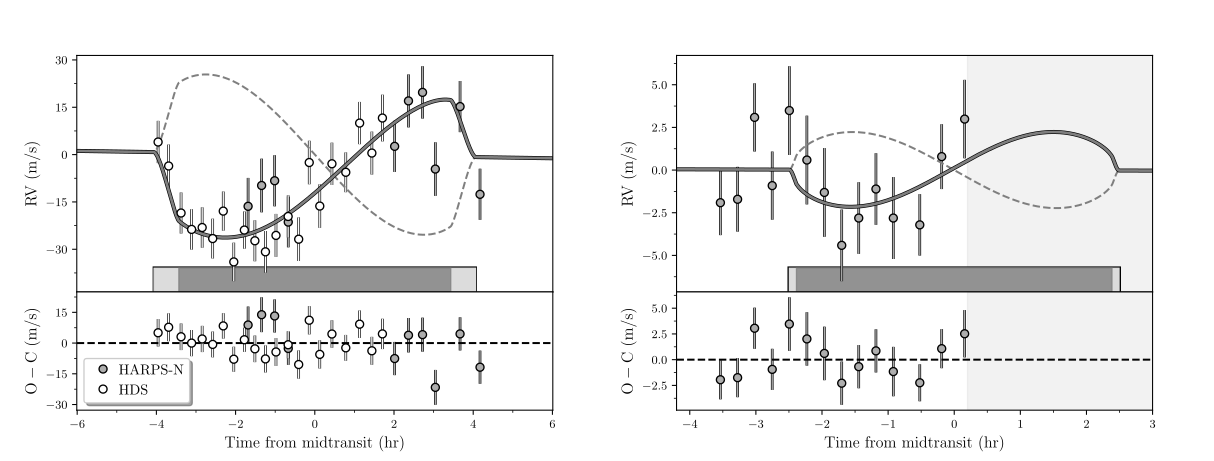
Seismology from Extreme Precision Radial Velocities (Li, Huber, Ong, et al. 2025; Hon+ incl. Ong 2024)
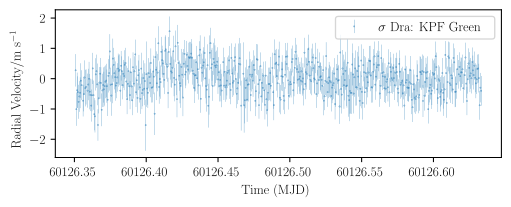
Ong: ASAS-SN; SONG WG1 & WG2; Keck Planet Finder via CPS
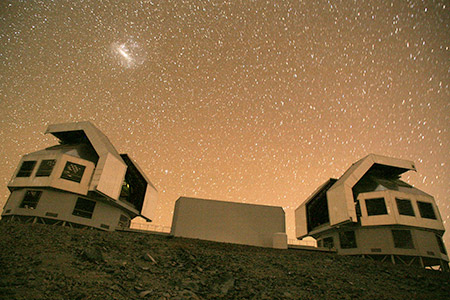
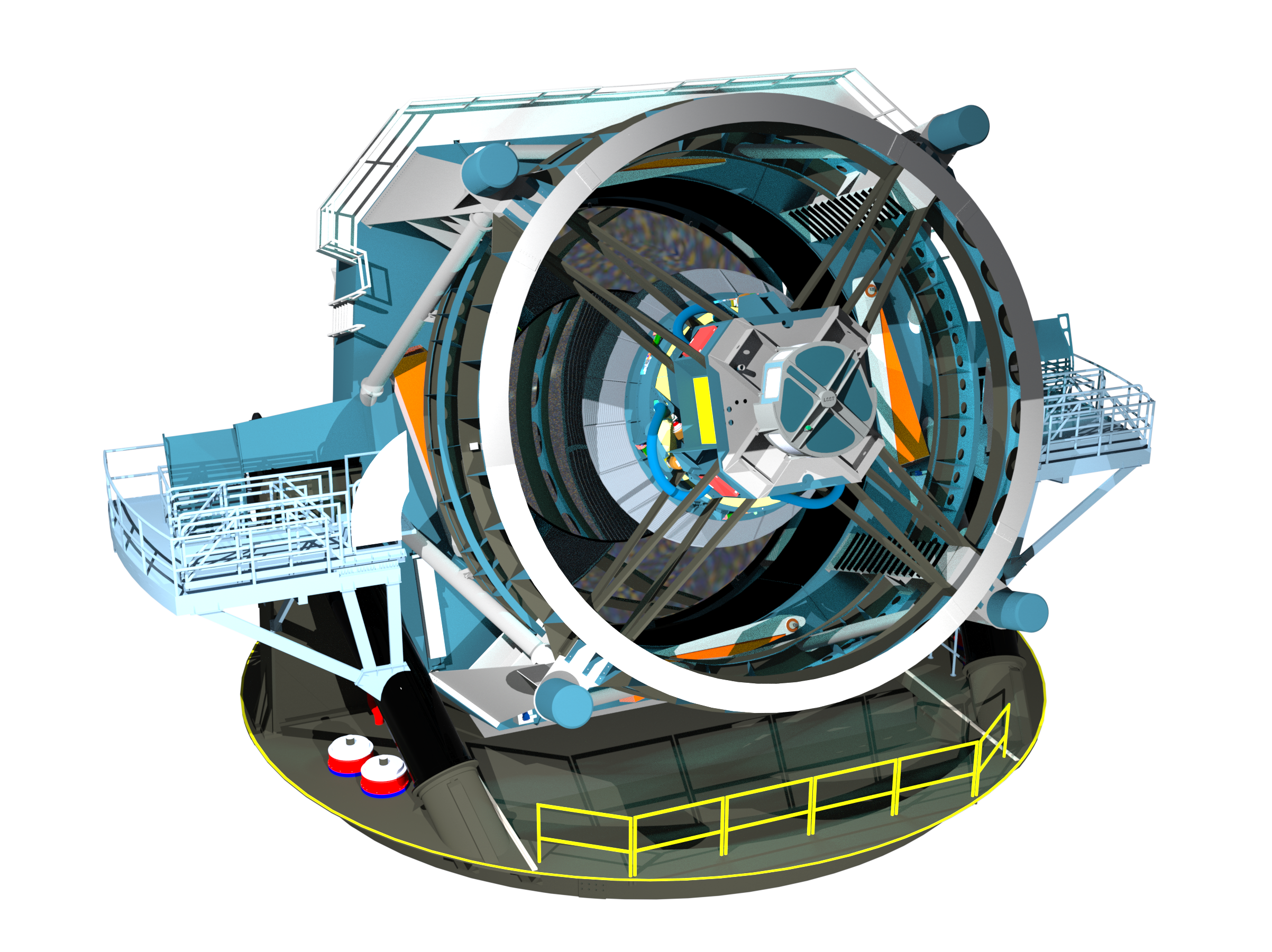
Coming Soon: HARPS-N; MINERVA; Rubin/LSST; G-CLEF?
  • Data
  • Technique
  • Theory

Asteroseismology in the TESS Era

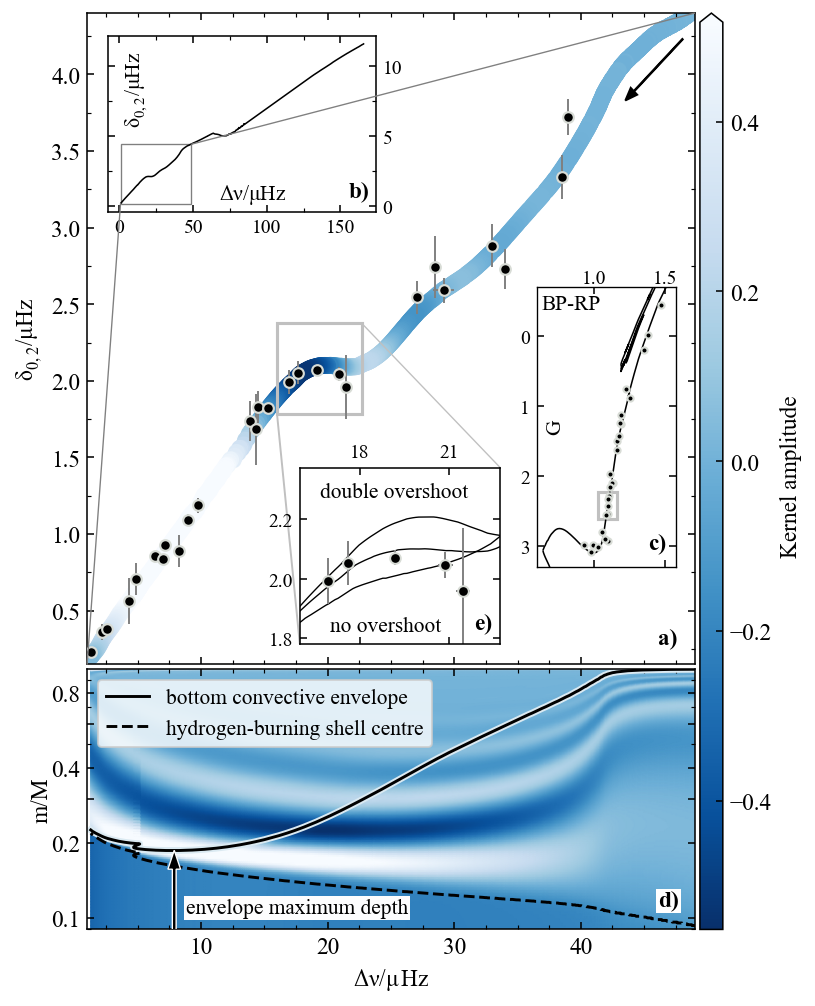
Probes of mixing processes
near convective boundaries

(Lindsay, Ong, Basu 2022, and 2024;
Ong, Lindsay, Reyes et al. 2025;
Reyes, Stello, Ong, et al. 2025Nature)

†: mentoree paper

Ong: TESS Guest Investigator Cycle 7, PI

?

  • Data
  • Technique
  • Theory

from Jeffery & Saio (2016)


Convective Boundary Mixing

from Blouin et al. 2023a, b

Theory: g-modes in Massive Stars

Nonlinear evolution is
the primary obstacle to
g-mode inversions.

Will understanding this (Hoogendam, Ong, in prep.) permit further technique development?

from Vanlaer et al. 2023

proxy for age \(\to\)

†: mentoree paper
Theory: Turbulence

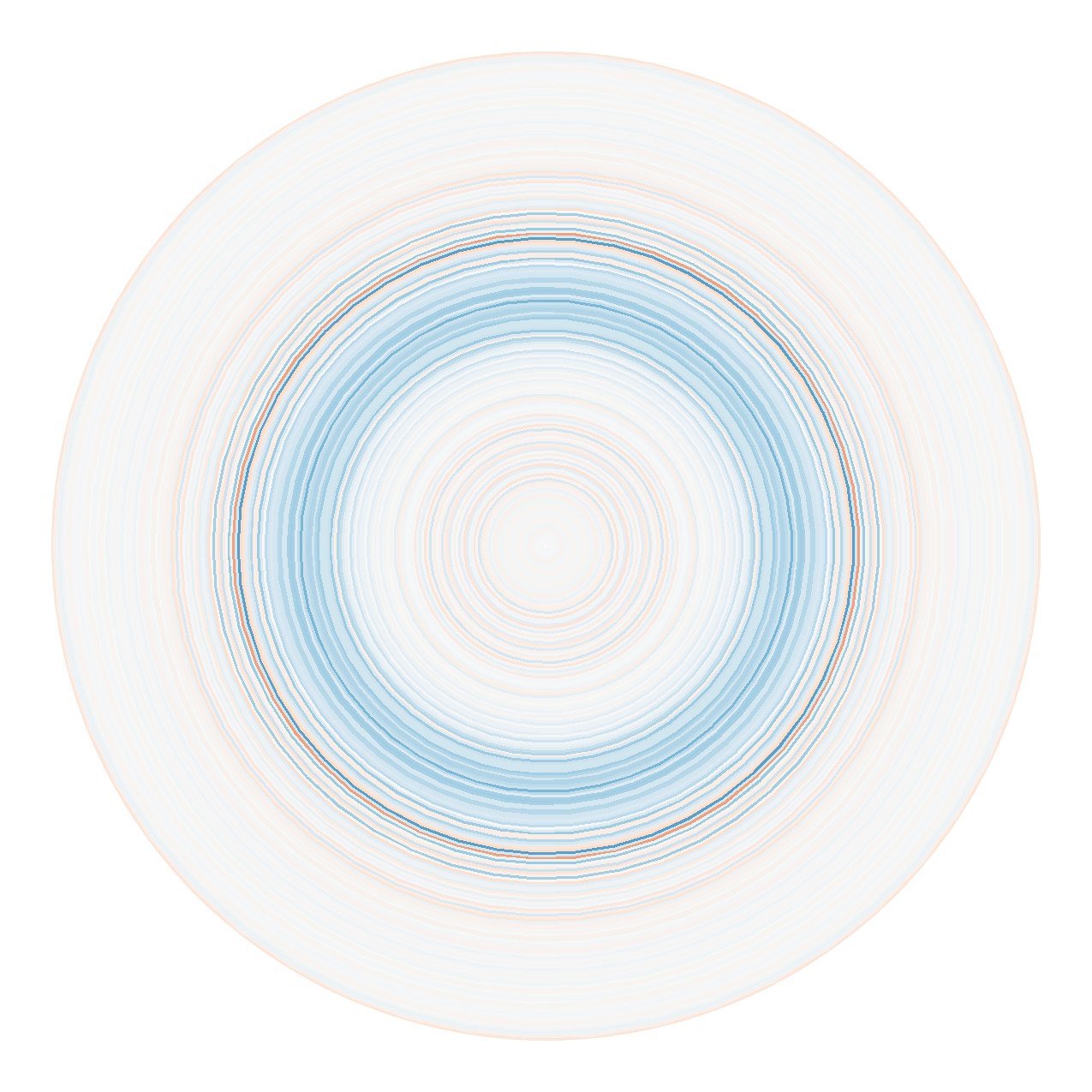
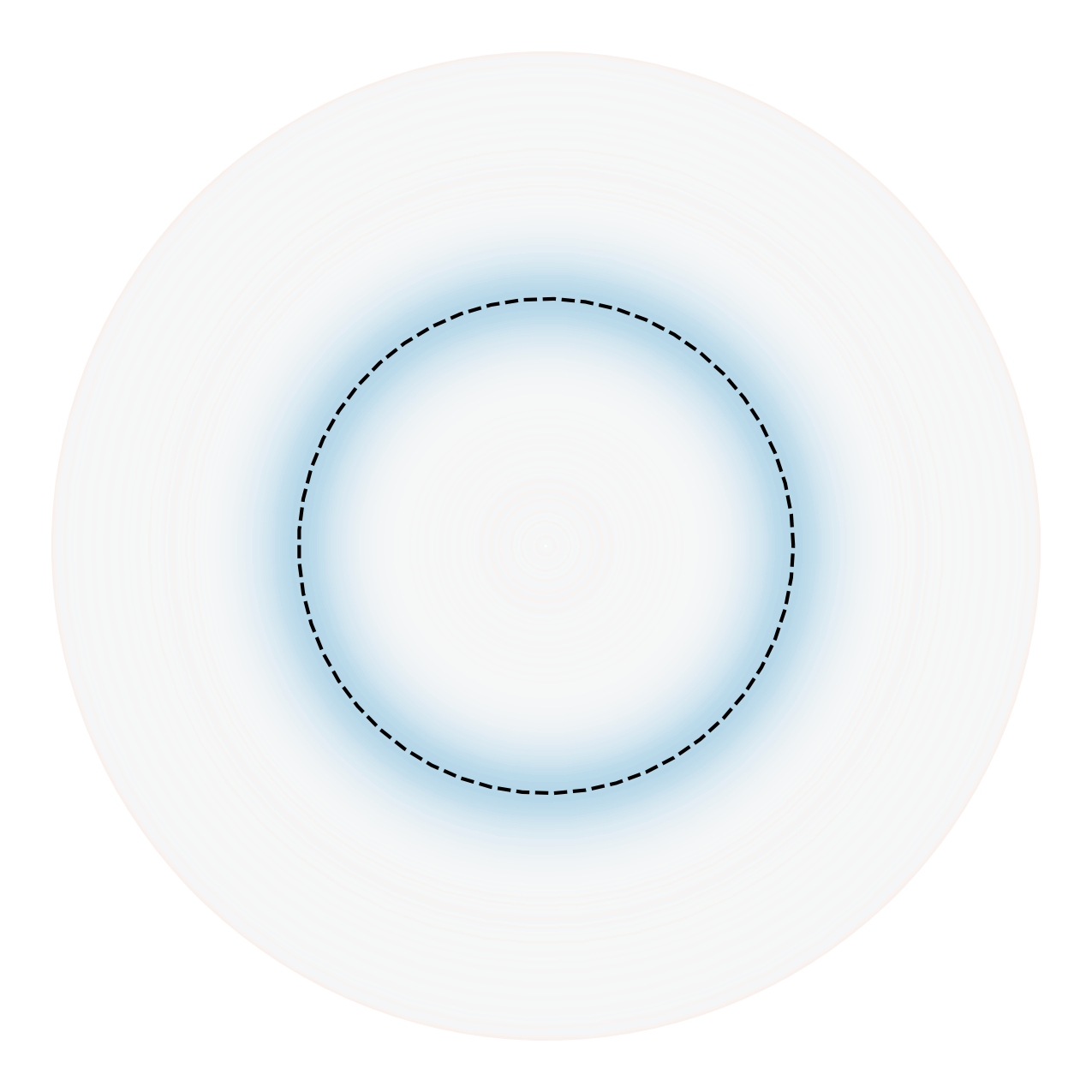
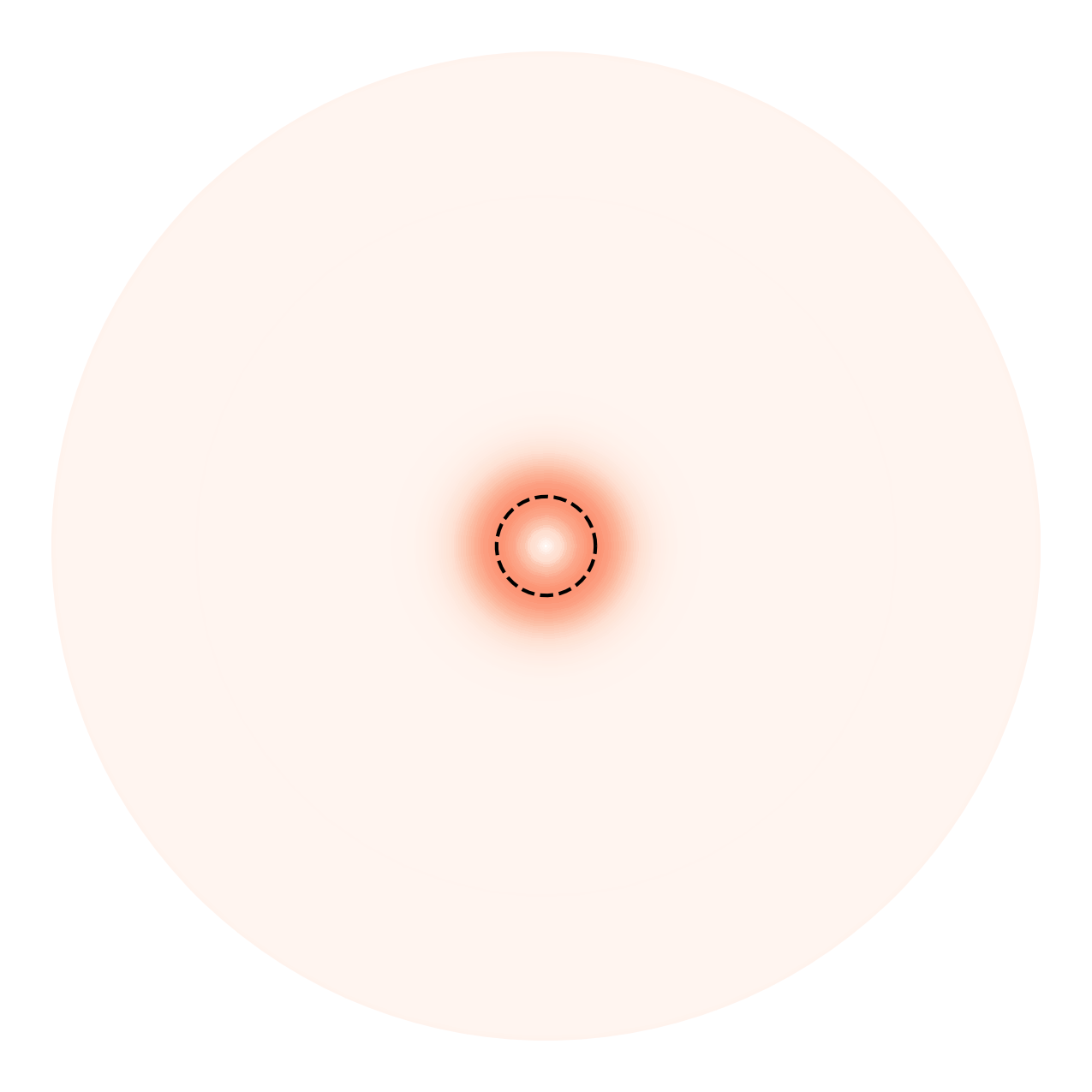
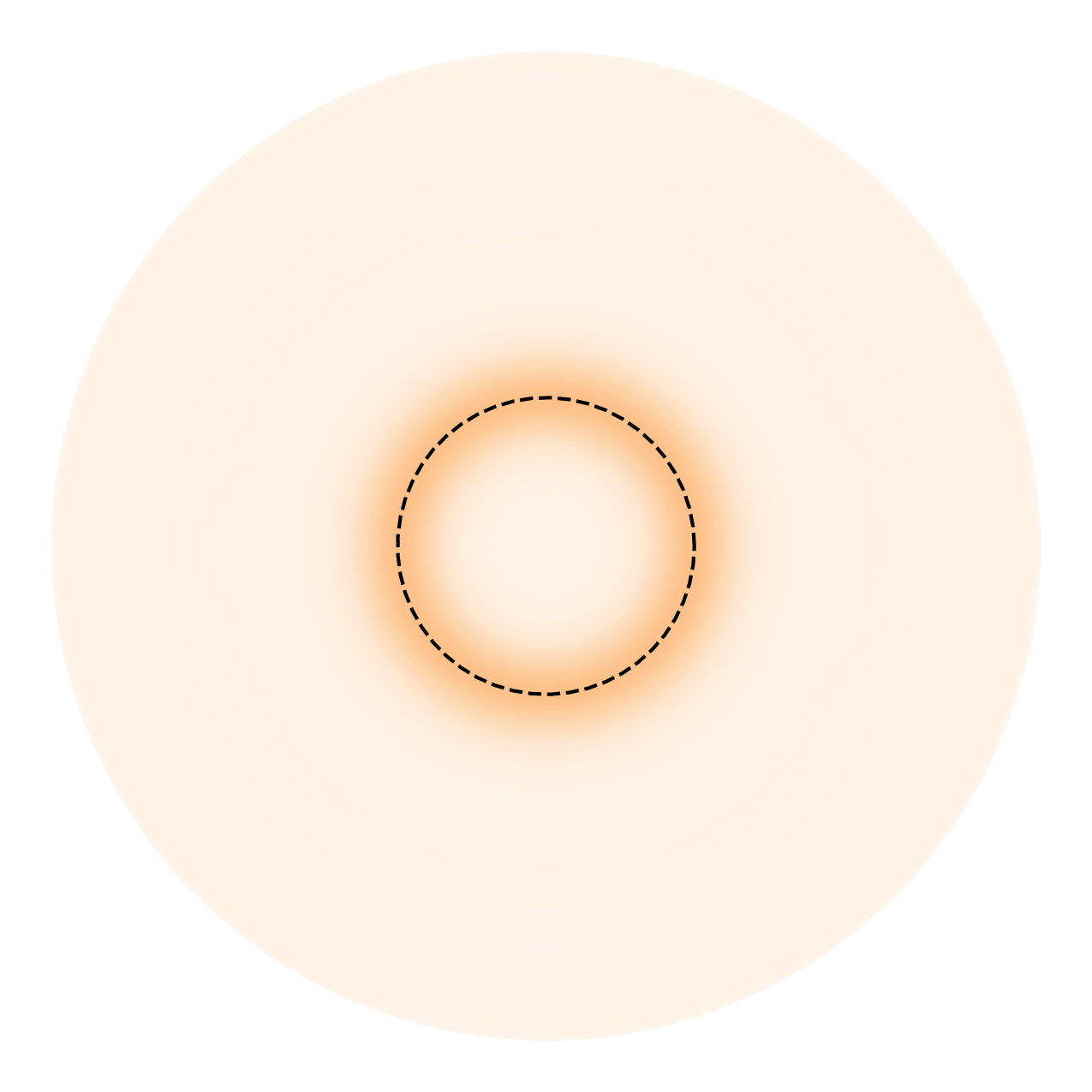
(RHD simulations courtesy of Joel D. Tanner)

?

(illustration courtesy of Conny Aerts)

Asteroseismology in is the Future

Stellar oscillations have revolutionised our understanding of
stellar structure, dynamics, and evolution.

The development of theory and technique
unlocks their use as a tool (e.g.: mixed modes \(\to\) RGB science).

My group will combine these developments with new surveys
to make these measurements astrophysically interesting.

Supplementary Slides

Why RV Seismology?

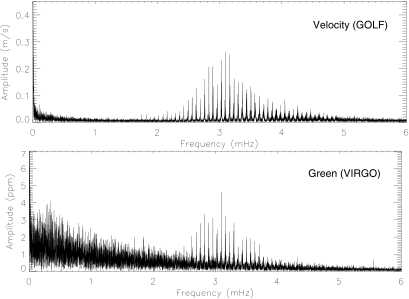
The Sun as seen by SOHO:
Bedding & Kjeldsen 2005
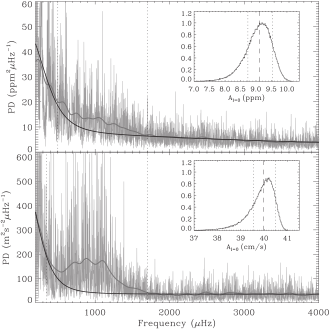
Procyon from MOST vs. RVs:
Huber et al. 2011
Mixed Modes and Stellar Evolution

Inversions

Normal modes satisfy an operator eigenvalue problem
\(\hat{\mathcal{L}}\left|\xi_{n\ell m}\right> = -\omega^2_{n\ell m}\left|\xi_{n\ell m}\right>\).

Under a small perturbation \(\hat{\mathcal{L}} \mapsto \hat{\mathcal{L}} + \lambda \hat{\mathcal{V}}\),

\[\begin{aligned} \omega^2_{n\ell m} &\mapsto \omega^2_{n\ell m} - \lambda \left<\xi_{n\ell m}|\hat{\mathcal{V}}|\xi_{n\ell m}\right> + \mathcal{O}\left(\lambda^2\right)\\ &\approx \omega^2_{n\ell m} - \lambda \int \mathrm d^3 x \cdot \rho \left(\vec{\xi}_{n\ell m}^* \hat{\mathcal{V}} \vec{\xi}_{n\ell m}\right) + \mathcal{O}\left(\lambda^2\right). \end{aligned}\]

e.g. for (slow) rotation in particular

\[ \omega^2 \mapsto \omega^2 + 2 m\ b_{n\ell m} \omega \int \Omega(r) K_{nlm}(r) \mathrm dr \]

Rotational Inversions

For slow rotation, \[\boxed{\delta\omega_{nlm} \sim m b_{nl} \int \Omega(r) K_{nl}(r) \mathrm d r}\]

Variations in \(\delta\omega_\text{rot}\) are

  • assumed to imply, and
  • \(\therefore\) used to study,

radial differential rotation.

\[\boxed{{\color{orange}{\delta\omega_{nlm}}} \sim {\color[RGB]{0,100,255}{m b_{nl} \sum_i {\color{black}{\Omega(r_i)}} K_{nl}(r_i) \Delta r_i}}}\] is of the form \({\color[RGB]{0,100,255}\mathbf{A}}\mathbf{x} = {\color{orange}\mathbf{b}}\).

i.e. Inferring the rotational profile
\(\Omega(r)\) is a linear inverse problem.

Rotational Inversions

\[\scriptsize\begin{aligned} \int \Omega(r) {\color[RGB]{0,100,255}\left(\sum_i c_i K_{i}(r)\right)} \mathrm d r &\sim \sum_{i} \left(c_i \over m_i b_{i} \right) \delta\omega_{\mathrm{rot}, i} \\ & \to \boxed{\Omega({\color[RGB]{0,100,255}r_0})}\end{aligned}\]

e.g. OLA (Backus & Gilbert 1968; Gough 1985;
Pijpers & Thompson 1992; Schunker 2016; Ong 2024; etc.)

\(\implies\) we can make measurements of internal rotational structure!

Inversions for Stellar Structure

from Basu (2020)

two standard
solar models

\[\huge {{\color{orange}{\delta\omega_i \over \omega_i}} \approx {\color[RGB]{0,100,255}{\int K_{\rho|c_s^2, i}(r)}} {\delta\rho \over \rho}{\color[RGB]{0,100,255}{\mathrm d r}} + {\color[RGB]{0,100,255}{\int K_{c_s^2|\rho, i}(r)}} {\delta c_s^2 \over c_s^2}{\color[RGB]{0,100,255}{\mathrm d r}}} \]

\[{\Large{\color[RGB]{0,100,255}\mathbf{A}}\mathbf{x} = {\color{orange}\mathbf{b}}}\]

Structure perturbations
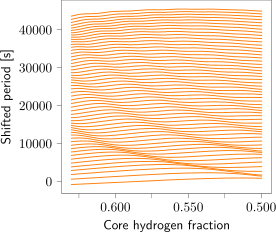
do not reorder mixed modes!
(cf. Ball+ 2018)
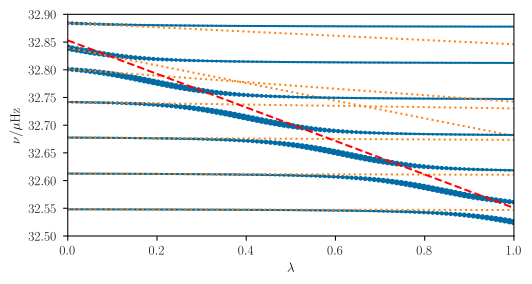
Mode mixing yields avoided crossings
between multiplet components of identical \(m\)

(cf. Mosser+ 2012, Ouazzani+ 2013, Deheuvels+ 2017)

pure p
pure g
mixed
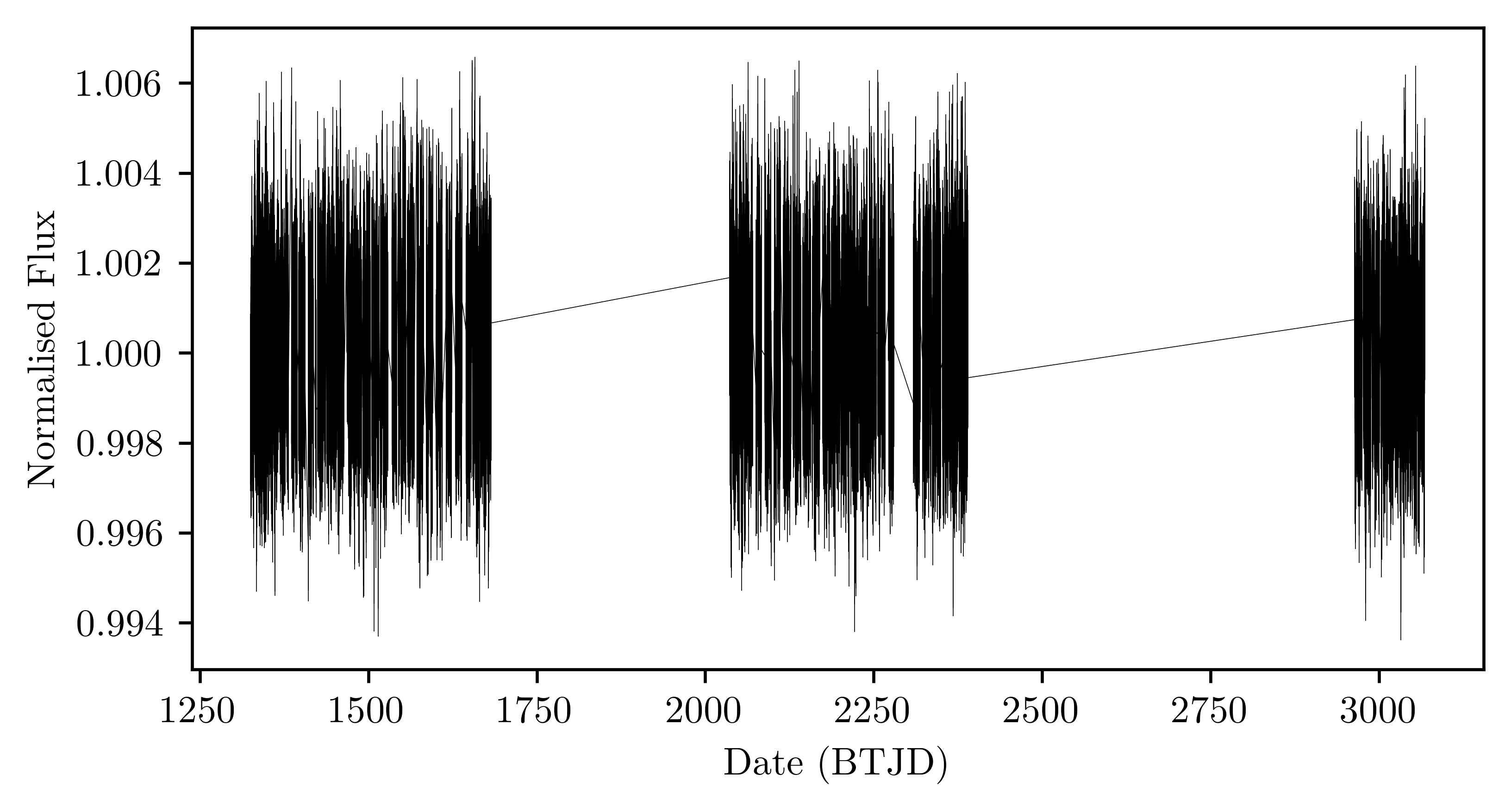
More about Zvrk

Very high \(\mathrm{A(Li)}\),
but otherwise innocuous
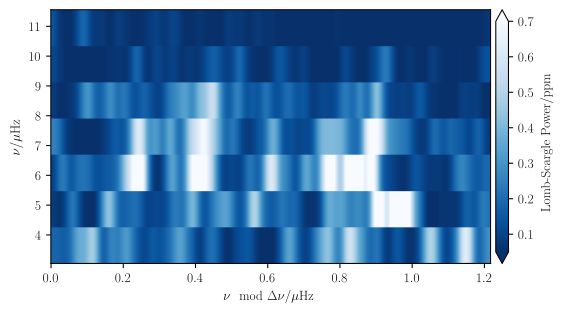
Mode Identification

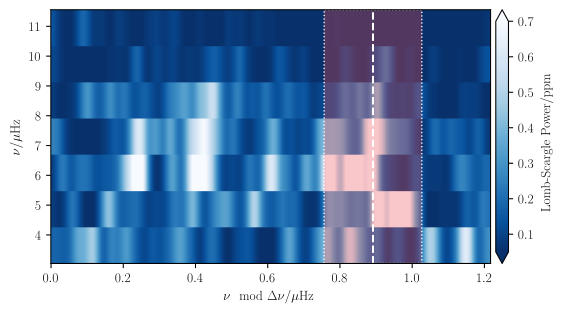
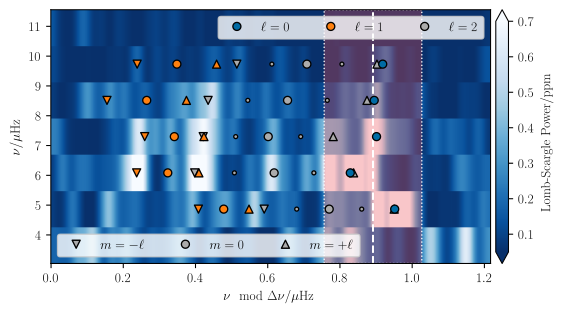
\[\ell = 0,2?\]

But Kepler says \(\ell = 0\) have to live here!
(and theory says so too…)
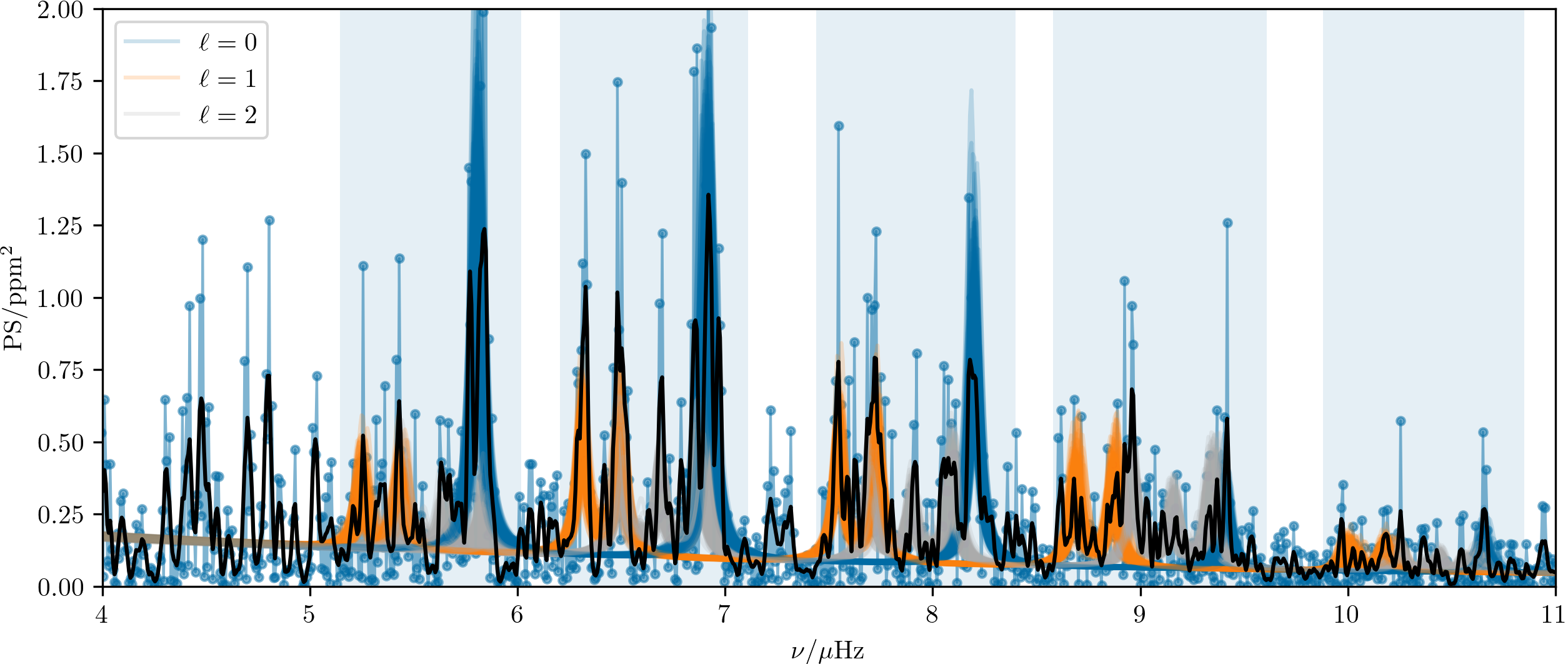
Asteroseismology Happens…

Rotational splittings from seismology:
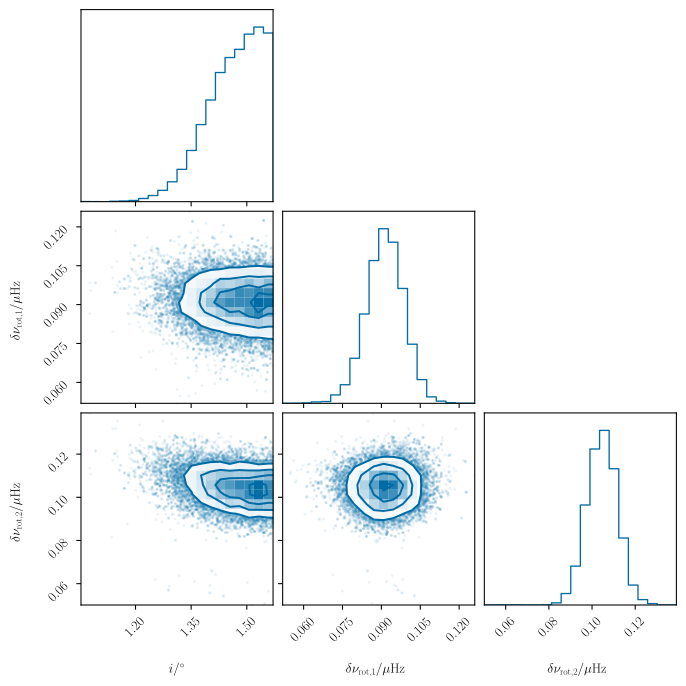
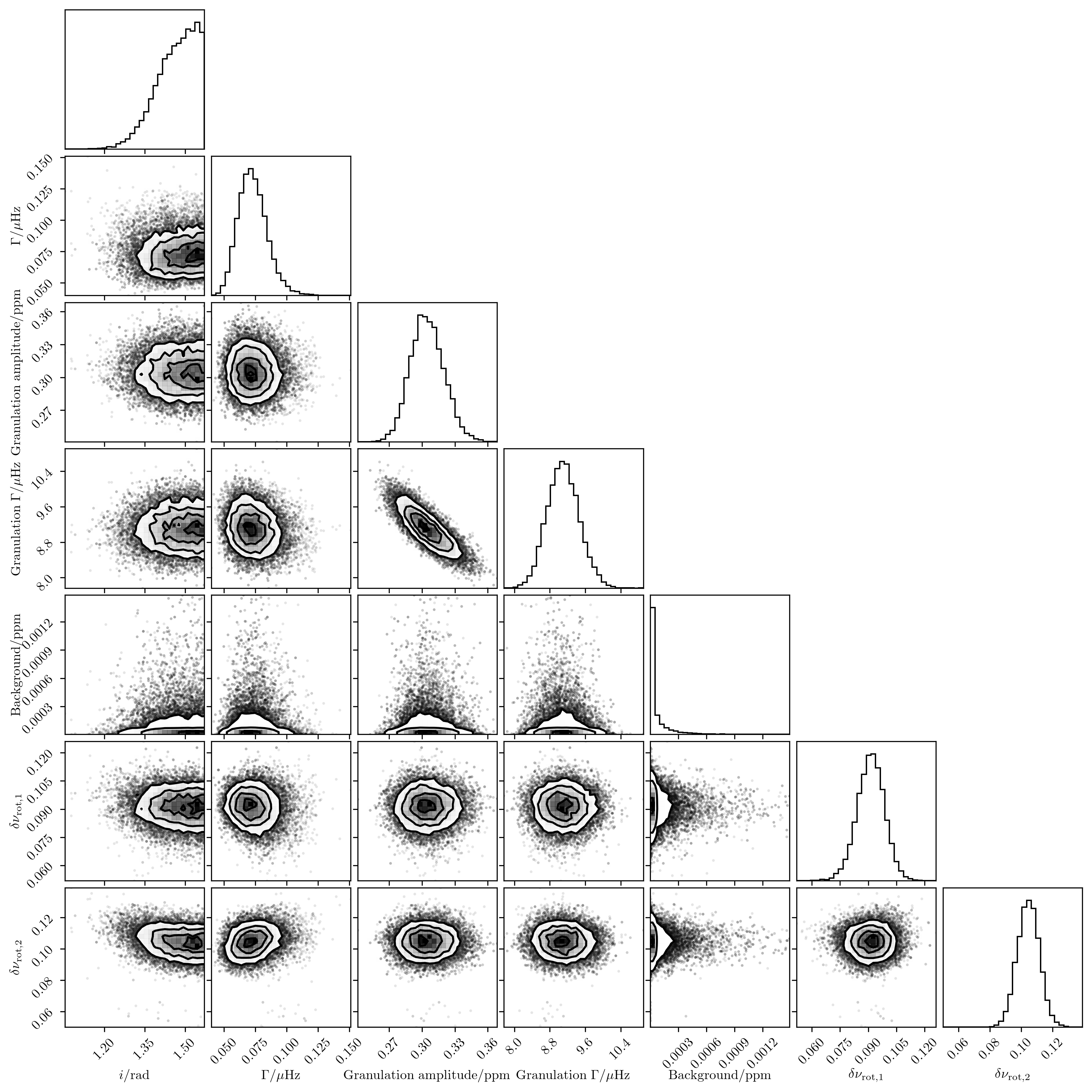
  • \(\ell = 1\): \(\delta\nu_{\text{rot},1} \sim 0.09\ \mu\mathrm{Hz}\)
  • \(\ell = 2\): \(\delta\nu_{\text{rot},2} \sim 0.10\ \mu\mathrm{Hz}\)

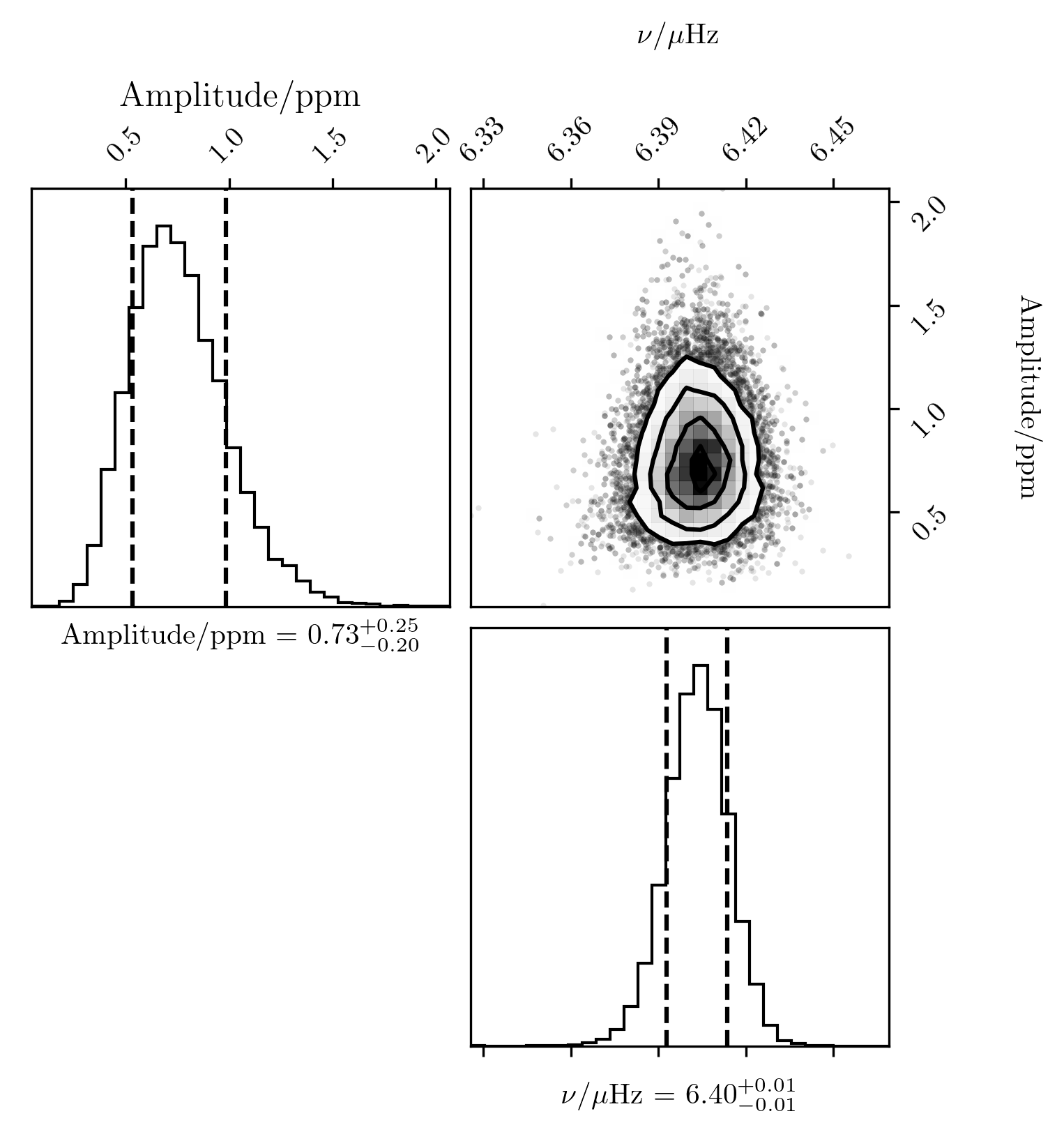
\(\implies P_\text{rot} \sim 115\ \mathrm{d}?\)

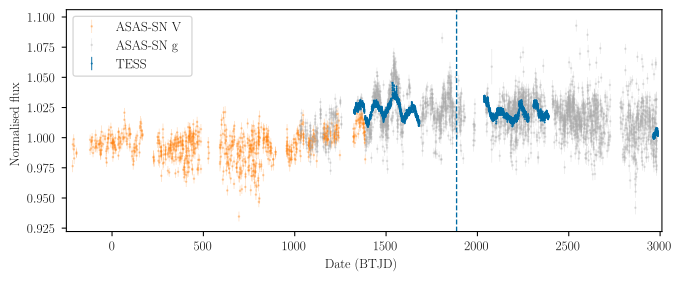
Rotational signal probably got
detrended away
by systematic corrections…
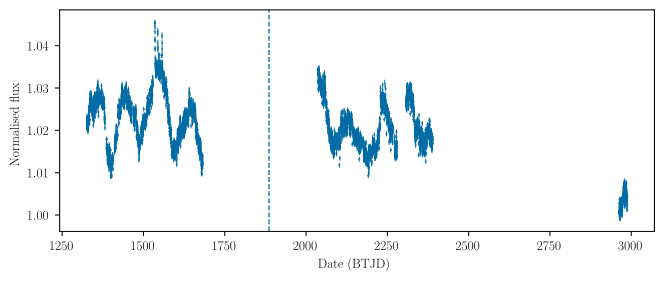
TESS w/ Pixel-Level Decorrelation + Stitching

Very suggestive…
but is this real?

Probably yes!
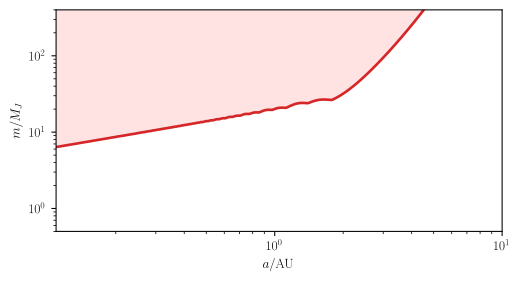
Observational Overview

Asteroseismology:

  • \(M \sim 1.14 \pm 0.04\ M_\odot\)
  • \(R \sim 23.5 \pm 0.03\ R_\odot\)
  • \(\boxed{P_\text{rot,bulk} \sim 115 \pm 10\ \text{d}}\)
  • (Maybe rotational shear?)

Photometry:

  • \(\boxed{P_\text{rot,surf} \sim 99 \pm 3\ \text{d}}\)

Spectroscopy:

  • \(\boxed{V\text{sin } i \implies P_\text{rot} \sim 110 \pm 8\ \text{d}}\)
  • \(\mathrm{A(Li)} = 3.16 \pm 0.08\ \mathrm{dex}\)
  • \(^{14}\mathrm{N}\)-deficient relative to APOGEE sample

Gaia DR3:

  • RUWE of 1.06
  • \(\sigma_V = 0.16\ \mathrm{km/s}\)
    over 2.2 years

How did this happen??

Gaia RV scatter rules out
large RV semiamplitudes…

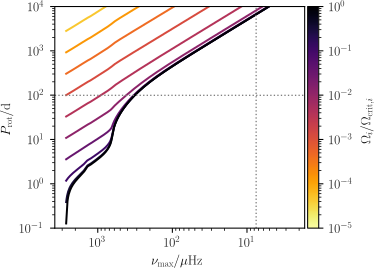
\(P_\text{orb} \gg 99\ \mathrm{d}\) cannot spin star
up to 99-day rotational period…

Remaining permissible orbits are
unstable to tidal dissipation!

\(\implies\) ENGULFMENT?
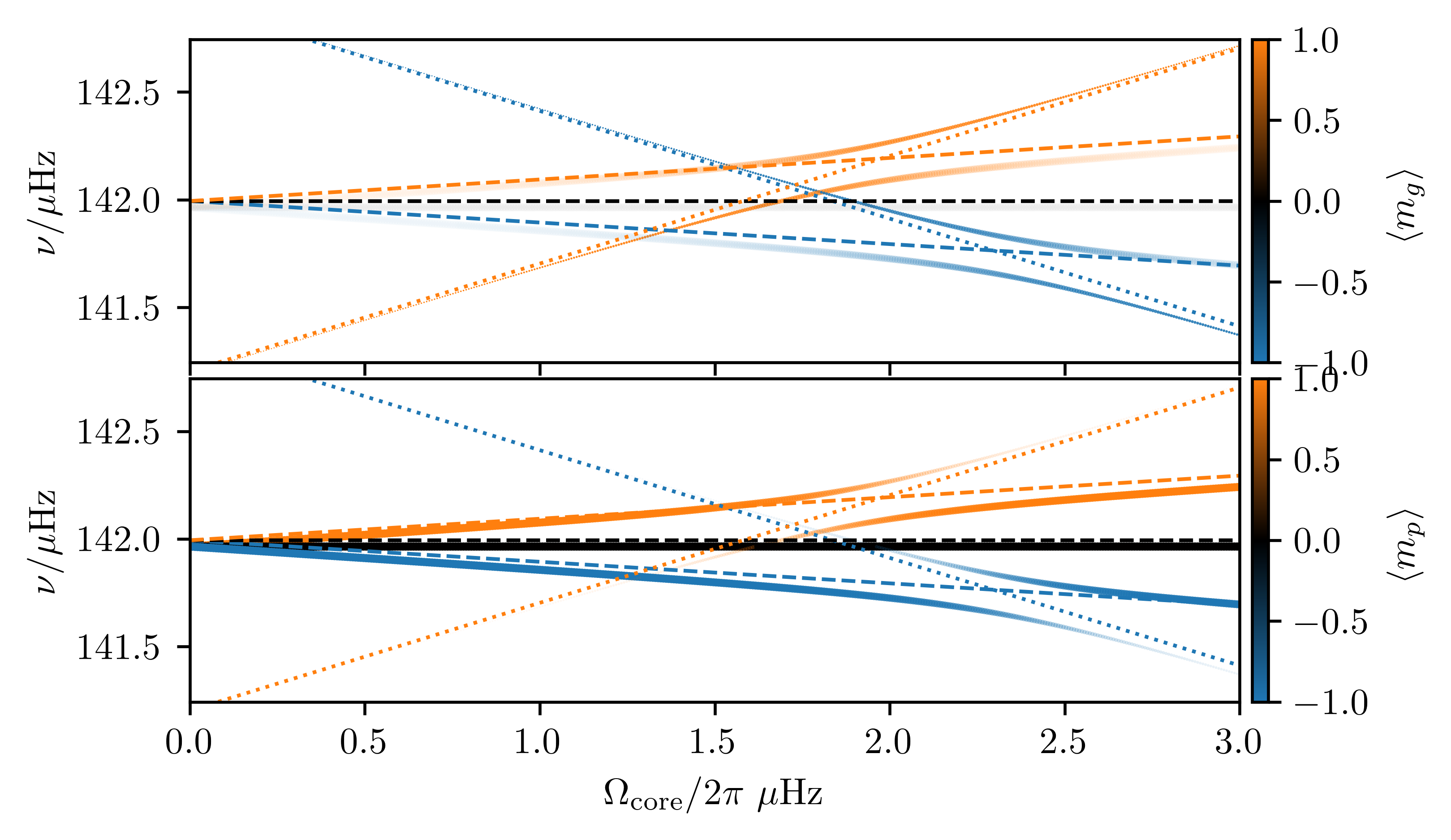
Misaligned Mixed Modes

Angular Momentum Matrices

\(\forall \ell, \exists (2\ell + 1) \times (2\ell + 1)\) matrices
\(\mathbf{J}_x^\ell\), \(\mathbf{J}_y^\ell\), \(\mathbf{J}_z^\ell\) satisfying commutation relations
\(\left[\mathbf{J}_i, \mathbf{J}_j\right] = -i\epsilon_{ijk}\mathbf{J}_k\), with
\(\mathbf{J}_z \hat{=} \mathrm{diag}(-\ell, -\ell + 1 \ldots \ell - 1, \ell).\)

Example: \(\ell = 1\)

\[\small\mathbf{J}_x \hat{=} {1 \over \sqrt{2}}\begin{bmatrix}0 & 1 & 0 \\ 1 & 0 & 1 \\ 0 & 1 & 0\end{bmatrix}; \mathbf{J}_y \hat{=} {1 \over \sqrt{2}}\begin{bmatrix}0 & i & 0 \\ -i & 0 & i \\ 0 & -i & 0\end{bmatrix}; \mathbf{J}_z \hat{=} \begin{bmatrix}-1 & 0 & 0 \\ 0 &0 &0 \\ 0& 0 &1\end{bmatrix}.\]

Rotation as an Eigenvalue Problem

For fixed \(m\) (to leading order):

\[\left(-\mathbf{\Omega}_0^2 + 2 \omega m \mathbf{R} + \omega^2 \mathbf{\Delta}\right)\mathbf{c} = 0\]

For fixed \(n\) (to leading order):

\[(-\omega_0^2 \mathbb{1}_{2\ell+1} + 2 \omega \mathbf{J}_z R_{n,n} + \omega^2 \mathbb{1}_{2\ell+1})\mathbf{y} = 0\]

Combined Angular Momentum Operator
(Aligned Case)

\[\vec{\xi}_{n\ell m}(r, \theta, \varphi) = \vec{\xi}_{n\ell}(r) Y_\ell^m(\theta, \phi) \iff \underbrace{\tilde{R}_{n, n', m, m'} = R_{n,n'} J_{m,m'}}_{\text{this is a }\textbf{tensor product}!}\]

\[\implies \left(-\mathbf{\Omega_0}^2 \otimes \mathbb{1}_{2\ell+1} + 2 \omega \underbrace{\mathbf{R} \otimes \mathbf{J}_z}_{\tilde{\mathbf{R}}} + \omega^2 \mathbf{\Delta} \otimes \mathbb{1}_{2\ell+1}\right)\mathbf{x} = 0\]

The Misaligned Angular Momentum Operator

Let’s associate with each mass shell at \(r\) both \(\Omega(r)\)
(as is customary), and also an axis \(\hat{\mathbf{n}}(r) =\sum_i n_i \mathbf{e}_i\).

\[\small \begin{aligned} \mathbf{R}_{n\ell, n\ell} &= b_{n\ell}\int {\mathbf{d}^\ell}^\dagger(\beta(r)) \Omega(r) \mathbf{J}_z {\mathbf{d}^\ell}(\beta(r))\ K(r)\ \mathrm{d} r\\ &= b_{n\ell}\int \Omega(r) (\hat{\mathbf{n}} \cdot \vec{\mathbf{J}})\ K(r)\ \mathrm{d} r\\ &= \boxed{b_{n\ell}\left(\int \vec{\mathbf{\Omega}}(r) K(r)\ \mathrm{d} r\right) \cdot \vec{\mathbf{J}}}. \end{aligned} \]

\[ \boxed{\tilde{\mathbf{R}} = \int \mathbf{K}\otimes\left(\Omega_\text{rot}(r)\ \hat{\mathbf{n}}\cdot \vec{\mathbf{J}}\right)\ \mathrm{d}r} \]

\(\implies\) For each mode, AM matrix is
specified by usual vector addition.

Mixed Modes

We only assume that the pure p- and g-mode solutions
are separately amenable to separation of variables;
the mixed-mode eigenfunctions need not be.

\[ \small \left(\begin{bmatrix} {\color{grey}\mathbf{L}_{\pi\pi}} & \mathbf{L}_{\pi\gamma} \\ \mathbf{L}_{\pi\gamma}^T & {\color{red}\mathbf{L}_{\gamma\gamma}} \end{bmatrix} \otimes \mathbb{1}_{2\ell+1} + 2 \omega \begin{bmatrix} {\color{forestgreen}\tilde{\mathbf{R}}_\pi} & 0 \\ 0 & {\color{forestgreen}\tilde{\mathbf{R}}_\gamma}\end{bmatrix} + \omega^2 \begin{bmatrix} \mathbb{1} & \mathbf{D} \\ \mathbf{D}^T & \mathbb{1} \end{bmatrix} \otimes \mathbb{1}_{2\ell+1} \right)\mathbf{x} = 0. \]

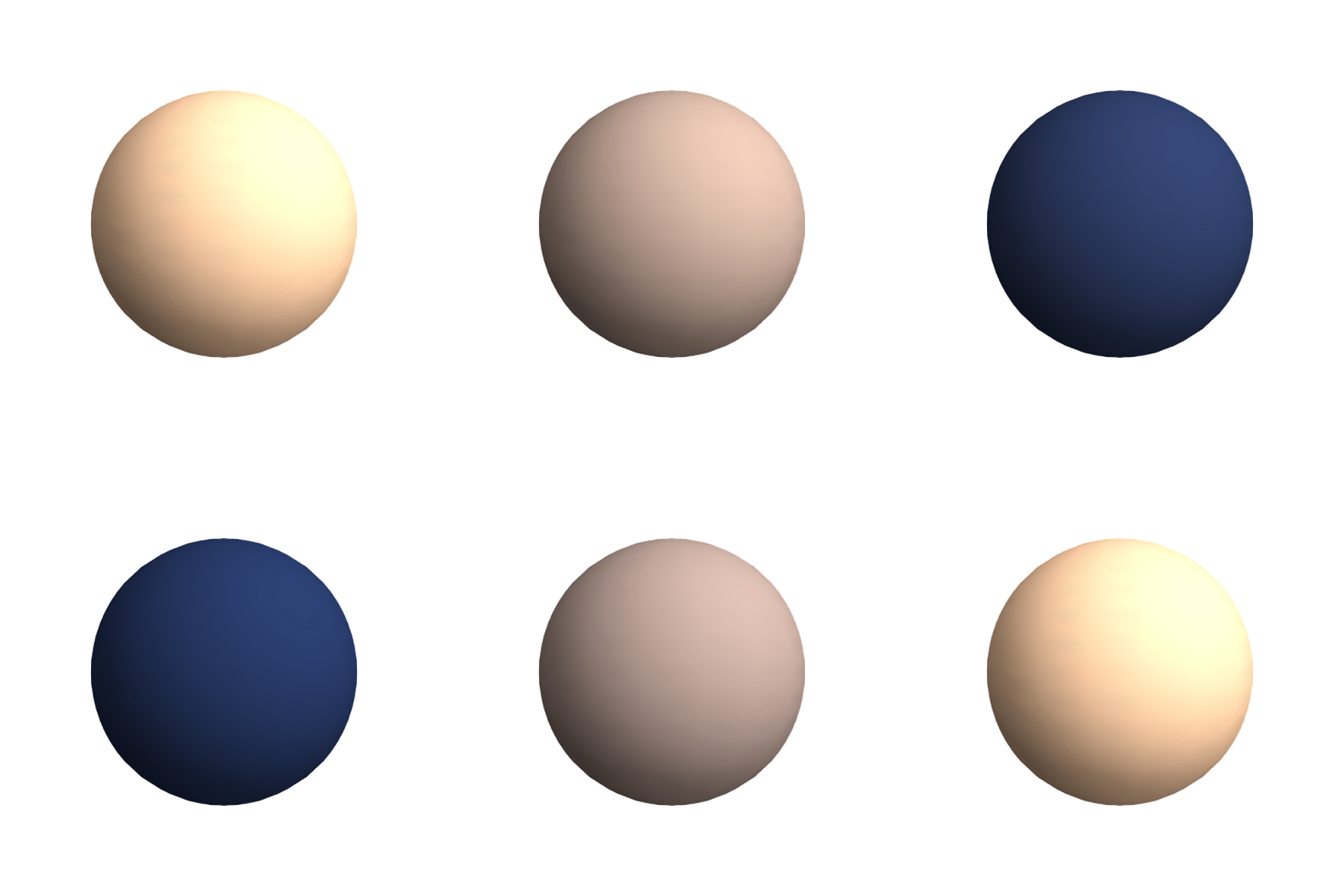
Parameterising Misalignment: Euler Angles

\(\beta = 0\)

\(\beta = {\pi\over10}\)

\(\beta = {\pi\over2}\)

\(\beta = \pi\)
What does Misalignment Mean???

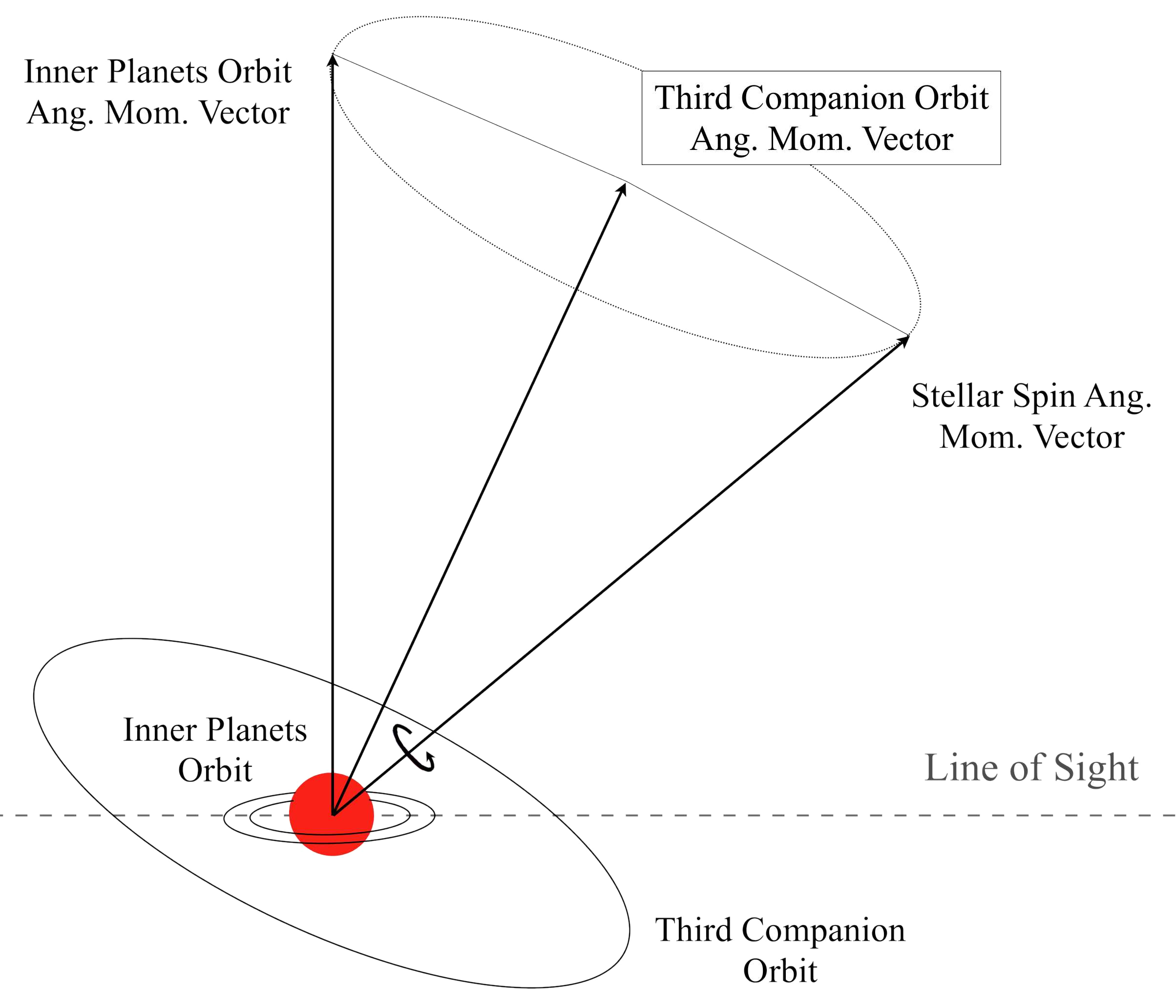
  • Only three known misaligned multiplanet systems (HD 3167 and K2-290A)
    • Implications for orbital architectures?
  • What about other notionally envelope-counterrotating stars?
  • Constraints on realignment \(\mathcal{Q}\) and/or torque mechanisms?

Hjorth et al. 2021: Extreme misalignment angles are possible even in a coplanar configuration